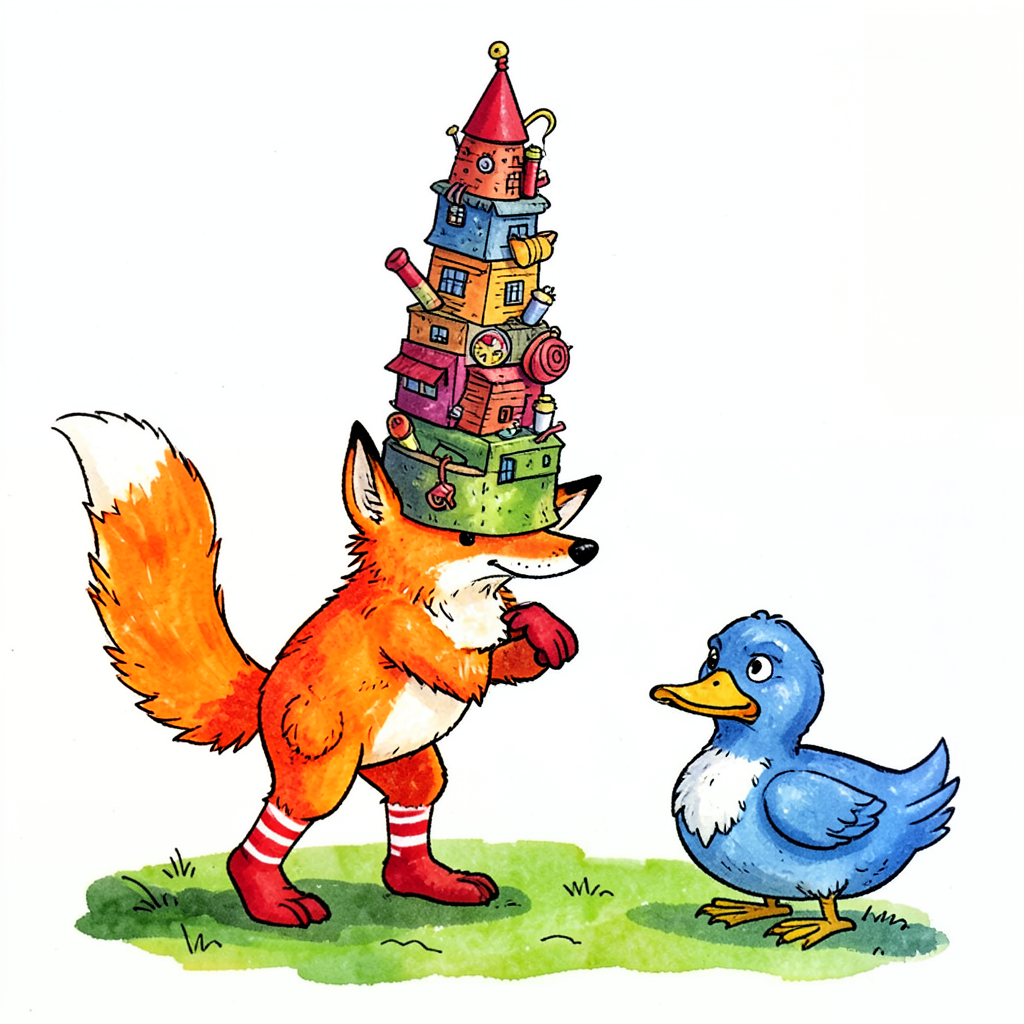
Fox in Socks
About This Book
Fox challenges his friend Knox to increasingly complicated tongue twisters involving socks, blocks, clocks, and cheese trees. The verbal gymnastics build from simple rhymes to nearly impossible tongue tanglers that leave poor Knox — and readers — hilariously tongue-tied.
Themes
LanguageHumorChallenge
Best For
- Car rides and road trips where kids can try the tongue twisters out loud without disturbing anyone
- Children who are just beginning to read independently and need a low-pressure reason to sound out words
- Families who want a read-aloud that is genuinely funny for the adult too, not just the child
- Classrooms and reading groups where shared laughter at a common challenge builds community
- Any child who loves silly sounds and made-up words
Why Parents Love This Book
Fox in Socks has been delighting families since 1965 for one simple reason: it turns language itself into a playground. Dr. Seuss built this book around a single brilliant idea — what if tongue twisters got progressively harder until they became nearly impossible? Fox, the gleeful instigator, cheerfully piles on the verbal chaos while Knox grows increasingly exasperated, and that dynamic is genuinely funny to children and adults alike. The escalating structure means every page feels like a challenge accepted. Kids who can barely read want to try the twisters out loud; kids who read fluently want to master them at speed. The nonsense words and invented phrases ("tweetle beetles," "slow Joe Crow") reward phonics awareness while sounding absolutely ridiculous, which is exactly the point. After sixty years this book has not lost a single step. It is still the book children ask for again and again specifically so they can watch a parent stumble over "Blox" and "bricks mix" — and that irreplaceable joy is why it endures.
Reading Tips for Parents
Read this one slowly at first, especially on the longer twisters — speed is the enemy on a first pass. Once your child knows the book, flip the dynamic: let them be Fox and challenge you to say the tongue twisters. This role reversal is surprisingly motivating for early readers because it gives them genuine authority. Point to each word as you read to reinforce the connection between the sounds your mouth is making and the letters on the page. Do not worry about stumbling; fumbling the twisters is part of the fun and shows children that even adults find language tricky. For older kids in the 4-7 range, make it a game by timing how fast they can recite a single page correctly. Keep sessions short if frustration appears — the book is meant to end in laughter, not tears.
Awards & Recognition
- New York Times Bestseller — a perennial bestseller since its 1965 publication
- One of Publishers Weekly's All-Time Bestselling Children's Books
Educational Value
This book helps children develop skills across multiple areas:
- Phonics: The layered rhyme schemes and repeated consonant clusters give early readers direct, playful practice with blending and sound manipulation.
- Vocabulary: Invented compound words and nonsense phrases encourage children to use context clues and think about how words are built.
- Oral language: Reading the tongue twisters aloud builds articulation, breath control, and the kind of expressive fluency that supports confident public speaking later on.
- Sequencing: The escalating structure of the twisters teaches children to notice how a pattern can grow in complexity step by step.
- Humor and perspective-taking: Knox's mounting frustration contrasted with Fox's cheerful mischief invites children to consider how the same situation feels different depending on who you are.
- Self-regulation: Attempting the harder twisters and managing the resulting laughter and stumbling builds a light, low-stakes tolerance for difficulty and mistakes.
Discussion Questions
Use these questions to spark conversation before, during, or after reading:
- Why do you think Fox keeps making the tongue twisters harder and harder? Do you think he is being kind or mischievous?
- Which tongue twister was the hardest for you to say out loud? Can you say it three times fast?
- Knox gets really frustrated by the end of the book. Have you ever felt frustrated when something was very hard to do? What did you do?
- Dr. Seuss made up silly words like "tweetle beetles." Can you make up your own silly word and use it in a sentence?
- If you were Knox, would you keep playing Fox's game or would you tell Fox to stop? Why?
Content Notes for Parents
There are no scary, sad, or mature elements in this book. The closest thing to conflict is Knox's comedic frustration, which resolves happily. This is a completely gentle read suitable for all children in the target age range.
Frequently Asked Questions
What age is Fox in Socks actually right for?
The book is aimed at ages 4 to 7, but it spans that range in different ways. Younger children in the 4-5 range will enjoy the silliness and the pictures even if the longer twisters are beyond them. Children aged 6 and 7 who are early readers get the most out of it because they can attempt the twisters themselves and feel the satisfaction of getting one right.
Is this book good for helping my child learn to read?
Yes, it is particularly effective for phonics and oral fluency. The repetitive consonant sounds force children to pay close attention to individual letters and blends, which reinforces the decoding skills taught in kindergarten and first grade. Reading it aloud together — with the child following along — is more effective than silent reading for this title specifically.
My child gets frustrated easily. Will the hard tongue twisters upset them?
Possibly, if the pressure to perform is high. The key is framing it as a game you are both failing at together rather than a test. If you go first and stumble spectacularly, most children find the shared failure hilarious rather than demoralizing. Keep the mood light and stop before frustration peaks.
Are there any content concerns parents should know about?
None at all. The book contains no scary content, no sad moments, and no mature themes. The only conflict is Knox's comic exasperation at Fox's escalating word games, and it resolves cheerfully.
What books are similar to Fox in Socks that we might enjoy next?
If your child loves the wordplay angle, try Dr. Seuss's own Hop on Pop for a simpler phonics workout or The Lorax for more complex Seussian language. Outside Seuss, Shel Silverstein's Where the Sidewalk Ends offers the same delight in language as a toy. For pure tongue-twister fun, look for Alvin Schwartz's Busy Buzzing Bumblebees and Other Tongue Twisters.