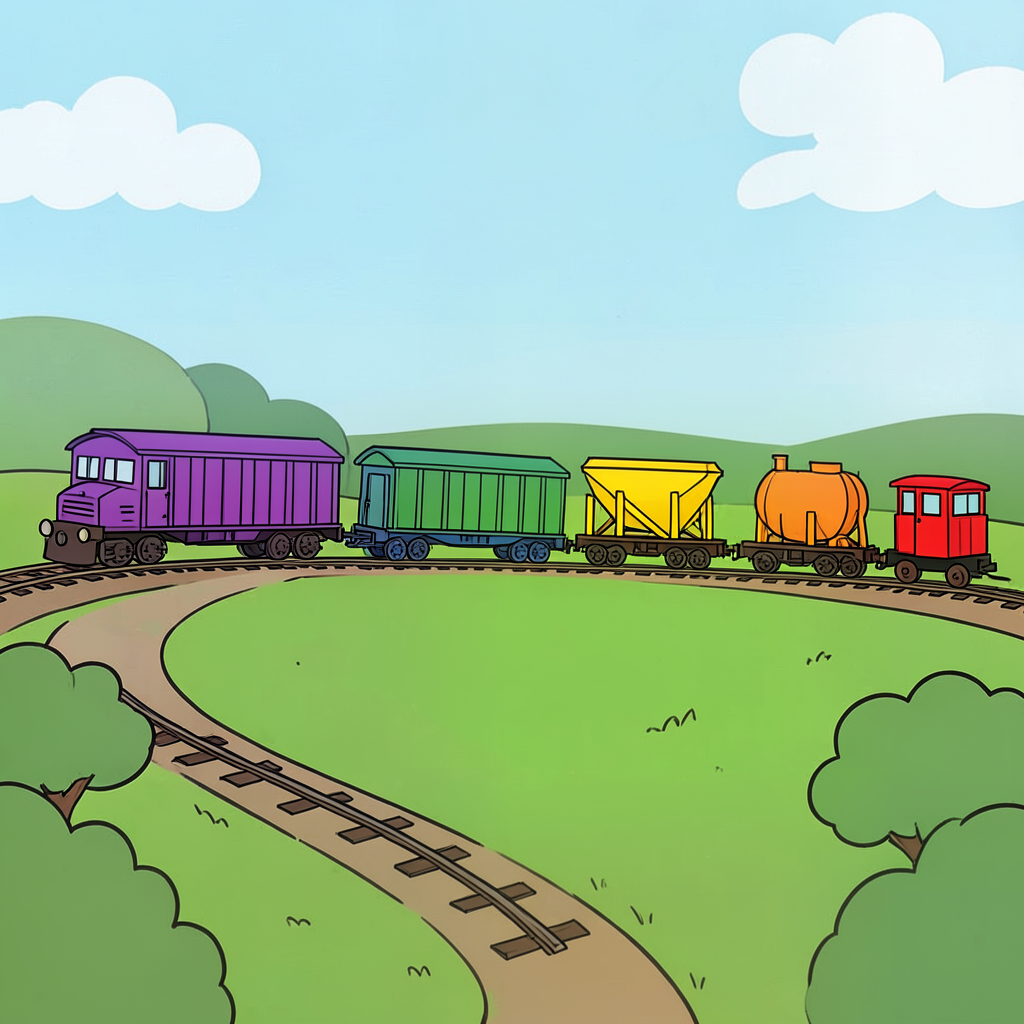
Freight Train
About This Book
A freight train rolls through tunnels, past cities, over trestles and into the night — its cars a simple parade of colours moving with gathering speed. Donald Crews' spare, elegant Caldecott Honor book teaches colours and movement with a minimalism that somehow captures the magic of trains perfectly.
Themes
TrainsColorsMovement
Best For
- Babies and toddlers who are fascinated by vehicles and moving things
- Early color-learning sessions where a parent wants a book rather than flashcards
- Short attention spans — the entire book can be read in under two minutes and still feel complete
- Bedtime reading when you want something calm but visually engaging
- Gifting to newborns as a first library book that will grow with them into the toddler years
Why Parents Love This Book
Donald Crews does something remarkable in Freight Train: he distills the romance of trains into fewer than two hundred words and a handful of bold, flat colors, and the result is more evocative than many picture books ten times as wordy. Published in 1978, the book opens with a simple diagram of each car and its color — red caboose, orange tank car, yellow hopper car — before setting the whole train in motion. As the pages turn, the train accelerates, the colors begin to blur, and the white space of the page becomes sky and speed. It is one of the earliest examples in picture books of using visual motion to tell a story, and it still feels fresh. The minimalism is the point: Crews trusts children to feel the rumble of the wheels and the rush of passing through a tunnel. Generations of toddlers have grown up with this book and then shared it with their own children. It earns its longevity because it respects young readers and delivers genuine visual pleasure on every reading.
Reading Tips for Parents
Read this slowly on the first pass so children can absorb each car's name and color, then pick up your pace and vocal energy as the train "moves" and the illustrations blur — children respond instantly to that shift in tempo. Point to the color swatches on the opening spread before you begin the journey so toddlers have a reference to return to. After reading, ask your child to name the colors they remember; you may be surprised how many stick. The book pairs naturally with a walk near railroad tracks or watching a real train, which transforms the abstract pictures into lived experience. For babies who are not yet verbal, simply naming the colors as you turn pages is enough. The spare text means you can improvise freely, adding sound effects — "clickety-clack," the long moan of a whistle — without losing your place.
Awards & Recognition
- Caldecott Honor Book, 1979 (American Library Association)
- ALA Notable Children's Book
Educational Value
This book helps children develop skills across multiple areas:
- Color recognition: Each car is a single vivid hue — red, orange, yellow, green, blue, purple, black, white — making this one of the most effective early color-teaching books available.
- Vocabulary: Introduces specific train-car names (caboose, hopper car, tank car, gondola car, box car, flat car) in a concrete, visual context that makes the words memorable.
- Sequencing: The fixed order of the cars, revisited on each page, builds early memory and sequencing skills as children anticipate what comes next.
- Science and physics: The blurring illustrations offer an intuitive, age-appropriate introduction to the concept that things look different when they move very fast.
- Visual literacy: Crews uses color blending and negative space to convey speed — children learn to read pictures as storytelling tools, not just decoration.
- Early literacy: The repetitive, minimal text builds print awareness and gives very young children the confidence to 'read' along from memory after just a few exposures.
Discussion Questions
Use these questions to spark conversation before, during, or after reading:
- Can you point to each train car and tell me its color?
- Which part of the train's journey would you most like to see — going through a tunnel, crossing a bridge, or passing by a city?
- Why do you think the colors start to look blurry near the end of the book?
- If you could add one more car to this freight train, what color would it be and what would it carry?
- Where do you think the train is going after it disappears into the night?
Content Notes for Parents
There are no scary, sad, or mature elements in this book. It is a gentle, joyful ride from start to finish and is suitable for all ages within the 0-3 range without reservation.
Frequently Asked Questions
What age is Freight Train really best for?
The book works across a surprisingly wide range. Babies as young as four to six months respond to the bold, high-contrast colors. Toddlers aged one to three get the most from it because they can begin to name colors and engage with the train's journey. Many children revisit it happily at four or five, by which point they enjoy 'reading' it aloud from memory.
Is this a board book or a picture book?
Freight Train was originally published as a picture book and is still widely sold in that format. Board book editions exist as well, making it durable enough for very young children who are still learning to handle pages carefully. Check the edition when purchasing if board book format matters to you.
My child is obsessed with trains — will this hold their interest even though it is so simple?
Absolutely. Children who love trains tend to love this book deeply and permanently. The simplicity does not diminish the appeal; if anything, the clean illustrations let a train-obsessed child project their own imagination onto the page. Many train-loving toddlers request it night after night.
Are there similar books you would recommend alongside Freight Train?
Donald Crews' own follow-up, Truck (also a Caldecott Honor book), uses the same wordless-or-near-wordless visual style and is a natural companion. Byron Barton's Trains is another excellent pairing for the same age group, with slightly more text. For slightly older children, Lois Ehlert's color-focused books share Freight Train's bold graphic aesthetic.
Does the book actually tell a story, or is it just a concept book about colors?
It does both at once, which is part of its genius. There is a genuine narrative arc — the train assembles, departs, travels through varied landscapes at gathering speed, and disappears into the night — but the story doubles as a color lesson. You never feel like you are doing a drill; it reads like a journey.