Holes
About This Book
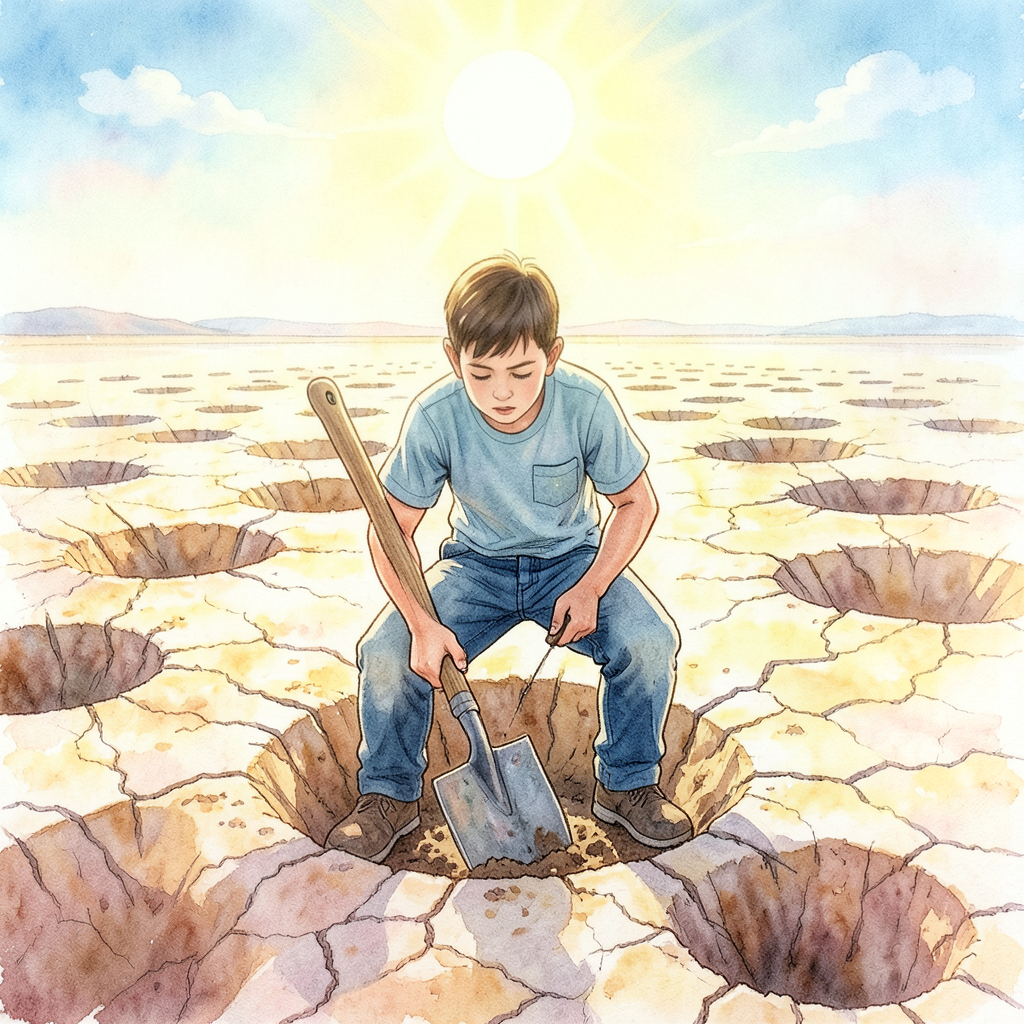
Stanley Yelnats is sent to Camp Green Lake, a juvenile detention center where boys dig holes all day in a dried-up lake bed. Stanley uncovers a web of connections between his family's curse, a treasure, an outlaw, and the warden's true motives in this intricately plotted, Newbery Medal-winning adventure.
Themes
JusticePerseveranceFriendship
Best For
- Kids aged 9-12 who enjoy mystery and puzzle-like plots where everything connects at the end
- Classroom read-alouds for grades 4-6, where the three timelines can be tracked as a group
- Reluctant readers who respond to short chapters, dry humor, and an underdog protagonist
- Family road-trip listening on audiobook, since the twists land well in audio format
- Children interested in questions of fairness and justice who are ready to move beyond simple good-vs-evil stories
Why Parents Love This Book
Holes is that rare novel where every detail matters. Louis Sachar weaves three storylines across generations — Stanley's present-day ordeal at Camp Green Lake, a 19th-century romance gone tragically wrong, and a family curse stretching back to Latvia — and then snaps them together with the precision of a puzzle. What makes the book endure is how naturally the plot clicks into place: readers who pay attention feel genuinely rewarded when the connections emerge. Beyond the clever architecture, Sachar draws unforgettable characters. Stanley is easy to root for — overweight, picked on, and blameless, yet fundamentally decent. His friendship with Zero is one of the most quietly moving in middle-grade fiction. The dry Texas setting, the absurdity of the warden's scheme, and the thread of dark humor throughout give the book a distinctive voice that keeps pages turning. It trusts young readers to track complexity, and that respect is exactly why kids love it.
Reading Tips for Parents
Before starting, consider mapping the three timelines on an index card together — "today," "the Wild West," and "Latvia long ago." This simple visual helps younger readers keep track as Sachar jumps between them. Ask your child to notice what the holes symbolize (forced labor, secrets buried, truth uncovered) as they read; it sparks great conversation mid-book rather than only at the end. The ending moves quickly, so plan a short check-in after the final chapters to make sure everything landed. For reluctant readers, the short chapters (many are only 2-3 pages) make excellent natural stopping points. The audiobook narrated by Kerry Beyer is outstanding and particularly useful for kids who struggle with the shifting timelines.
Awards & Recognition
- Newbery Medal, 1999
- National Book Award for Young People's Literature, 1998
Educational Value
This book helps children develop skills across multiple areas:
- Critical thinking: The interlocking plot trains readers to track cause-and-effect across time and recognize how past events shape the present.
- Vocabulary: Rich, precise language including words like 'desolate,' 'perseverance,' 'warden,' and 'recede' appears naturally in context, building academic vocabulary.
- Social-emotional learning: Stanley's journey models empathy, loyalty, and standing up for a friend even at personal cost.
- History and social justice: The story touches on racial injustice in 19th-century Texas and the legacy of systemic inequality, opening discussions about fairness and institutional power.
- Literary analysis: The three-strand narrative structure gives older readers an accessible introduction to non-linear storytelling and thematic echoes.
- Geography and environment: The vividly rendered Texas desert sparks curiosity about ecology, drought, and how landscape shapes human behavior.
Discussion Questions
Use these questions to spark conversation before, during, or after reading:
- Why do you think Stanley never tells his parents the truth about what Camp Green Lake is really like? What would you do in his situation?
- The Yelnats family blames all their bad luck on a curse from their great-great-grandfather. Do you think the curse is real, or is there another explanation for what happens to them?
- Stanley and Zero come from very different backgrounds, but they become close friends. What do they see in each other that others miss?
- The Warden says the boys are building character by digging holes. Do you think hard, unfair work can ever build character — or does it have to be fair to count?
- If you found something valuable but keeping it meant breaking a rule, what would you do? Does your answer change if the rule itself was unjust?
Content Notes for Parents
The book includes depictions of child labor, bullying, racial violence in historical flashback, and the death of a character by scorpion sting. None of these are graphic, but sensitive readers around age 8 may find some scenes — particularly the historical racism and the harsh conditions at the camp — worth discussing with a parent.
Frequently Asked Questions
What age is Holes really appropriate for?
Most children read it comfortably between ages 9 and 12, and it is commonly assigned in grades 4 through 6. Mature 8-year-olds can handle it, though parents may want to be available to discuss the historical scenes involving racial injustice. The story's complexity rewards older readers who can track multiple timelines.
Is Holes too scary or dark for younger middle-grade readers?
The book has a serious, sometimes grim tone — boys are sent to a harsh detention camp, a character dies, and there are scenes of historical racial violence — but none of it is graphic or gratuitous. Sachar balances the dark material with humor, friendship, and an ultimately hopeful ending. Most 9-year-olds handle it well.
Does Holes work as a family read-aloud?
It works beautifully as a read-aloud, particularly with children aged 8 and up. The short chapters make sessions easy to pace, and the emerging connections between storylines give everyone something to speculate about together. The audiobook narrated by Kerry Beyer is also an excellent option for car trips.
Are there other books like Holes for kids who loved it?
Try Louis Sachar's own 'Stanley Yelnats' Survival Guide to Camp Green Lake' for more time in that world. For a similar puzzle-plot feel, 'From the Mixed-Up Files of Mrs. Basil E. Frankweiler' by E.L. Konigsburg is a classic, and 'The House on Mango Street' or 'Bud, Not Buddy' offer comparable depth on justice and identity for this age group.
Is there a movie version, and is it faithful to the book?
Yes — the 2003 Disney film stars Shia LaBeouf and was written by Louis Sachar himself, making it one of the more faithful book-to-film adaptations in children's literature. Most plot elements and characters translate well to screen. Many teachers use the film as a complement after students finish the novel.