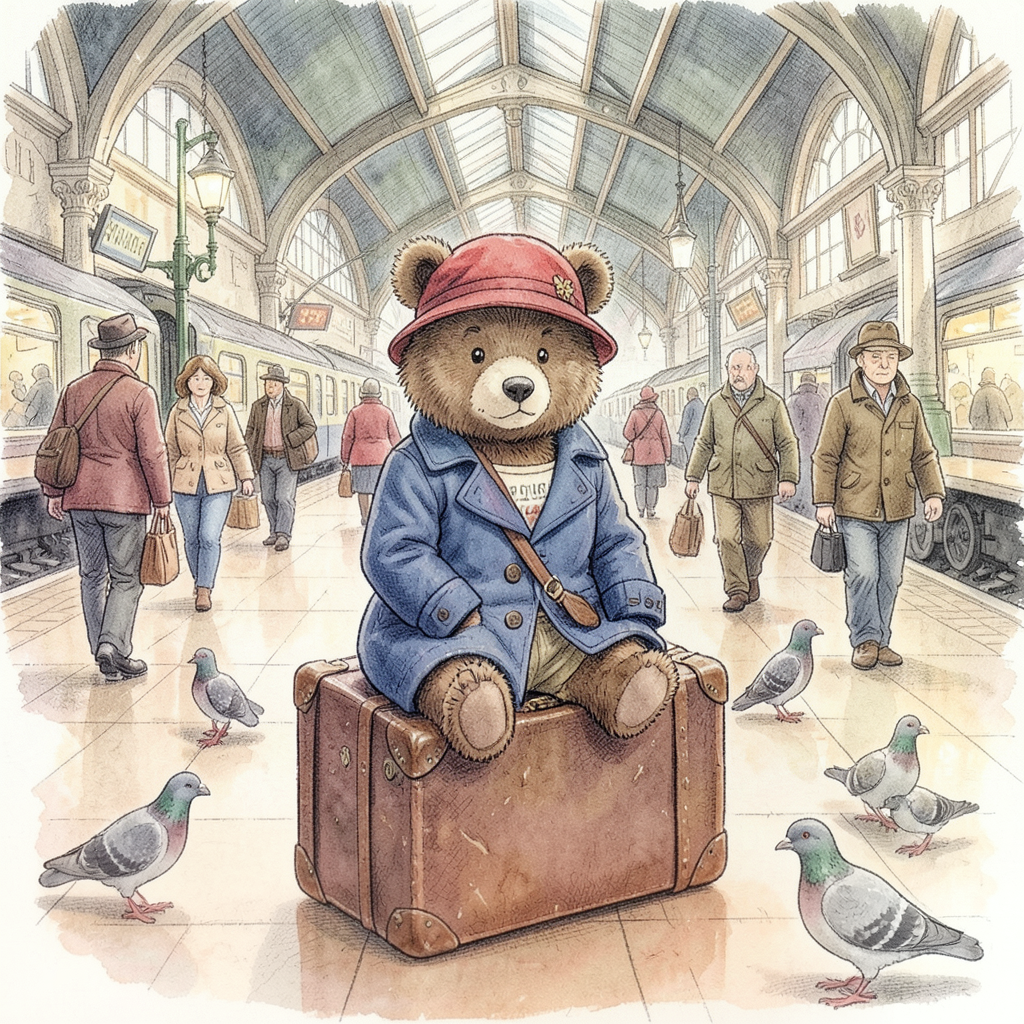
A Bear Called Paddington
About This Book
The Brown family finds a small bear sitting on a suitcase at Paddington Station with a note reading 'Please look after this bear.' Originally from Peru, Paddington moves in with the Browns and his well-intentioned but accident-prone nature leads to one delightful mishap after another.
Themes
KindnessBelongingHumor
Best For
- Read-aloud sessions with children ages 5 to 8 who are ready for chapter-book storytelling but still enjoy sharing the experience with a parent
- Children who have recently moved, changed schools, or joined a new group — Paddington's experience of belonging somewhere new resonates deeply
- Families who enjoy humor together and want a book that makes everyone in the room laugh out loud
- Young readers making the transition from picture books to chapter books, since each episode is short and satisfying on its own
- Children curious about other countries and cultures, or families with connections to the UK or South America
Why Parents Love This Book
First published in 1958, A Bear Called Paddington has charmed readers for generations — and for good reason. Michael Bond's genius lies in pairing an earnest, courteous bear with a world that keeps getting the better of him. Paddington genuinely tries his best. He follows instructions, means well, and approaches English customs with sincere curiosity. Yet somehow a simple trip to a department store becomes a catastrophe involving an escalator, a paint display, and a very flustered floor manager. That gap between Paddington's good intentions and the chaos that follows is the beating heart of the book. Children recognize the feeling of trying hard and still getting things wonderfully wrong. Bond also captures something quietly moving: a small creature far from home, taken in by strangers who choose to become family. The Brown family's unconditional welcome gives the book a warmth that lingers long after the last chapter. Peggy Fortnum's loose, expressive pen-and-ink illustrations add personality without overpowering the imagination.
Reading Tips for Parents
This is a chapter book best suited for reading aloud with children ages 5 to 8, or for confident independent readers around ages 7 to 9. Each chapter is a self-contained episode, which makes it ideal for bedtime reading — you can easily stop after one chapter without losing narrative momentum. When reading aloud, lean into Paddington's polite, formal speech patterns; children find the contrast between his dignified manner and his chaotic outcomes especially funny. Before diving in, briefly explain that Paddington comes from Peru (South America) and has traveled alone by ship to London — this geography sets up why everything feels unfamiliar to him. You may also want to introduce the concept of marmalade sandwiches, since they are central to Paddington's identity throughout the series. The book's British vocabulary ("duffle coat," "buns," "platform") offers a natural opportunity to discuss how language varies across English-speaking countries.
Awards & Recognition
- New York Times Notable Children's Book (series recognized over decades of publication)
- Named one of the BBC's 100 Favourite Children's Books (2003)
- International bestseller — over 35 million copies sold worldwide across the Paddington series
Educational Value
This book helps children develop skills across multiple areas:
- Vocabulary: Rich exposure to British English expressions and formal speech patterns ('I'm much obliged,' 'duffle coat,' 'elevenses') broadens children's language awareness and introduces the idea that English varies by region and culture.
- Social-emotional: Paddington's experience as a newcomer navigating an unfamiliar culture builds children's empathy for those who feel out of place, and models how a welcoming community can make someone feel at home.
- Humor and inference: Bond's comedy relies on dramatic irony — readers understand what is about to go wrong before Paddington does — which develops children's ability to anticipate consequences and read situational cues.
- Geography and culture: The story naturally introduces Peru, London, Paddington Station, and British customs, providing a springboard for exploring maps and comparing daily life across countries.
- Character analysis: Paddington is a richly consistent character whose politeness and determination remain constant even as situations change, giving children a strong model for discussing character traits and motivations.
Discussion Questions
Use these questions to spark conversation before, during, or after reading:
- Why do you think the Brown family decided to take Paddington home instead of leaving him at the station? What would you have done?
- Paddington always tries very hard to do the right thing, but things still go wrong. Can you think of a time when you tried your best and something still didn't work out the way you expected?
- How do you think Paddington feels about leaving Peru and living in London? What clues does the story give us about how he feels?
- Which of Paddington's mishaps made you laugh the most? Why do you think it was funny?
- If you found a bear at a train station with a note asking someone to look after him, what would you do? What would be the hardest part about helping him?
Content Notes for Parents
There are no scary, violent, or mature elements in this book. The mishaps Paddington encounters are comic in tone and entirely benign; some situations may cause very sensitive children mild secondhand embarrassment on Paddington's behalf, but nothing rises to the level of a content concern.
Frequently Asked Questions
What age is this book actually right for?
As a read-aloud, A Bear Called Paddington works beautifully for ages 5 to 8. The humor lands well even for younger children when a parent reads with expression. For independent reading, most children are ready around ages 7 to 9, depending on reading confidence. The vocabulary is more formal and British than modern children's chapter books, so some children may need a little support with unfamiliar words.
Is this the first book in a series? Do I need to read them in order?
Yes, this is the first of many Paddington books by Michael Bond. Each book is a collection of mostly stand-alone episodes, so you do not need to read them in any particular order after the first one. Starting with A Bear Called Paddington is recommended simply because it introduces Paddington's arrival and the Brown family, which gives children the full context for everything that follows.
My child has only seen the Paddington movies. Is the book very different?
The movies are wonderful adaptations but differ significantly in plot from the original books. The books are gentler, quieter, and more episodic — a series of smaller domestic misadventures rather than a single dramatic storyline. Children who love the films will recognize Paddington's personality and values immediately, but the book will feel like a fresh experience rather than a retelling of what they have already seen.
Are there any sad parts that might upset a young child?
The book touches lightly on the fact that Paddington has left his home in Peru and his Aunt Lucy, who now lives in a home for retired bears. These details are handled warmly and without dwelling on loss, but very sensitive children may feel a pang of sadness for him. Overall the tone is consistently cheerful and comic, and the sadder undertones tend to sail over the heads of younger readers.
What books would you recommend after this one?
If your child loves Paddington, the next natural step is more books in the Paddington series — More About Paddington follows immediately. Beyond Paddington, great companion reads include the Winnie-the-Pooh books by A.A. Milne for a similar warm British charm, the Mrs. Piggle-Wiggle series for episodic humor, or The Mouse and the Motorcycle by Beverly Cleary for a small creature navigating a big human world.