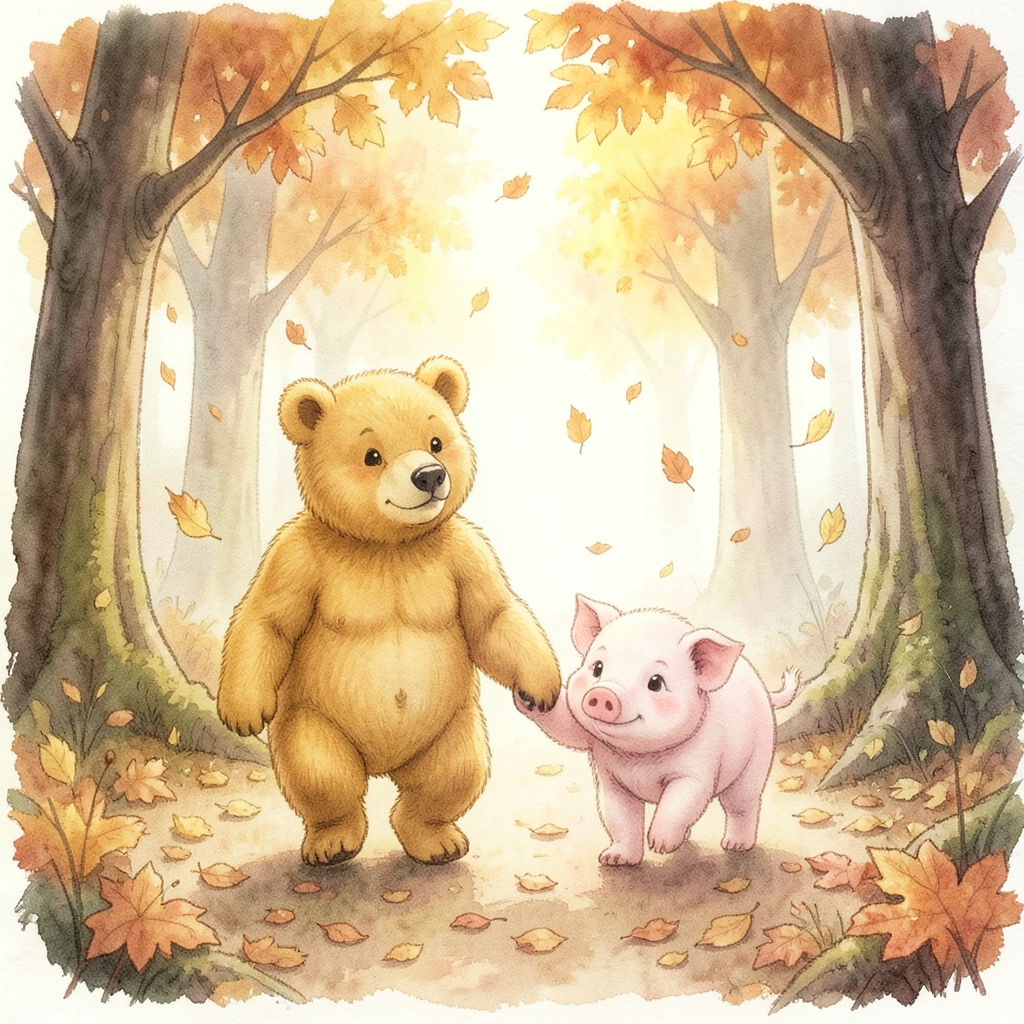
Winnie-the-Pooh
About This Book
In the Hundred Acre Wood, the lovable, honey-obsessed bear Winnie-the-Pooh and his friends — anxious Piglet, gloomy Eeyore, bouncy Tigger, and wise Owl — share gentle adventures with their boy Christopher Robin. From tracking Heffalumps to rescuing Piglet from a flood, each story celebrates friendship and simple pleasures.
Themes
FriendshipImaginationKindness
Best For
- Bedtime read-aloud sessions that work one chapter at a time without a cliffhanger
- Children who are about to start school or experience a major transition, thanks to the final chapter's gentle handling of change
- Families who enjoy wordplay and want to laugh together at humor that works on multiple levels
- Children who loved the first Winnie-the-Pooh book and are ready for more of the same world
- Quiet afternoon reading with a child who enjoys imaginative, character-driven stories over action-heavy plots
Why Parents Love This Book
The House at Pooh Corner is the second and final Winnie-the-Pooh collection by A.A. Milne, published in 1928, and it carries a bittersweet warmth that sets it apart from nearly all children's literature. This is the book that introduces Tigger — the bouncing, exuberant newcomer whose arrival shakes up the Hundred Acre Wood in the most delightful way. But it is also the book where everything gently winds down: the final chapter, in which Christopher Robin must leave for school and says a quiet goodbye to Pooh, has moved generations of parents to tears while reading aloud to children who have not yet grasped why. E.H. Shepard's illustrations are inseparable from the text — scratchy, warm, and utterly unhurried. Milne's prose is conversational yet layered, filled with gentle wordplay and philosophical asides that children take at face value and adults receive as something more. It is a book about the preciousness of childhood imagination told by someone who understood that it cannot last.
Reading Tips for Parents
Read this book aloud slowly. Milne's sentences are long and gently rhythmic — rushing them loses the humor and the mood. The chapter introducing Tigger works beautifully as a standalone read-aloud for a single sitting. For the final chapter, "In Which Christopher Robin and Pooh Come to an Enchanted Place," be prepared: many parents find it emotionally difficult. It can open a meaningful conversation with older children about growing up and saying goodbye. If your child has not read the first Winnie-the-Pooh book, that is fine — each chapter stands on its own — but reading them in order deepens the affection for the characters. Encourage children to notice Eeyore's dry humor; younger children often miss it but will laugh with a little nudging.
Awards & Recognition
- Considered a classic of 20th-century children's literature and consistently appears on best-of-all-time children's book lists
- The Winnie-the-Pooh characters were awarded the Disney Legacy and have been recognized by the Children's Literature Association as foundational texts in the English-language canon
Educational Value
This book helps children develop skills across multiple areas:
- Vocabulary: Milne's elevated, slightly formal prose introduces words like "customary," "anxious," "expedition," and "suspicious" in context, giving children repeated natural exposure to rich language.
- Social-emotional: The characters model a full range of emotional types — anxious Piglet, gloomy Eeyore, impulsive Tigger — and show children that friends with different temperaments can still care for one another.
- Humor and inference: Milne's irony and wordplay require children to read between the lines, building early inference skills and an appreciation for comic timing.
- Narrative structure: Each chapter is a self-contained story with a beginning, complication, and resolution, helping children understand story structure in manageable pieces.
- Empathy: The final chapter models how to say a kind and loving goodbye, giving children language and emotional scaffolding for transitions like starting school.
- Listening comprehension: The long, winding sentences reward attentive listening and help children build the patience to follow extended narrative threads.
Discussion Questions
Use these questions to spark conversation before, during, or after reading:
- Why do you think Tigger had trouble finding a food he liked? Have you ever tried something new and had to keep looking for the right fit?
- Eeyore often expects bad things to happen. Do you know anyone like Eeyore? How do Pooh and Piglet treat him, and what can we learn from that?
- At the end of the book, Christopher Robin has to go away to school and can't spend as much time in the Hundred Acre Wood. How do you think Pooh felt about that? How would you feel?
- If you built a house for a friend like Pooh built one for Eeyore, what would you put in it to make your friend happy?
- Pooh says things that sound a little mixed up but somehow still make sense. Can you find a moment where Pooh said something silly that was actually kind of wise?
Content Notes for Parents
There are no scary, violent, or mature elements in this book. The final chapter carries a gentle melancholy about growing up and leaving childhood behind, which may prompt emotional questions from sensitive children or their parents, but it is handled with great tenderness.
Frequently Asked Questions
What age is The House at Pooh Corner best for?
The book is ideal for ages 4 through 8 as a read-aloud. Independent readers around ages 7-9 can tackle it on their own, though some of Milne's irony and wordplay will be better appreciated with a parent reading alongside. The emotional depth of the final chapter tends to land more fully with children aged 6 and up.
Do I need to read the first Winnie-the-Pooh book first?
It helps but is not required. Each chapter is a standalone adventure, so you can jump in without prior knowledge of the characters. That said, reading the original Winnie-the-Pooh (1926) first deepens the attachment to Pooh, Piglet, Eeyore, and Christopher Robin, making the farewell in the final chapter more resonant.
Is Tigger introduced in this book or the first one?
Tigger is introduced in The House at Pooh Corner, not in the original Winnie-the-Pooh. His arrival is one of the highlights of this volume, and his chapter — in which he bounces everyone and tries to find a food he likes — is a favorite for read-aloud sessions.
The last chapter made me cry. Is it too sad for young children?
Many parents find the final chapter deeply affecting because it is written as much for adults as for children. Young children typically experience it as a sweet goodbye rather than a loss, while parents recognize the allegory for childhood ending. It is not distressing for children — it is gentle and loving — but you may want to have a moment to compose yourself before reading it aloud.
What books are similar to this one that my child might enjoy next?
If your child loved the Hundred Acre Wood, try "The Wind in the Willows" by Kenneth Grahame for a similar world of small animals and gentle adventures. "Charlotte's Web" by E.B. White offers comparable emotional depth and themes of friendship. For something lighter and more playful, the "Frog and Toad" series by Arnold Lobel carries the same warmth in a shorter format suitable for younger or less experienced readers.