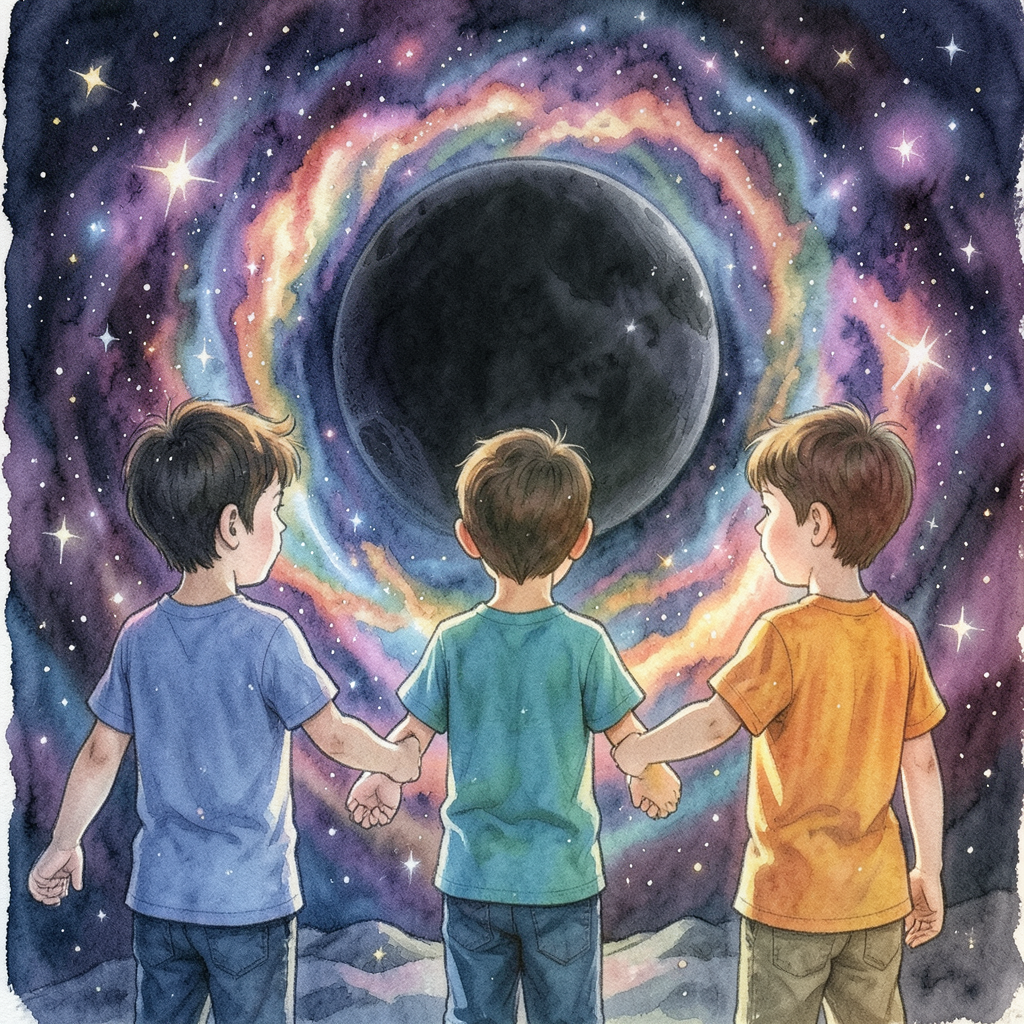
A Wrinkle in Time
About This Book
Meg Murry, her genius little brother Charles Wallace, and their friend Calvin travel through space and time via a phenomenon called a tesseract to rescue Meg's father, a scientist imprisoned on a dark planet ruled by an evil entity called IT. Meg discovers that love is the most powerful force in the universe.
Themes
CourageLoveIdentity
Best For
- Independent readers in grades 4 to 6 who have exhausted straightforward adventure stories and are ready for genuinely complex ideas
- Children who feel like outsiders or are struggling with self-confidence, because Meg's arc validates exactly that experience
- Family read-alouds where parents want to open conversations about conformity, identity, and what it means to be different
- Classrooms or book clubs looking for a text that bridges science, philosophy, and storytelling in a single compelling narrative
- Young readers who enjoyed the Chronicles of Narnia and are ready for a story that trades allegory for science-fantasy and a female lead
Why Parents Love This Book
A Wrinkle in Time endures because it refuses to make its hero conventionally heroic. Meg Murry is stubborn, hot-tempered, and deeply insecure — and those very flaws turn out to be exactly what saves the day. Madeleine L'Engle wrote a science fantasy adventure at a time when girls simply did not lead stories like this, and she packed it with genuine ideas: the nature of conformity, the danger of surrendering individual thought, and the radical notion that love is not weakness but the most potent force in existence. The tesseract as a concept of folded space-time gives young readers their first brush with real physics framed as wonder rather than textbook. The three celestial guides — Mrs Whatsit, Mrs Who, and Mrs Which — are among the most memorable characters in all of children's literature. More than six decades after publication, the book still reads as urgent, strange, and deeply human.
Reading Tips for Parents
Read this one alongside your child if possible — the science concepts (tessering, the fifth dimension) are genuinely tricky the first time and become much richer when you can pause and talk them through. The villain IT, which imposes identical rhythmic thought on an entire planet, is a good entry point for real conversation about peer pressure and groupthink. Chapters 6 and 7, when Camazotz is revealed, can feel quietly menacing to sensitive readers; previewing them yourself first is worthwhile. Because the vocabulary is advanced (L'Engle uses words like "ineffable" and "ephemeral" without glossing them), keep a dictionary handy and treat unknown words as puzzles rather than obstacles. The book is short enough — around 200 pages — that most strong readers in grades 4 through 6 can finish it in two weeks of bedtime reading.
Awards & Recognition
- Newbery Medal, 1963
- Lewis Carroll Shelf Award, 1965
- New York Times Bestseller (multiple editions, including the 2018 Disney film tie-in edition)
Educational Value
This book helps children develop skills across multiple areas:
- Vocabulary: L'Engle uses rich, challenging words in natural context — readers absorb terms like 'ephemeral,' 'resilient,' and 'tangible' through story rather than drill.
- Science concepts: The tesseract introduces the idea of higher dimensions and the geometry of folded space-time, giving curious readers a genuine foothold in physics and mathematics.
- Critical thinking: The planet Camazotz dramatizes the cost of conformity and the suppression of individual thought, prompting children to analyze why sameness can be dangerous.
- Social-emotional learning: Meg's journey models that insecurity and anger are not disqualifying traits; self-acceptance and love for others are presented as sources of real power.
- Literary analysis: The novel blends genres — science fiction, fantasy, and family adventure — making it an ideal text for discussing how authors combine elements to serve a story's themes.
- Resilience and identity: Characters repeatedly question who they are under pressure, giving readers language and frameworks to think about their own sense of self.
Discussion Questions
Use these questions to spark conversation before, during, or after reading:
- Meg is often told she has too many faults. Which of her faults ends up being her greatest strength, and why do you think that is?
- The children on Camazotz all bounce their balls at exactly the same moment. What is scary about that, and can you think of any real situations where everyone doing exactly the same thing might be a problem?
- Mrs Whatsit, Mrs Who, and Mrs Which each help in a different way. Which one would you most want as a guide on a dangerous journey, and what makes you choose her?
- Meg's love for Charles Wallace is what finally defeats IT. Do you think love is really more powerful than intelligence or strength? Can you think of an example from your own life?
- If you could tesser — fold space-time to travel instantly — where or when would you go, and what would you most want to see or change?
Content Notes for Parents
The planet Camazotz and the entity IT present a sustained atmosphere of psychological menace — conformity enforced by mind control — that may unsettle sensitive readers around ages 8 to 9; there is no graphic violence but the threat to individual identity can feel genuinely frightening. A father's long absence and a family under emotional strain are also central to the plot, which may resonate differently for children in families experiencing separation.
Frequently Asked Questions
What age is A Wrinkle in Time really appropriate for?
Most children read it comfortably between ages 9 and 12, though strong readers at 8 can handle it with an adult alongside. The vocabulary and the abstract concepts around conformity and identity are the main difficulty, not the story itself. Sensitive children under 10 may find the Camazotz sections quietly disturbing.
Is there anything scary or dark in the book?
The villain IT controls an entire planet through mind-control, stripping people of individual thought, and that atmosphere of psychological menace is the book's main source of tension. There is no gore or graphic violence. The scariest moments are conceptual rather than action-based, which some children find more unsettling than a straightforward monster.
My child loved Harry Potter — will they like this?
Almost certainly yes, though the books feel quite different. A Wrinkle in Time is shorter, denser with ideas, and more science-inflected than purely magical. The emotional core — a child who doesn't fit in, a quest to save someone they love, guides who offer cryptic wisdom — will feel familiar and welcoming.
Should I read it with my child or let them read it alone?
Either works, but reading together unlocks more of the book. The physics concepts, the literary quotes Mrs Who drops, and the philosophical undercurrent all become conversation starters that solo readers can miss. Even if your child reads ahead independently, plan time to discuss the Camazotz chapters and the ending.
Are there sequels, and are they as good?
L'Engle wrote four books in the Time Quintet — A Wind in the Door, A Swiftly Tilting Planet, Many Waters, and An Acceptable Time — and most readers find the first two sequels strong. The series shifts focus between siblings and becomes increasingly theological and cosmic; parents should preview later books as the themes grow more complex.