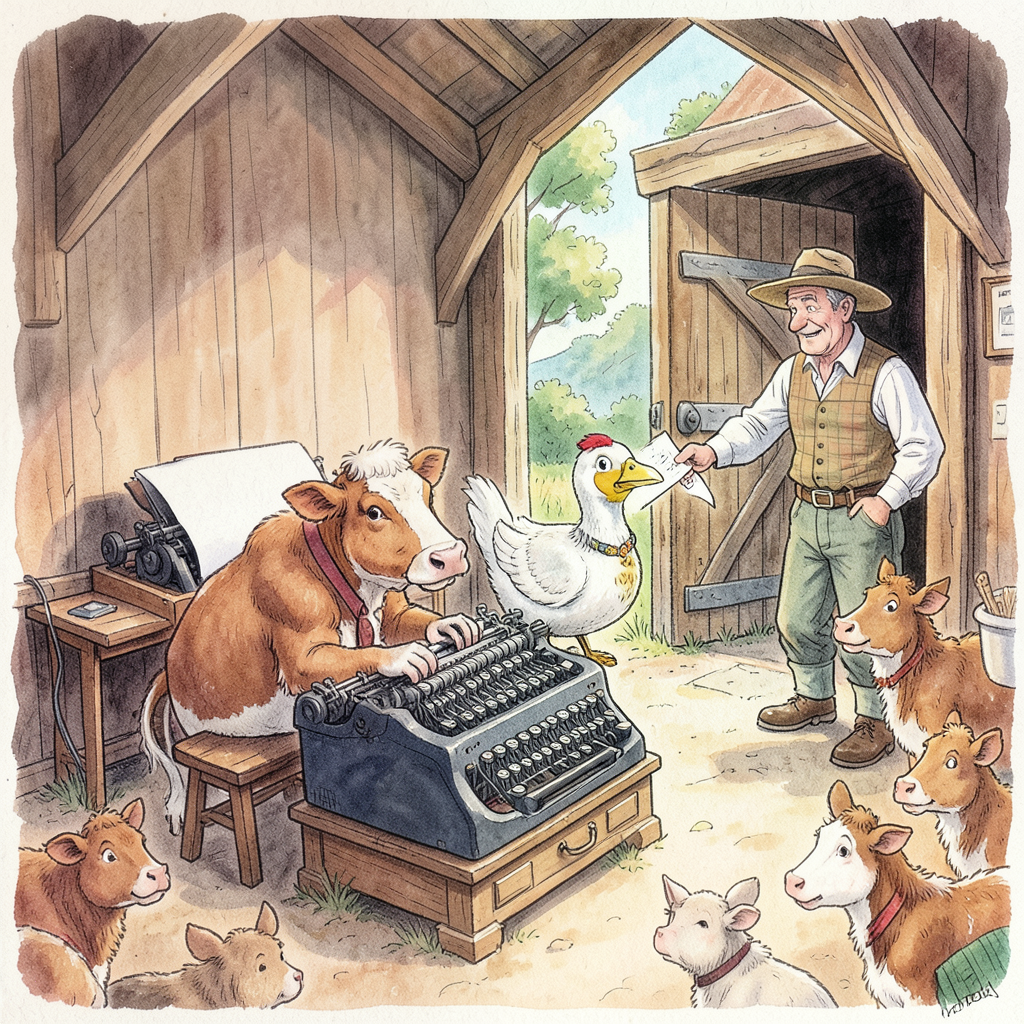
Click, Clack, Moo: Cows That Type
About This Book
Farmer Brown's cows find a typewriter in the barn and begin typing demands — electric blankets, please, it's cold at night. When Farmer Brown refuses, the cows go on strike: no milk. The hens join in: no eggs. Duck serves as neutral mediator in this hilarious tale of barnyard negotiation.
Themes
HumorNegotiationTeamwork
Best For
- Read-alouds in preschool or kindergarten classrooms where group participation in refrains is encouraged
- Families looking for a springboard to talk about fairness and negotiation without a heavy-handed lesson
- Children who love animal stories with humor and unexpected twists
- Introducing the concept of written communication and what letters or notes can accomplish
Why Parents Love This Book
Click, Clack, Moo: Cows That Type has earned its place as a modern picture book classic by doing something genuinely rare — it treats young children as sophisticated enough to appreciate workplace humor, collective bargaining, and the absurdity of literate livestock. Doreen Cronin's text is a masterclass in comic timing, with the rhythmic "click, clack, moo" sound effects mimicking an actual typewriter and building delicious tension with every typed demand. Betsy Lewin's loose, energetic watercolor-and-ink illustrations perfectly match the barnyard chaos — her cows look simultaneously earnest and scheming, which is exactly right. What truly elevates this book is that nobody is the villain. Farmer Brown is not cruel, the cows are not greedy; they simply want to be warm and are willing to negotiate in good faith. Duck's role as neutral mediator is a stroke of genius that children find hilarious and adults find surprisingly apt. The story ends with a twist that rewards careful readers and guarantees rereads. Over two decades since publication, it has not aged a day.
Reading Tips for Parents
Before your first read-through, point out the typewriter and explain briefly what it is — many children born after 2005 have never seen one, so a quick "it's like a printer and keyboard combined" will prevent confusion. As you read the typed notes aloud, shift to a slightly different voice or slow your pace, signaling that these are written words the animals produced. Pause after Farmer Brown reads each note and let children predict his reaction. The phrase "I'm sorry. The barn is closed" is ripe for discussion: ask children what "on strike" might mean before you explain it. On a second read, invite your child to clap along to the "click, clack, moo" refrains — it builds phonemic awareness and keeps wiggly listeners engaged. The ending's sly twist plays better if you act mildly surprised yourself, which invites children to feel smart for catching on.
Awards & Recognition
- Caldecott Honor Book, 2001
- New York Times Bestseller
Educational Value
This book helps children develop skills across multiple areas:
- Vocabulary: Introduces words like 'demand,' 'neutral,' 'emergency,' and 'impatient' in a context that makes their meanings clear and memorable.
- Civic / Social Studies: Presents the concepts of collective bargaining, negotiation, and compromise in an accessible, non-threatening way that mirrors real-world conflict resolution.
- Literacy: Distinguishes between spoken and written language on every page — children see that the same ideas can be communicated in both forms, reinforcing reading as a meaningful act.
- Social-Emotional Learning: Models perspective-taking by showing that both Farmer Brown and the animals have legitimate needs, building empathy and fairness thinking.
- Phonological Awareness: The repeating 'click, clack, moo' refrain builds rhythm recognition and phonemic pattern awareness through joyful repetition.
- Critical Thinking: The twist ending rewards children who have been paying close attention, encouraging inference and prediction skills.
Discussion Questions
Use these questions to spark conversation before, during, or after reading:
- Why do you think the cows learned to type? What would you type if you found a typewriter in your room?
- Was it fair for the cows and hens to go on strike? How do you feel about Farmer Brown's side of things?
- Duck was the go-between for Farmer Brown and the animals. Have you ever helped two people work out a disagreement? What did you do?
- The cows gave up the typewriter at the end — but then something unexpected happened. Did that ending surprise you? Was it fair?
- If the pigs or horses found the typewriter next, what do you think they would ask for?
Content Notes for Parents
There are no scary, violent, or sad elements in this book. The conflict is entirely comedic and resolves through negotiation, making it suitable for all children in the target age range without reservations.
Frequently Asked Questions
What age is Click, Clack, Moo best for?
The book is ideal for ages 4 through 7. Younger children in the 4-5 range enjoy the animal sounds and slapstick humor, while 6- and 7-year-olds are better positioned to grasp the negotiation plot and appreciate the twist ending. It also works well as a classroom read-aloud through early second grade.
Do I need to explain what a typewriter is before reading?
A brief explanation helps, especially for children under six who have grown up entirely in a touchscreen world. You can simply say it is a machine that prints letters onto paper as you press the keys — like a keyboard and printer in one box. Once children understand what the animals are doing, the humor lands much more effectively.
Is the strike concept too complicated for young children?
Most children aged 5 and up grasp the core idea intuitively even without knowing the word 'strike' — the animals stop doing their jobs until they get what they want, which mirrors playground negotiations children experience every day. You do not need to give a civics lecture; the story explains it through action. If a child asks, you can simply say the animals decided to stop working until things were fair.
Are there any content concerns parents should know about?
None. The book contains no scary scenes, no sad moments, and no mature themes. The conflict is played entirely for laughs and resolves through mutual agreement. It is a worry-free choice for all children in the picture book age range.
What books would my child enjoy if they love this one?
Doreen Cronin's follow-up books — Duck for President and Giggle, Giggle, Quack — feature the same barnyard cast and the same wry humor, so they are natural next reads. For a similar tone of animals with unexpected agency, Mo Willems's Pigeon series (Don't Let the Pigeon Drive the Bus!) and Jon Klassen's I Want My Hat Back both reward children who enjoy stories where animals negotiate and schemes go sideways.