If You Give a Mouse a Cookie
About This Book
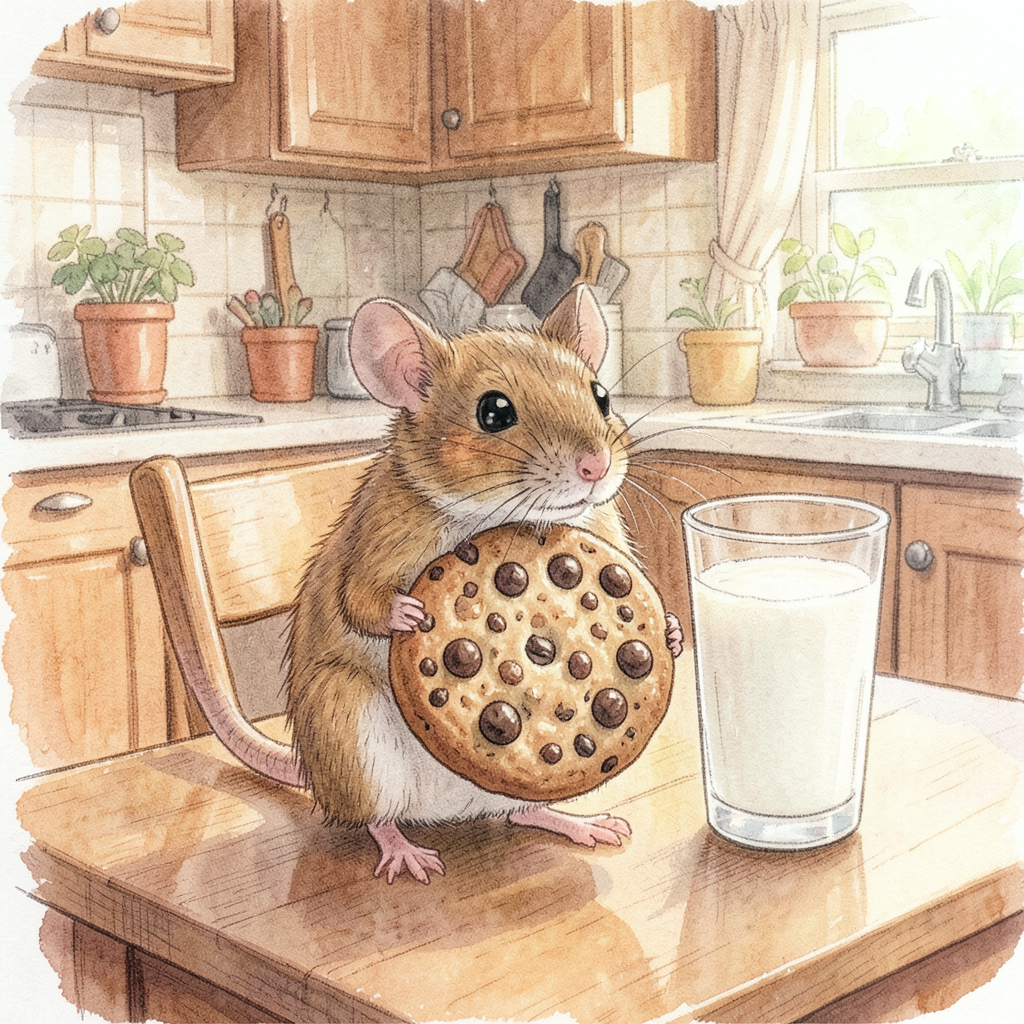
If you give a mouse a cookie, he'll want a glass of milk. And then he'll need a napkin, a mirror, scissors for a trim, and on and on in an entertaining circular chain of events that always leads right back to where it started.
Themes
Cause and EffectHumorImagination
Best For
- Bedtime read-alouds when you want a story with a satisfying, predictable rhythm that winds down naturally
- Introducing the concept of cause and effect to preschool and kindergarten-age children
- Encouraging reluctant listeners — the fast-moving chain of events holds attention even for wiggly kids
- Reading alongside a snack, especially milk and cookies, to make the story come alive
- Children who love repetition and call-and-response — this book rewards multiple readings and memorization
Why Parents Love This Book
If You Give a Mouse a Cookie has been delighting children and parents alike since 1985, and its staying power comes from one brilliantly simple idea: every small action sets off an unstoppable chain of consequences. Laura Numeroff's writing has a wonderfully breathless rhythm — each sentence leads so naturally into the next that children are leaning forward before they even realize it. Felicia Bond's illustrations are full of warmth and tiny comic details, capturing the mouse's cheerful obliviousness to the chaos he creates. What makes this book truly special is how it mirrors the real experience of living with small children: one request always leads to another, and somehow you end up miles away from where you started. Kids find it hilarious precisely because they recognize themselves in the mouse's never-ending demands. The circular structure is also quietly clever — the story loops back to its beginning with such satisfying inevitability that children beg for it to be read again, which of course means it starts all over, just like the story itself.
Reading Tips for Parents
Read this one slowly, pausing after each new demand to ask your child what they think will happen next. The circular chain of cause and effect is the whole point, so let kids predict and get it wrong — that surprise is part of the fun. For a second reading, try letting your child shout out the next item before you say it; many kids memorize the sequence quickly and love showing off that knowledge. This book pairs naturally with a real snack: reading it over milk and cookies makes the opening scene immediately relatable. For children who resist bedtime or transitions, this book opens a gentle conversation about how one thing leads to another — a concept that resonates well beyond the story itself.
Awards & Recognition
- New York Times Bestseller — a consistent bestseller since its 1985 publication
- American Booksellers Book of the Year (ABBY) Honor Book
- IRA-CBC Children's Choice selection
Educational Value
This book helps children develop skills across multiple areas:
- Cause and Effect: The entire narrative is a chain of if-then logic, giving children an intuitive, joyful introduction to sequential reasoning.
- Vocabulary: Words like 'trim,' 'handy,' and 'comfortable' appear naturally in context, building language in a low-pressure, story-driven way.
- Math: The circular structure introduces early pattern recognition and the concept of cycles — the story ends exactly where it began.
- Social-emotional: The mouse's relentless needs model the experience of wanting more, opening conversations about satisfaction, patience, and knowing when enough is enough.
- Narrative Comprehension: Predicting what the mouse will need next builds active listening skills and story sequencing ability.
- Humor and Perspective-Taking: Children learn to find humor in situations by seeing events from an outside perspective — recognizing that the mouse's behavior is funny because we can see what he cannot.
Discussion Questions
Use these questions to spark conversation before, during, or after reading:
- Why do you think the mouse keeps needing more and more things after he gets his cookie?
- If you gave a mouse a cookie at your house, what do you think would happen next?
- At the very end, the mouse is back where he started. Did you notice that? Why do you think the story goes in a circle?
- Have you ever asked for one thing and then realized you needed something else to go with it? What happened?
- Which part of the mouse's day would you most want to do with him — drawing a picture, taking a nap, or something else?
Content Notes for Parents
There are no scary, sad, or mature elements in this book. It is gentle, humorous, and entirely appropriate for its target age range with no content concerns whatsoever.
Frequently Asked Questions
What age is this book best for?
The publisher recommends ages 4 to 8, and that range holds up well in practice. Children around 4 to 5 love the silliness and the rhythm, while 6 to 7 year olds begin to appreciate the circular structure on a more conscious level. Even confident early readers in second grade enjoy it as a read-aloud because the humor works at multiple levels.
Is there a good way to use this book to teach cause and effect?
Yes — the book is practically built for it. After reading once for fun, try a second read where you stop after each event and ask 'What caused that to happen?' You can also draw a simple circle on paper and fill in each step together as you go, making the circular pattern visible. Teachers and parents report this works well as an introduction to if-then thinking before more formal lessons.
My child wants me to read it over and over. Is that okay?
Absolutely — repeated reading of a favorite book is one of the most beneficial things for early literacy development. Each re-reading builds vocabulary, comprehension, and a sense of narrative structure. The fact that your child wants to hear it again and again means it is doing exactly what a great picture book should do.
Are there other books in the series?
Yes, Laura Numeroff and Felicia Bond created a full series of 'If You Give a...' books, including If You Give a Moose a Muffin, If You Give a Pig a Pancake, and several others. Each follows the same circular cause-and-effect structure with a different animal. Children who love the mouse book typically enjoy the entire series.
Is this book appropriate for sensitive children?
This book is very gentle and funny with no frightening, sad, or upsetting content. The mouse is cheerful and well-meaning throughout, and the story ends happily with everything coming full circle. It is one of the most universally safe picture books for sensitive readers of any temperament.