Cloudy with a Chance of Meatballs
About This Book
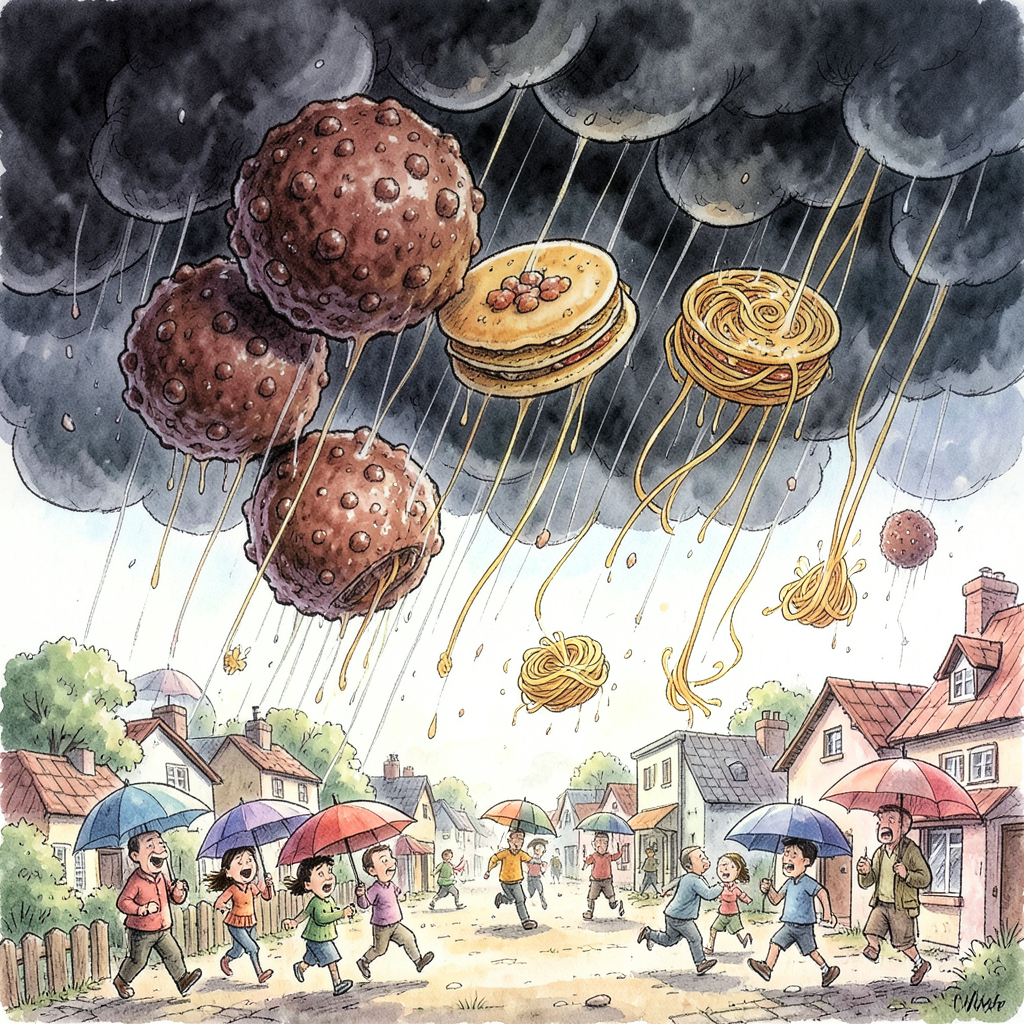
In the town of Chewandswallow, the weather delivers all meals — it rains soup, snows mashed potatoes, and blows in storms of hamburgers. Life is delicious until the food weather goes wild, forcing the entire town to evacuate on giant bread rafts.
Themes
ImaginationHumorCommunity
Best For
- Rainy or snowy days when children are stuck indoors and ready for imaginative play
- Picky eaters — the absurd food scenarios often get reluctant eaters laughing and talking about foods they'd actually try
- Before a cooking or baking activity, to set a playful tone around food
- Family storytelling sessions where parents want a model for telling their own made-up bedtime tales
- Classroom read-alouds on weather units in preschool or kindergarten
Why Parents Love This Book
Cloudy with a Chance of Meatballs has enchanted children since 1978 for one simple reason: it takes a completely ridiculous premise and commits to it with total sincerity. Judi Barrett's story is framed as a grandfather's bedtime tale, which gives the whole adventure a warm, cozy wrapper even as the plot gets wonderfully absurd. Ron Barrett's detailed, newspaper-style black-and-white illustrations are a treasure — children spend long minutes poring over each spread, spotting syrup rivers and tomato tornadoes hiding in the corners. The story also has genuine narrative tension. Chewandswallow is a paradise, but it falls apart, and the townspeople must work together and leave everything behind. That bittersweet undertone is rare in picture books aimed at this age and gives the story real emotional depth alongside the humor. Decades later, it remains a masterclass in how a single imaginative "what if" question — what if weather were made of food? — can carry a full, satisfying story with a beginning, middle, and end.
Reading Tips for Parents
Plan on reading this book slowly. Ron Barrett's illustrations reward careful looking — ask your child to find hidden food details before turning each page. The grandfather-telling-a-story framing is a natural prompt to share your own made-up bedtime tales afterward, turning the book into a springboard for family storytelling. The evacuation section can feel slightly sad or unsettling for sensitive four-year-olds, so pause there and talk about how the townspeople stayed together as a community. After reading, the book pairs beautifully with a simple cooking activity — making pancakes or a soup together while using weather vocabulary ("a drizzle of syrup," "a flurry of croutons") extends the language play naturally. For beginning readers, several food and weather words in the text offer good phonics practice if you track the words with your finger.
Awards & Recognition
- New York Times Best Illustrated Children's Books of the Year (1978)
- School Library Journal Best Books of the Year selection
Educational Value
This book helps children develop skills across multiple areas:
- Vocabulary: Introduces rich weather and food vocabulary — 'forecast,' 'overcast,' 'sanitation,' 'avalanche' — in a context that makes unusual words memorable and fun.
- Narrative structure: The story has a clear three-part arc (paradise, crisis, resolution) that helps children understand how stories are built and retold.
- Critical thinking: The grandfather framing invites children to question whether the story is real, building early skills in distinguishing fact from fiction.
- Community and social studies: The townspeople cooperate to solve a shared problem and relocate together, modeling collective action and community responsibility.
- Science: The book opens natural conversations about real weather patterns, precipitation, and how weather affects daily life.
- Creative writing: The 'what if food fell from the sky' premise is a natural model for children to invent their own imaginative story worlds.
Discussion Questions
Use these questions to spark conversation before, during, or after reading:
- If you lived in Chewandswallow, what is the one food you would most want to fall from the sky? What food would you least want?
- Why did the people of Chewandswallow have to leave their town? How do you think they felt about leaving their homes?
- Grandpa tells this story as if it really happened. Do you think Chewandswallow is a real place? How can you tell the difference between a real story and a made-up one?
- The food weather started out wonderful but then became a problem. Can you think of something that is great in small amounts but bad when there is too much of it?
- If you were the mayor of Chewandswallow, what rules would you make about the food weather to keep everyone safe?
Content Notes for Parents
The book includes a mildly tense disaster sequence in which food storms grow dangerous and the entire town must evacuate on bread rafts, which may feel sad or scary to very sensitive four-year-olds. There are no frightening images or mature themes; the tone stays humorous and the community ultimately finds safety together.
Frequently Asked Questions
What age is Cloudy with a Chance of Meatballs best for?
The book is ideal for ages 4 through 7. The vocabulary and story length are manageable for preschoolers as a read-aloud, while early readers aged 6-7 can begin tackling the text independently. Some words like 'sanitation' and 'overcast' will need explanation for younger listeners, which makes for great conversation.
Is the book too scary for young children?
Most children handle it just fine, but there is a disaster sequence where food storms turn dangerous and the whole town has to flee. Very sensitive four-year-olds may find this unsettling. Pausing to reassure them that the community stays safe and together tends to resolve any anxiety quickly.
Is this book related to the animated movie?
The 2009 Sony Pictures film shares the title and the basic food-weather concept, but the movie has a completely different plot, characters, and tone. The original book by Judi and Ron Barrett is a quieter, more thoughtful story with no scientists or invention machines. Many families enjoy both, but it's worth setting that expectation before a child expects the movie's story.
What books are similar to this one?
If your child loves the imaginative food premise, try Shel Silverstein's poetry collections or James and the Giant Peach by Roald Dahl for more edible fantasy. For picture books with a similarly absurd comic logic, If You Give a Mouse a Cookie by Laura Numeroff and The True Story of the 3 Little Pigs by Jon Scieszka both reward rereading in the same way.
Can I use this book to encourage picky eaters?
Many parents find it works surprisingly well. The book presents foods in such a ridiculous, joyful context — raining down from the sky, flooding streets — that it strips away the mealtime pressure. Asking a picky eater which food they'd want to fall from the sky often opens conversations about foods they're willing to try, without any direct negotiation around the dinner plate.