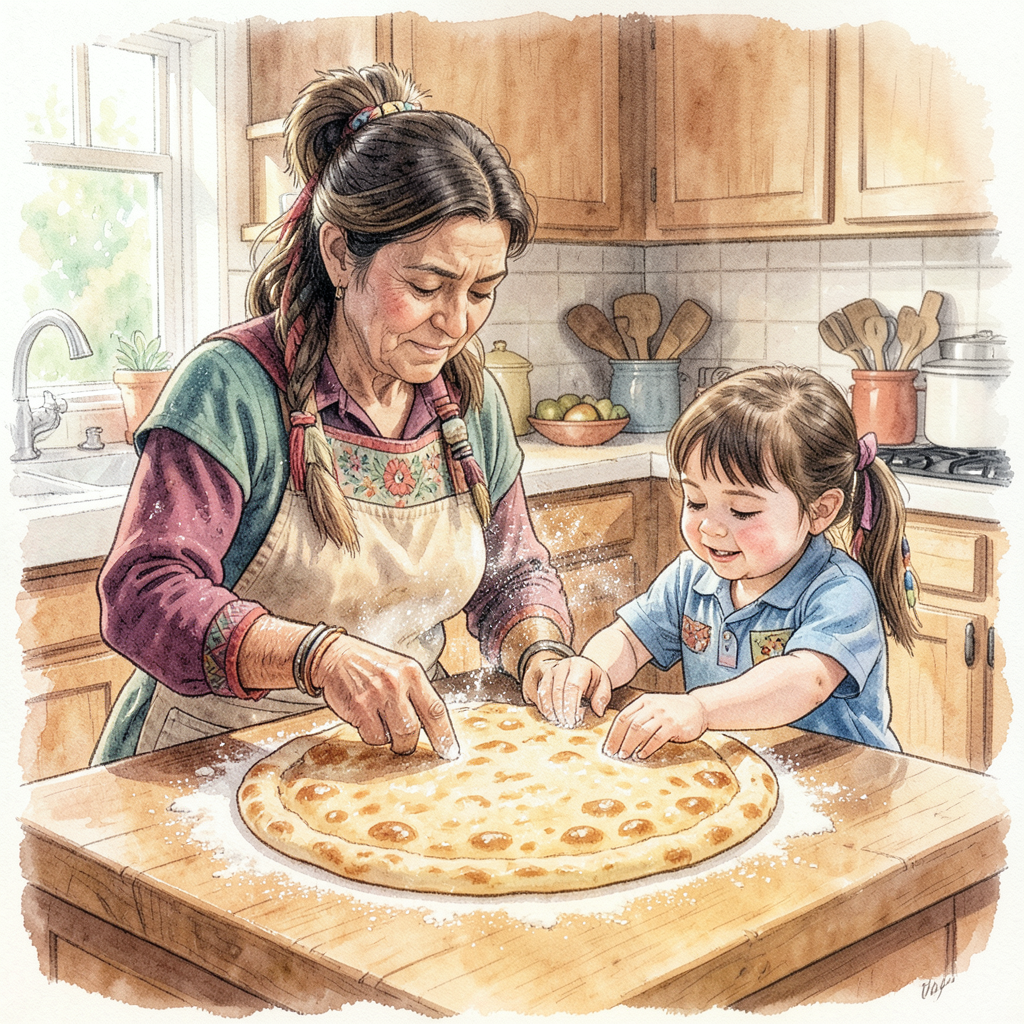
Fry Bread: A Native American Family Story
About This Book
Fry bread is food, but it is also time and place and tribe. Kevin Noble Maillard's gorgeous lyrical text traces the many meanings of this staple food across generations of a Native American family — flavour and history, memory and belonging, all mixed into one. A 2020 Sibert Honor book that is as much poetry as it is picture book.
Themes
Native American CultureFamilyFood
Best For
- Multicultural read-alouds in classroom or library settings looking for authentic Own Voices representation
- Families exploring heritage, food traditions, and intergenerational storytelling
- Children ages 4-7 who are ready to engage with poetic, layered picture book text
- Social studies and cultural studies units on Indigenous peoples and contemporary Native American life
- Cooking and food-themed storytime sessions paired with a simple fry bread recipe
Why Parents Love This Book
Fry Bread: A Native American Family Story is one of those rare picture books that functions simultaneously as poetry, history lesson, and family portrait. Kevin Noble Maillard, a Seminole Nation citizen, brings rare insider authenticity to a subject too often filtered through outsider perspectives. His text unfolds in a gentle, circular structure — fry bread is food, then flavor, then history, then family, then nation — building layer upon layer until readers understand that this simple fried dough holds centuries of meaning. Juana Martinez-Neal's warm, textured illustrations span a gorgeous range of skin tones and family configurations, making clear that Native American families are diverse, contemporary, and very much present. The book resists nostalgia and instead celebrates living culture. It never talks down to young readers, trusting them to feel the weight of words like "nation" and "memory" alongside the warmth of "family" and "home." For many children, this will be their first genuinely Indigenous-authored picture book — and it sets a high bar.
Reading Tips for Parents
Before reading, make a batch of fry bread together if you can — even a simplified version — so the smell and texture are fresh in your child's mind as you turn the pages. Read slowly and let the lyrical, poem-like text breathe; this is not a book to rush. Pause at each double-page spread and ask your child what they notice in the illustrations before moving on. The book's circular structure rewards a second reading: on the second pass, children often catch layers they missed the first time. If your family has a signature dish tied to heritage or memory, use this book as a springboard to talk about it. For families new to learning about Native American cultures, the author's note at the back provides invaluable context and is worth reading aloud to children ages six and up.
Awards & Recognition
- Robert F. Sibert Honor Book, 2020 (American Library Association)
- New York Times Bestseller
Educational Value
This book helps children develop skills across multiple areas:
- Vocabulary: Introduces rich, evocative language including 'tradition,' 'nation,' 'memory,' and 'belonging' in meaningful context rather than as definitions.
- Social-emotional: Builds empathy and cultural curiosity by inviting children to see family, food, and heritage through an Indigenous lens.
- Cultural Studies: Provides an authentic, author-insider introduction to Native American family life and the ongoing, living nature of Indigenous cultures.
- Language Arts: The lyrical, poetic text structure models how language can layer meaning, making it a strong mentor text for early writers.
- Family and Community: Sparks conversations about intergenerational connection and how culture is passed down through everyday rituals.
- History: Gently introduces the concept that foods and traditions can carry historical weight and community identity across generations.
Discussion Questions
Use these questions to spark conversation before, during, or after reading:
- Why do you think the author says fry bread is not just food, but also time and place and tribe? What does that mean to you?
- What is a food in our family that feels special or that reminds you of something important? Why is it special?
- Look at all the different people in the illustrations. What do you notice about the families shown in the book?
- The book says fry bread is memory. Can a food really be a memory? How?
- If you could teach someone one thing about your family using only food, what food would you choose and what would it say?
Content Notes for Parents
There are no scary, violent, or upsetting elements in this book. Parents should be aware that the author's note touches briefly on the historical hardships faced by Native peoples, which may prompt questions from older or more curious children that are worth addressing honestly and age-appropriately.
Frequently Asked Questions
What age is this book best for?
The book is officially aimed at ages 4-7, but the lyrical text and layered meanings give it a long shelf life. Younger children (ages 4-5) will respond to the warm illustrations and rhythmic language, while children ages 6-8 can begin to grasp the deeper themes of heritage and history. Many teachers use it successfully with children as old as 10 in discussion-based settings.
Is this book appropriate for non-Native families, and will our child feel included?
Absolutely. The book is written from an insider Native perspective, but its themes of family, food, memory, and belonging are universal. Non-Native children are welcomed into the story through the universal language of food and family. The diversity of families shown in the illustrations also means many children will see themselves reflected in some way.
Are there any difficult or sad topics I should prepare for?
The main text is joyful and celebratory with no sad or difficult content. The author's note at the back briefly references historical hardships faced by Native peoples, which is informative for parents and older children but is not part of the main story. You can choose whether to read it aloud depending on your child's age and readiness.
What books are similar to this one that we could read next?
If your child loves this book, try 'When We Were Alone' by David A. Robertson (Indigenous culture, gentle and beautiful), 'We Are Water Protectors' by Carole Lindstrom (Native American, Caldecott Medal winner), or 'Alma and How She Got Her Name' by Juana Martinez-Neal (the same illustrator, focused on family and identity). For more food-as-heritage stories, 'Bee-Bim Bop!' by Linda Sue Park is a wonderful companion.
Can I use this book to teach my child about Native American history?
Yes, it is an excellent starting point. The book celebrates living Native American culture rather than portraying it as historical or past, which is itself an important lesson. For families wanting to go deeper, the author's note provides useful context. This book works best as an opening conversation rather than a complete history lesson — follow it up with library resources and, where possible, books by other Native authors.