Hatchet
About This Book
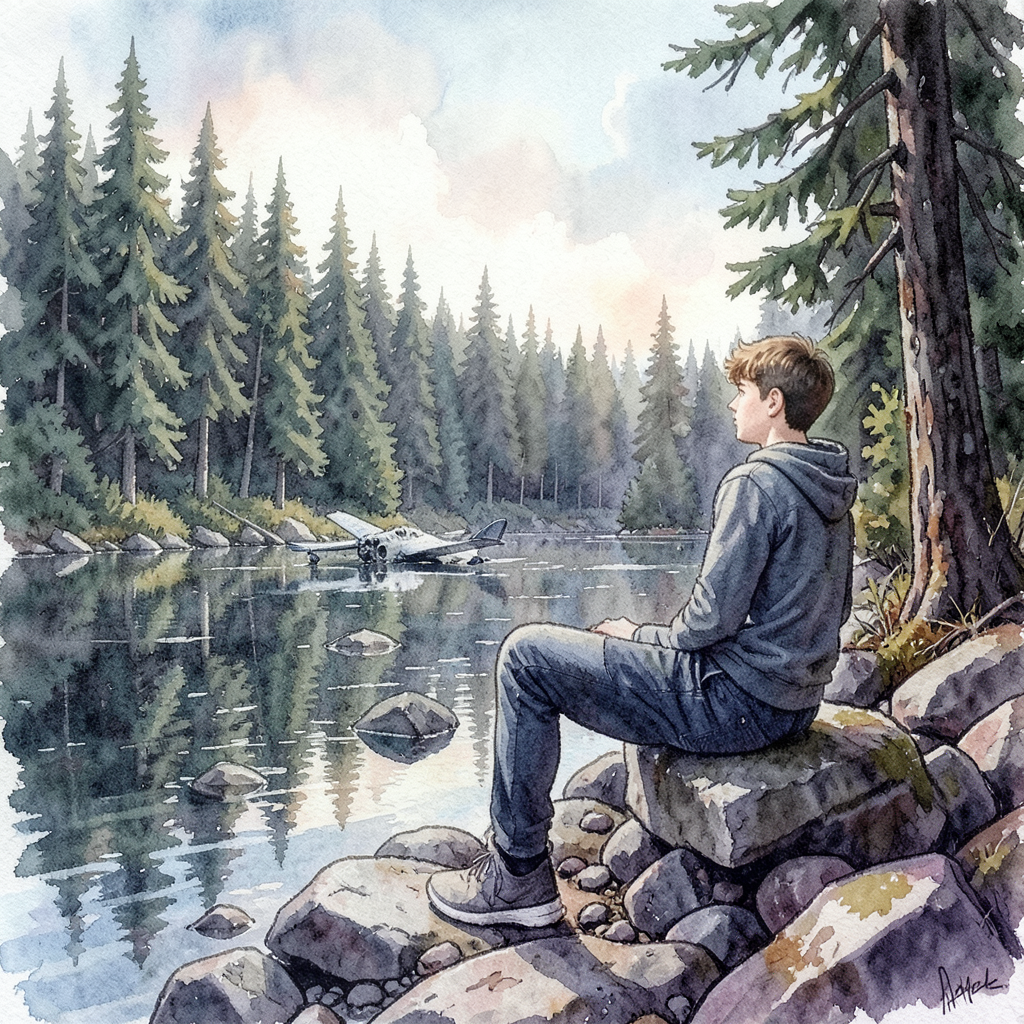
Thirteen-year-old Brian Robeson is stranded alone in the Canadian wilderness after his pilot suffers a heart attack. Armed only with a hatchet — a gift from his mother — Brian must learn to survive: building shelter, finding food, and facing his deepest fears over 54 days of solitude.
Themes
SurvivalResilienceSelf-Reliance
Best For
- Kids who say they do not like reading but love action and adventure — Hatchet's short chapters and relentless forward momentum convert reluctant readers reliably.
- Children processing a family divorce or major life disruption, who may find Brian's emotional journey quietly validating.
- Classroom survival-fiction units or independent reading at grades 5 through 7.
- Young readers curious about the outdoors, camping, or wilderness skills who want fiction grounded in practical reality.
- Summer reading for ages 10-13 who want a book that respects their intelligence and does not wrap everything up too neatly.
Why Parents Love This Book
Hatchet has captivated young readers for nearly four decades, and the reason is simple: Gary Paulsen writes survival with visceral, you-are-there urgency. Thirteen-year-old Brian does not stumble through the Canadian wilderness with plot-convenient luck. He fails, backtracks, and tries again — fishing with his hands, constructing a crude shelter, coaxing fire from flint. Every small victory feels genuinely earned. The hatchet of the title does real narrative work too: it is a gift from his mother, and Brian's relationship with it mirrors his shifting feelings about the family secret he is carrying — the knowledge of his mother's affair that cracked his family apart before the plane crash ever happened. Paulsen trusts young readers with both the physical and emotional weight of that burden. The result is a book that does not talk down to its audience, rewards careful reading, and leaves kids with the satisfying certainty that a determined mind and a useful tool can carry a person through almost anything.
Reading Tips for Parents
Brian's 54 days of solitude unfold in tight, present-tense prose that moves quickly — most middle-grade readers will finish Hatchet in three to five sittings. Before reading, consider asking your child what single item they would want if stranded alone: it is a great entry point into the book's central question. The survival chapters are vivid enough that some younger or more sensitive readers may find a few moments stressful (bee attack, moose charge, tornado), so a quick read-aloud of those scenes together can help. The "Secret" — Brian's knowledge of his mother's infidelity — is present throughout but handled with restraint; Paulsen never explains it fully, which may prompt questions. A frank, age-appropriate conversation about divorce or family change pairs naturally with the book. Four sequels exist if your child cannot let go of Brian.
Awards & Recognition
- Newbery Honor Book, 1988
- ALA Notable Children's Book
- Publishers Weekly bestseller — more than 4.5 million copies sold in the United States
Educational Value
This book helps children develop skills across multiple areas:
- Vocabulary: Exposes readers to precise wilderness and survival terminology — deadfall, wallow, windfall — in context, building word knowledge through story rather than drill.
- Science: Covers practical ecology including animal behavior, edible plants, weather reading, and the physics of friction and spark that make fire-starting possible.
- Social-emotional learning: Models persistence and emotional regulation; Brian repeatedly confronts despair and chooses action, providing a concrete framework for resilience.
- Geography: The Canadian boreal forest setting gives readers a real sense of biome, climate, and latitude, and invites map-reading to trace Brian's location.
- Critical thinking: Brian must observe, hypothesize, and test constantly — the scientific method in survival form, making it a natural discussion anchor for inquiry skills.
- Literary analysis: Paulsen's tight third-person limited narration and deliberate pacing offer strong examples of how point of view and sentence rhythm create tension.
Discussion Questions
Use these questions to spark conversation before, during, or after reading:
- Brian carries what he calls "the Secret" throughout the story. How do you think that weight affects the way he deals with being alone in the wilderness?
- What does the hatchet mean to Brian beyond being a tool? Why do you think Paulsen made it a gift from his mother specifically?
- Brian fails many times before he succeeds at things like making fire or catching fish. Can you think of something in your own life where you had to fail before you got it right — and how did that feel?
- If you were stranded with only one item of your choosing, what would it be and why? Would your choice change after reading this book?
- By the end of the novel, Brian has changed. What is the biggest difference between the Brian who boarded the plane and the Brian who is rescued?
Content Notes for Parents
The book contains a detailed plane crash, a frightening porcupine encounter, a painful bee swarm attack, a moose charge, and a tornado sequence; none are gratuitous but several scenes are genuinely tense and may unsettle sensitive readers around ages 8-9. Brian's parents are divorced and a subplot involves his knowledge of his mother's infidelity, which is present throughout but never explicitly spelled out.
Frequently Asked Questions
What age is Hatchet really right for?
Paulsen's publisher targets ages 10 and up, and that is a reasonable floor for most readers. Confident, mature readers at 8 or 9 can handle it with a parent nearby for the tenser scenes. The emotional subplot about Brian's parents is more meaningful — and less confusing — for readers who are 10 or older.
My child is a reluctant reader. Will this hold their attention?
Hatchet is one of the most reliably cited books for converting reluctant readers, particularly boys ages 10-13. The chapters are short, the action starts on page one, and Paulsen does not slow down for lengthy description. Many teachers assign it precisely because kids who claim to hate reading finish it.
Is the survival information in the book actually accurate?
Paulsen drew heavily on his own wilderness experience, and the broad strokes of fire-starting, shelter-building, and food-finding are credible. It is not a wilderness manual, but it is grounded enough to feel authentic and has prompted many young readers to look up real survival skills afterward.
Are there more books in the series if my child loves it?
Yes — Paulsen wrote four sequels: The River, Brian's Winter, Brian's Return, and Brian's Hunt. The River is the most direct continuation and nearly as strong as the original. Brian's Winter reimagines what would have happened had Brian not been rescued before winter, which many fans consider the best follow-up.
Does the book have a happy ending? I do not want my child left feeling sad.
Brian is rescued and survives, so the overall arc is hopeful. However, Paulsen resists a tidy emotional resolution — Brian returns changed, and the family situation is not fixed. Most readers find the ending satisfying rather than sad, but parents of very young or sensitive children should know it is not a triumphant movie finish.