My Side of the Mountain
About This Book
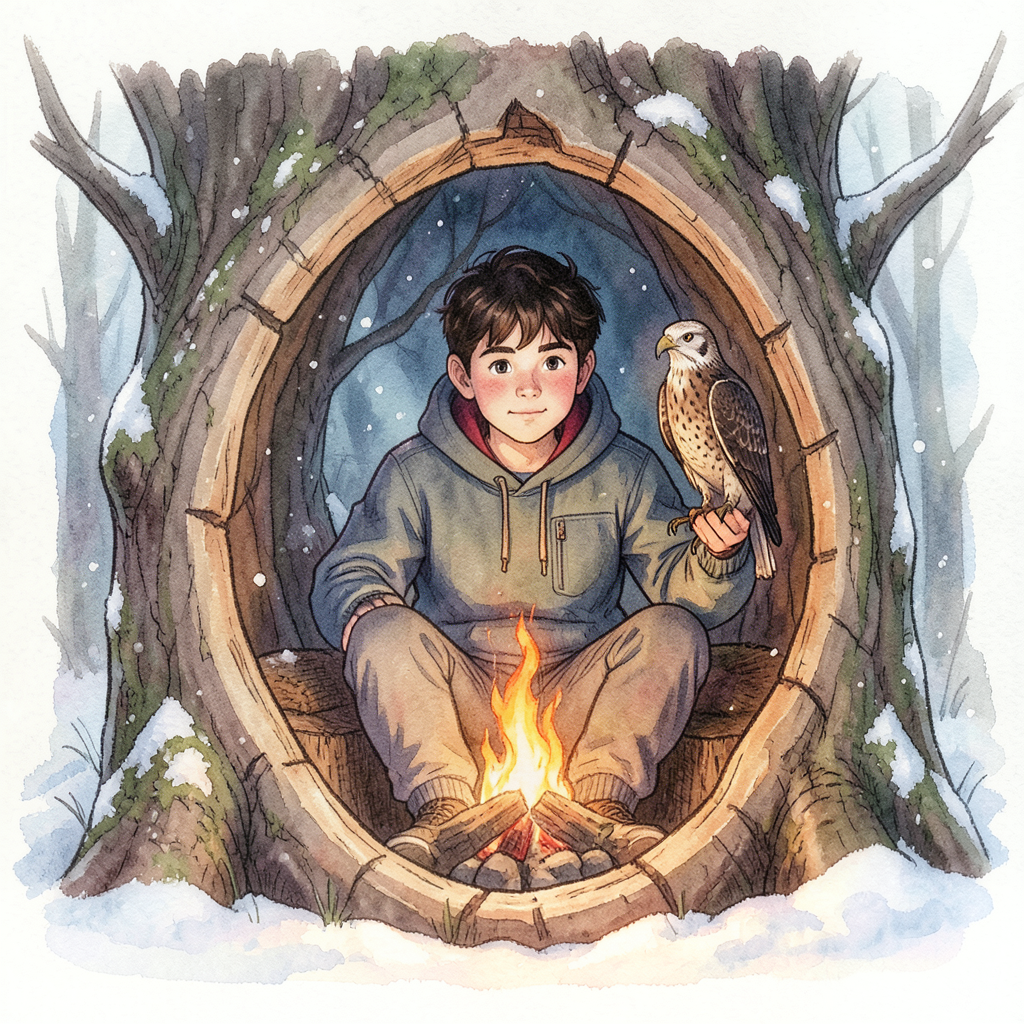
Twelve-year-old Sam Gribley runs away from his crowded New York City apartment to live in the Catskill Mountains on his great-grandfather's abandoned land. He hollows out a hemlock tree for shelter, trains a peregrine falcon, and lives off the land through all four seasons.
Themes
IndependenceNatureSelf-Reliance
Best For
- Kids who love animals, especially birds of prey or wildlife
- Reluctant readers who respond to action and hands-on detail over character drama
- Nature-curious children who enjoy field guides, hiking, or outdoor exploration
- Read-aloud families looking for a chapter book with satisfying seasonal structure
- Children going through transitions who connect with themes of independence and finding one's own place
Why Parents Love This Book
Jean Craighead George's 1959 classic endures because it answers a question every child quietly asks: could I survive on my own? Twelve-year-old Sam Gribley doesn't just run away — he builds a real life inside a hollowed-out hemlock tree in the Catskill Mountains, foraging for food, tanning deerhide, and training a wild peregrine falcon he names Frightful. What makes this book extraordinary is its specificity. George, a naturalist herself, laces the story with accurate, usable wilderness knowledge — which plants are edible, how to read animal tracks, how to smoke meat for winter. Readers finish the book feeling genuinely more capable. Sam's voice is calm, curious, and quietly brave, never melodramatic. The story unfolds across all four seasons, giving it a satisfying completeness that short adventure stories can't match. More than a survival tale, it's a meditation on solitude, self-knowledge, and the deep rewards of paying close attention to the natural world.
Reading Tips for Parents
Before reading, pull up a map of the Catskill Mountains with your child — Sam's journey becomes vivid when kids can see where the Catskills actually are relative to New York City. Keep a small notebook nearby; many children are inspired to record plants, birds, or weather observations as they read. George includes genuinely accurate foraging and wilderness detail, which is wonderful, but worth noting that real foraging requires expert guidance. Use that as a conversation starter rather than a caution. The book works well read aloud in seasonal chunks — stop at each season's turn and discuss what Sam learned. For animal-loving kids, the chapters about training Frightful the falcon are a natural entry point into research about falconry and raptors. The story also pairs naturally with a library trip to find field guides for your region.
Awards & Recognition
- Newbery Honor Book, 1960
- Hans Christian Andersen Award nominee
- ALA Notable Children's Book
Educational Value
This book helps children develop skills across multiple areas:
- Nature Science: Introduces real plant identification, animal behavior, and ecological relationships specific to the Catskill Mountain ecosystem.
- Vocabulary: Rich naturalist language — hemlock, peregrine, forage, tallow, molt — builds content-specific vocabulary in a meaningful context.
- Social-Emotional: Sam's year alone models healthy solitude, emotional self-regulation, and the difference between loneliness and chosen independence.
- Geography: The story grounds readers in a specific real landscape, connecting narrative to map-reading and regional ecology.
- Critical Thinking: Sam solves practical problems with limited resources, modeling creative problem-solving and iterative learning from failure.
- Research Skills: George's accurate natural history detail naturally motivates kids to verify facts and explore field guides, connecting fiction to nonfiction inquiry.
Discussion Questions
Use these questions to spark conversation before, during, or after reading:
- Why do you think Sam decides to run away to the mountains instead of telling his family how he feels? Have you ever wanted to have a place completely to yourself?
- Sam learns to identify edible plants, make fire, and preserve food. Which of his survival skills do you think would be hardest to learn, and why?
- Frightful the falcon is wild but lives with Sam. What do you think their relationship tells us about the difference between taming an animal and befriending one?
- Sam chooses to live alone for almost a year. Do you think you would enjoy that, or would you get lonely? What would you miss most?
- By the end of the book, Sam's family arrives. Do you think Sam is happy or sad about that? What do you think happens to him next?
Content Notes for Parents
Sam faces genuine hardship including harsh winter cold, near-starvation, and killing animals for food — all handled matter-of-factly and age-appropriately rather than graphically. No content concerns; the realistic treatment of nature's difficulty is a strength of the book, not a caution.
Frequently Asked Questions
What age is this book really right for?
Most children read it independently between ages 9 and 12, though strong readers of 8 can handle it comfortably. The vocabulary is rich but context usually makes meaning clear. It also works beautifully as a family read-aloud for ages 7 and up, with a parent available to discuss the more reflective passages.
Is it okay that Sam runs away from home? Will this give my child ideas?
Sam's decision is framed as an adventure rooted in deep love of nature rather than family conflict, and the book never romanticizes running away from problems. His family is portrayed warmly, and the ending brings them together. Most children read it as a fantasy of independence and capability rather than a blueprint for action.
My child is obsessed with animals — will they love this?
Almost certainly yes. The relationship between Sam and Frightful the peregrine falcon is the emotional heart of the book, and George writes about wild animals with real accuracy and respect. Many children who read this book go on to research falconry, raptors, or wild foraging on their own.
Are there sequels?
Yes — Jean Craighead George wrote two sequels: On the Far Side of the Mountain (1990), which continues Sam's story and focuses on Frightful, and Frightful's Mountain (1999), which tells the story from the falcon's point of view. Both are well-regarded, and Frightful's Mountain is particularly popular with animal-loving readers.
How does this compare to Hatchet by Gary Paulsen?
Both are beloved wilderness survival stories for the same age group, but they have a different feel. Hatchet is tenser and more plot-driven, with a protagonist stranded by accident under life-or-death pressure. My Side of the Mountain is more deliberate and lyrical — Sam chooses his adventure and savors it. Kids who love one often love both.