Madeline
About This Book
In an old house in Paris covered with vines live twelve little girls in two straight lines. The smallest and bravest is Madeline, who faces an emergency appendectomy with courage that makes all the other girls wish they had scars too.
Themes
CourageFriendshipAdventure
Best For
- Children who are anxious about upcoming doctor visits, shots, or minor medical procedures
- Families who enjoy read-alouds with strong rhyme and rhythm
- Introducing preschool and kindergarten children to Paris and French culture
- Bedtime reading — the calm, ordered convent setting and consistent routine feel cozy and soothing
- Children who love a spirited, independent female main character
Why Parents Love This Book
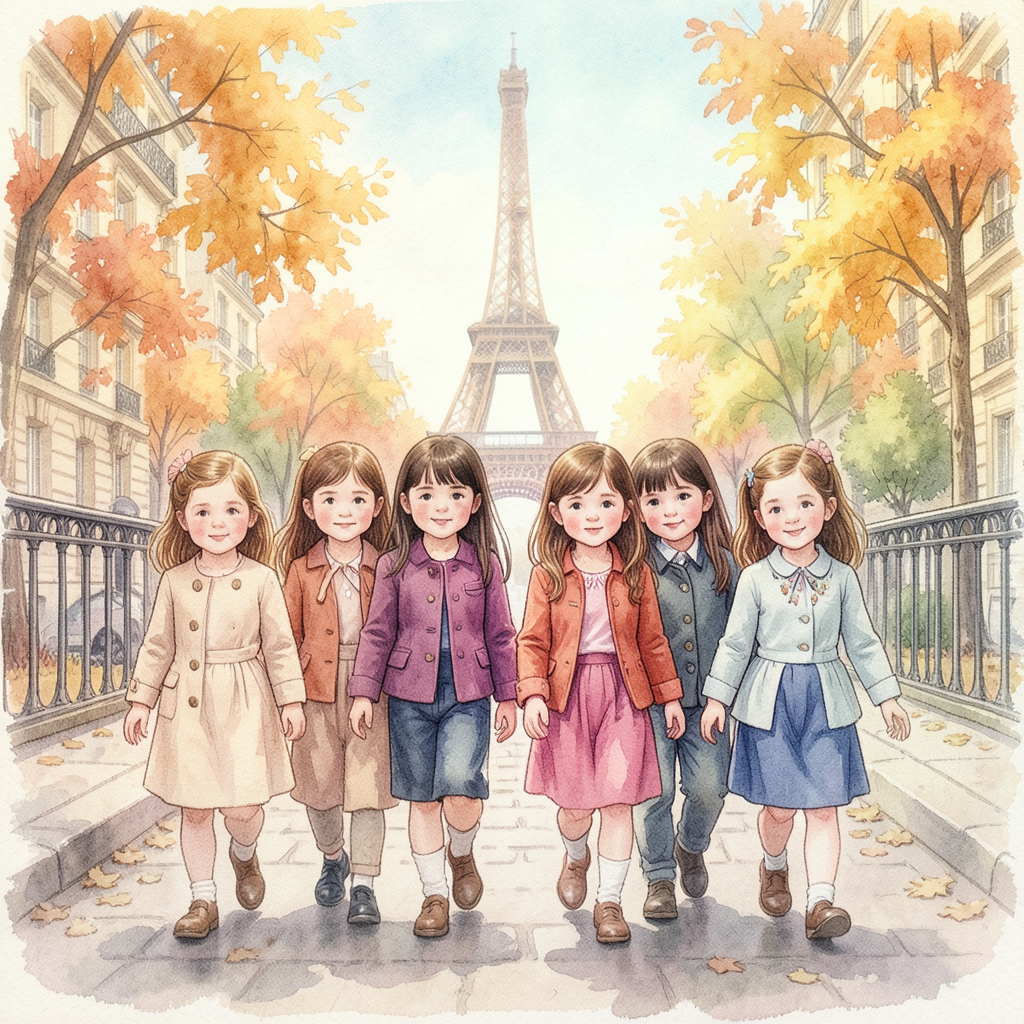
Madeline has captivated young readers since 1939 for one simple reason: she is fearless. In Ludwig Bemelmans's sun-drenched Paris, the smallest girl in the convent school faces a midnight hospital trip and an appendectomy without flinching — and somehow turns her scar into the envy of every classmate. That joyful reversal of fear into pride is the heart of the book's enduring magic. Bemelmans's watercolor illustrations are loose, warm, and full of Parisian charm — the Eiffel Tower, the Seine, horse-drawn carriages — giving children an effortless first glimpse of the wider world. The bouncing rhyming couplets ("In two straight lines they broke their bread / and brushed their teeth and went to bed") are enormously satisfying to read aloud and easy for children to memorize and recite. More than eight decades later, Madeline remains one of the most beloved picture books in the American canon precisely because it pairs genuine adventure with reassuring order: twelve girls, two straight lines, and one very brave smallest one.
Reading Tips for Parents
Read this one aloud at a measured, rhythmic pace — the rhyming couplets have a natural beat children love to follow along with. Pause at the double-page spread of the hospital to let children examine the details before turning the page. If your child has ever had a doctor visit, a shot, or a minor procedure, this is an ideal springboard: ask them what they were afraid of and how it turned out. The book is short enough for a single sitting but rich enough to revisit many times. On a second or third read, challenge older children in the 4-7 range to count the twelve girls in each illustration — they are not always easy to spot. Having a globe or simple map handy to point out Paris, France, adds wonderful context for curious kids.
Awards & Recognition
- Caldecott Honor Book, 1940
- New York Times Outstanding Books citation
- Listed on the American Library Association's list of most frequently checked-out books of all time
Educational Value
This book helps children develop skills across multiple areas:
- Vocabulary: Introduces rich, descriptive words like 'appendix,' 'crisis,' 'solemn,' and 'vines' in context, expanding language naturally through rhyme.
- Rhyme and phonological awareness: The consistent AABB rhyming couplets help children predict word sounds and build early reading and phonics skills.
- Social-emotional: Models courage and resilience in the face of a frightening medical situation, helping children process their own fears about hospitals and doctors.
- Geography and world cultures: Set entirely in Paris, the book sparks curiosity about France, French architecture, and life in other countries.
- Math and counting: Twelve girls appear throughout — counting them in illustrations is a playful, embedded numeracy activity for preschoolers.
- Narrative structure: The clear beginning (daily routine), middle (emergency), and end (recovery and envy) gives young children a strong model for how stories are shaped.
Discussion Questions
Use these questions to spark conversation before, during, or after reading:
- Why do you think Madeline is not afraid when she wakes up in the hospital? Would you be scared?
- Why do all the other girls suddenly wish they had an appendix scar at the end? Have you ever wanted something someone else had?
- Miss Clavel wakes up twice in the night with a feeling that something is wrong. How do you think she knew?
- What is your favorite thing you can see in the pictures of Paris? Would you like to visit someday?
- The girls always walk in two straight lines. Why do you think they do that? What rules does your family or class have that keep everyone together?
Content Notes for Parents
Madeline undergoes an emergency appendectomy, and the scene of Miss Clavel rushing her to the hospital at night may briefly worry sensitive children; however, the outcome is entirely positive and treated with warmth and even humor. There are no frightening images and no sad endings — this book is generally suitable for all children in the 4-7 age range.
Frequently Asked Questions
What age is Madeline best for?
The book is ideally suited for ages 4 through 7. The rhyming text and large illustrations engage preschoolers, while early readers in kindergarten and first grade can begin tackling the couplets independently. Younger children aged 2-3 can also enjoy it as a lap read, though the hospital storyline may need brief reassurance for very sensitive toddlers.
Is the hospital scene too scary for young children?
Most children handle it just fine. The scene is brief, the illustrations are warm rather than clinical, and Madeline herself is so cheerful that the tone never becomes alarming. If your child has had a negative hospital experience, the book can actually be a helpful way to talk through those feelings. You know your child best — preview it first if you have concerns.
My child loved Madeline — are there more books in the series?
Yes. Ludwig Bemelmans wrote five sequels: Madeline's Rescue (1953, Caldecott Medal winner), Madeline and the Bad Hat, Madeline and the Gypsies, Madeline in London, and Madeline's Christmas. Madeline's Rescue is widely considered the best of the follow-ups and is a great next read.
Is this a good book to use for teaching rhyming?
It is one of the best. The entire text is written in rhyming couplets with a consistent bouncy meter, making it easy for children to hear and anticipate the pattern. Reading it aloud slowly, pausing before the second rhyme in each pair and letting children fill it in, is a highly effective phonological awareness activity that feels like a game rather than a lesson.
Why is the book set in Paris, and does that matter for American kids?
Bemelmans was a European immigrant who drew on his own memories of European convent schools and Parisian streets. The Paris setting is one of the book's great gifts to American children — it normalizes the idea that there is a big, beautiful world beyond home. You do not need any knowledge of France to enjoy the story, but the illustrations naturally prompt questions about travel, culture, and geography that parents can build on.