Owl Moon
About This Book
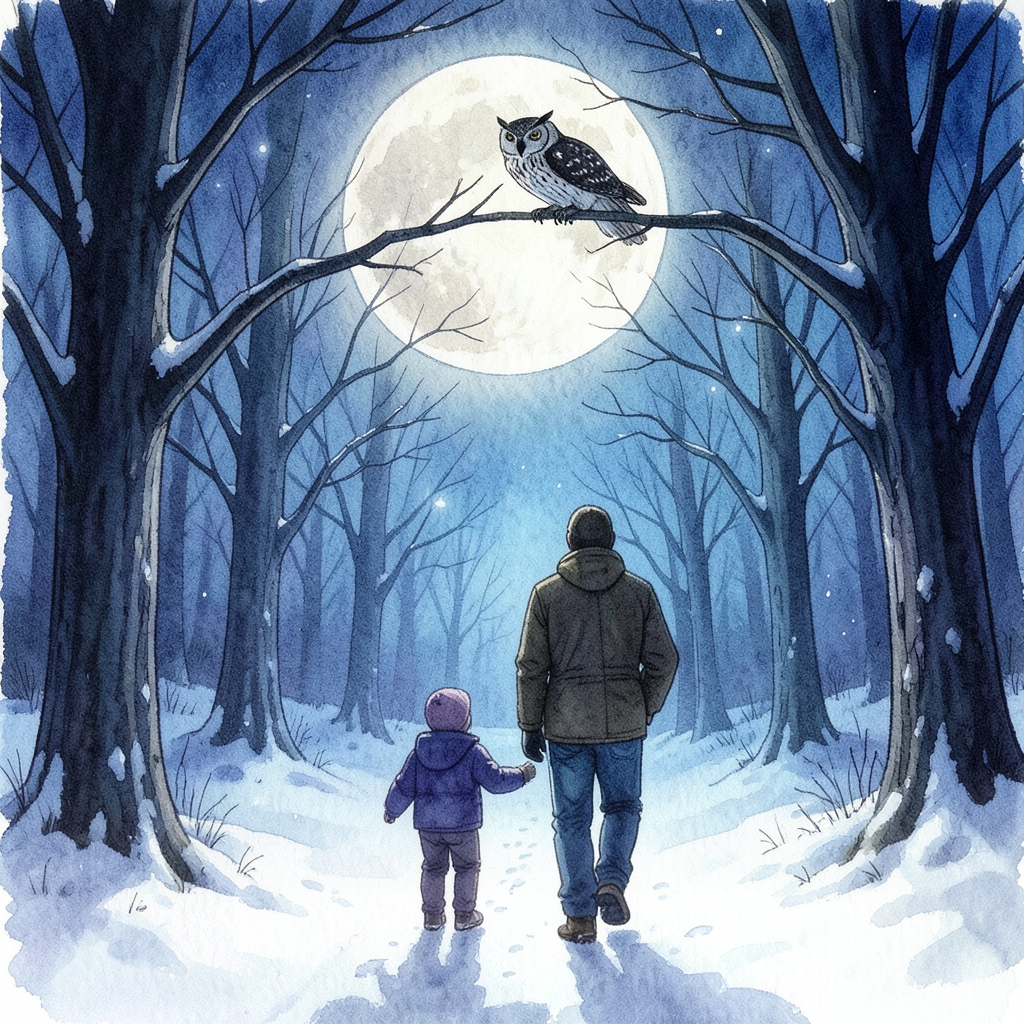
On a cold winter night, a young child and her father trek through moonlit woods to go owling. The Caldecott-winning watercolor illustrations capture the hushed beauty of the snowy landscape as they walk in silence, call for the owl, and share a moment of wonder when it finally appears.
Themes
NatureFamilyPatience
Best For
- Bedtime reading on cold winter evenings when a calm, peaceful story is needed
- Children who love animals and the outdoors, especially budding nature enthusiasts
- One-on-one read-alouds between a parent and child that invite quiet conversation afterward
- Introducing poetry and lyrical prose to early readers in an approachable picture-book format
- Families planning a nature walk or outdoor nighttime activity who want a literary companion to the experience
Why Parents Love This Book
Owl Moon is a quiet masterpiece that earns its place on every family's shelf. Jane Yolen's spare, lyrical prose mirrors the hush of a winter night in the woods — sentences that breathe slowly, giving children room to feel the cold and the wonder alongside the narrator. The story captures something rare: a child trusted to match an adult's pace, to hold still, to wait without complaint, and to be rewarded for it. John Schoenherr's luminous watercolors do the heavy lifting emotionally, washing each page in silver moonlight and deep blue shadow until the great horned owl finally appears in a blaze of gold. There is no villain, no conflict, no lesson hammered home — only a father-daughter walk and the mutual gift of a shared moment. That restraint is precisely what makes it timeless. Owl Moon teaches children that wonder is available to anyone willing to go looking quietly enough.
Reading Tips for Parents
Read this one slowly and deliberately — the text itself invites it. Pause on each spread so children can study Schoenherr's illustrations before you turn the page. The story works beautifully as a winter bedtime book because its mood is calm and its ending is peaceful. Before reading, you might tell your child what owling means and let them imagine doing it themselves. After reading, invite them to practice being absolutely quiet for thirty seconds — the same silence the characters hold. If you have the opportunity to step outside on a cold, clear night and look up together, even in a backyard or neighborhood, the connection to the book becomes unforgettable. The poetic language includes some challenging vocabulary ("feathery soft," "great horned owl") that rewards a second or third reading.
Awards & Recognition
- Caldecott Medal, 1988 (awarded to illustrator John Schoenherr)
- ALA Notable Children's Book
Educational Value
This book helps children develop skills across multiple areas:
- Vocabulary: Introduces poetic and descriptive language such as 'shadow,' 'echo,' 'whispery,' and 'fe-a-ther-y soft,' expanding a child's expressive word bank.
- Science/Nature: Introduces the concept of nocturnal animals and specifically the great horned owl, sparking curiosity about wildlife and the natural world at night.
- Social-emotional: Models patience, quiet persistence, and delayed gratification — the child waits without complaint through cold and silence to share a moment of wonder.
- Visual literacy: Schoenherr's watercolor illustrations reward close looking; children learn to read mood, season, and emotion through color, light, and shadow rather than text alone.
- Family connection: Centers a child who is fully seen and trusted by a parent, providing a springboard for conversations about special one-on-one experiences with family members.
- Listening and fluency: The slow, rhythmic prose is ideal for read-aloud expression, helping children develop an ear for pacing, pause, and the music of written language.
Discussion Questions
Use these questions to spark conversation before, during, or after reading:
- Why do you think Pa and the child had to be so quiet when they were owling? What would have happened if they talked or made noise?
- How do you think the child felt when the owl finally appeared? Can you describe a time you waited patiently for something and then it happened?
- The child says you have to bring your own hope when you go owling. What do you think that means?
- Look at the pictures — how does John Schoenherr show that it is very cold outside without using words?
- If you could go owling with someone in your family, who would you choose and what would you hope to see?
Content Notes for Parents
No content concerns. The story is gentle, quiet, and entirely reassuring — there are no scary moments, no danger, and the owl's appearance is a source of joy rather than fright. Fully appropriate for all children within and below the target age range.
Frequently Asked Questions
What age is Owl Moon best for?
The book is ideal for children ages 4 through 7. The story is simple enough for a curious four-year-old to follow, but the poetic language and emotional depth reward repeated readings well into early elementary years. Younger children (ages 2-3) may enjoy the illustrations even if the text is slightly advanced.
Is this book too slow or quiet for energetic kids?
It can be, depending on the child. Owl Moon rewards a calm reading environment — it works best as a wind-down book rather than a high-energy storytime pick. That said, many children are genuinely captivated by the owl reveal and the father-daughter dynamic. If your child tends to need action, try pairing it with an active nature walk earlier in the day to build context and buy-in.
Are there any scary parts? My child is nervous about the dark and animals.
There is nothing scary in this book. The woods at night are portrayed as quiet and beautiful rather than threatening, and the owl's appearance is a moment of pure magic. The child narrator is never afraid, which models a calm and curious relationship with the natural world. It is an exceptionally gentle book.
What books are similar to Owl Moon?
Families who love Owl Moon often enjoy 'The Snowy Day' by Ezra Jack Keats for its quiet winter wonder, 'Over and Under the Snow' by Kate Messner for nature-focused outdoor adventure, and 'In the Forest' by Marie Hall Ets for its similarly hushed, child-in-nature mood. For more Jane Yolen, 'Letting Swift River Go' and 'Welcome to the Green House' share her gift for lyrical environmental storytelling.
Does this book work for classroom use?
Yes, it is a staple in K-2 classrooms. Teachers use it for lessons on sensory language and descriptive writing, as a mentor text for personal narrative, and as a springboard for science units on nocturnal animals and owls. The Caldecott-winning illustrations also make it a strong choice for art or visual literacy discussions.