Sam and Dave Dig a Hole
About This Book
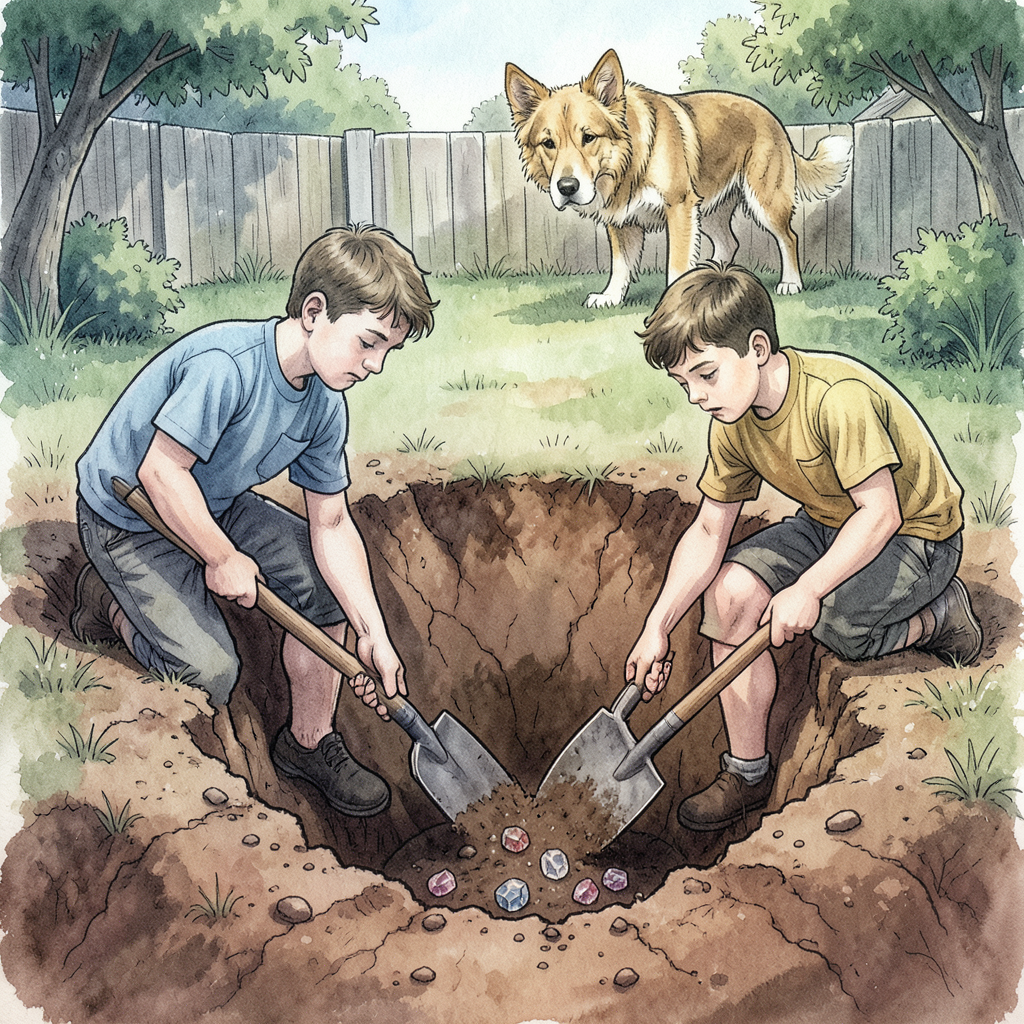
Sam and Dave dig a hole because they are going to find something spectacular. They dig and dig and dig — just missing gem after buried gem by inches as attentive readers track their impossible near-misses. Mac Barnett and Jon Klassen's Caldecott Honor collaboration is a masterclass in visual storytelling, deadpan humour, and the rewards of close attention.
Themes
PersistenceHumourAdventure
Best For
- Repeated bedtime reading, since children discover new visual details with every pass through the book
- Classrooms or read-alouds where a teacher wants to spark discussion about what illustrations add to a story
- Children who love humor and satisfying surprises
- Families who enjoy ambiguous, open-ended stories that spark genuine conversation
- Young readers being introduced to how pictures and words can tell different parts of the same story
Why Parents Love This Book
Sam and Dave Dig a Hole is a picture book that rewards readers who pay close attention — and that is precisely what makes it so remarkable. Mac Barnett's text is deliberately spare: two boys announce they will dig until they find something spectacular, and then they dig. The real magic happens in Jon Klassen's illustrations, where readers can see enormous diamonds, rubies, and gems sitting just beyond the tip of the boys' shovels — always narrowly missed. The gap between what the characters know and what readers see creates a gentle, repeated dramatic irony that delights children and adults alike. The ending, which loops back in a quietly surreal way, rewards rereading and generates genuine conversation about what actually happened. This is also one of the best examples available of how much a picture book's images can tell a story independently of the words. Klassen's deadpan visual humor and Barnett's perfectly measured restraint make this a book children return to again and again, finding something new each time.
Reading Tips for Parents
On first read, let your child lead. Resist the urge to point out the gems hiding in the illustrations — the joy of discovery is much greater when children spot them on their own. After reading, go back through the pages slowly and ask your child to look at what Sam and Dave almost found. The book's ending tends to puzzle children in a satisfying way; it is fine to sit with the uncertainty rather than explain it away. For a second or third reading, let your child be the narrator who "knows more than the diggers." This naturally builds perspective-taking skills. The dog, who appears on almost every page and whose behavior shifts subtly near the end, is worth tracking separately as a point of discussion.
Awards & Recognition
- Caldecott Honor Book (2015)
- New York Times Best Illustrated Children's Book (2014)
Educational Value
This book helps children develop skills across multiple areas:
- Visual literacy: Children practice reading illustrations independently of the text, noticing details the characters themselves miss — a foundational skill for critical thinking.
- Narrative perspective: The book introduces the concept of dramatic irony in an age-appropriate way, helping children understand that readers can know more than characters do.
- Persistence and resilience: Sam and Dave model sticking with a goal even when results are not immediate, opening conversations about effort and patience.
- Spatial reasoning: Tracking the boys' path underground and the location of the gems relative to their digging builds informal geometry and spatial awareness.
- Inference and prediction: Children are encouraged to predict what will happen next based on visual clues, strengthening comprehension skills.
- Humor and tone: The book's deadpan style introduces children to understatement as a form of comedy, expanding their understanding of how humor works in storytelling.
Discussion Questions
Use these questions to spark conversation before, during, or after reading:
- Why do you think Sam and Dave keep missing the gems? Was it bad luck, or something else?
- Did you notice anything in the pictures that Sam and Dave could not see? What was it?
- What do you think happened at the very end of the story? Where did they end up?
- Have you ever worked really hard at something and still not found what you were looking for? How did that feel?
- What would you do if you were digging and found something spectacular?
Content Notes for Parents
There are no scary, violent, or emotionally distressing elements in this book. The ambiguous ending may briefly puzzle very young children, but this is gently handled and most children find it intriguing rather than upsetting.
Frequently Asked Questions
What age is this book best suited for?
Sam and Dave Dig a Hole works well for children ages 4 through 7, which aligns with the picture book read-aloud stage. Younger children enjoy the repetition and the dog, while older children in the 6-7 range are more likely to catch the visual irony and engage with the puzzling ending. Many adults find it genuinely clever as well, making it an easy book for parents to read together with children multiple times without fatigue.
Is the ending confusing for kids? Should I explain it?
The ending is intentionally ambiguous — the boys seem to have looped back to where they started, but with subtle differences. Most children ages 5 and up handle this well and find it fun to puzzle over rather than distressing. Rather than explaining it, try asking your child what they think happened. There is no single correct answer, and that is part of the point of the book.
Are there any content concerns I should know about before reading this to my child?
There are no content concerns. The book contains no violence, scary imagery, or mature themes. It is a gentle, funny story about two determined children and their dog digging a very deep hole.
My child loves this book — what should we read next?
Jon Klassen's other picture books are natural next choices, particularly I Want My Hat Back and This Is Not My Hat, which share the same dry humor and visual storytelling style. Mac Barnett's collaboration with Klassen on the Triangle series (Triangle, Square, Circle) is also well-matched. Extra Yarn by Mac Barnett with Jon Klassen is another strong option for children who enjoyed this one.
Is this book good for classroom use?
Yes, it is an excellent classroom read-aloud for pre-K through second grade. The book is particularly effective for lessons on visual literacy and how illustrations carry meaning beyond the text. It also works well as a starting point for discussions about persistence. The short text and high visual detail make it manageable for group reading and follow-up activities.