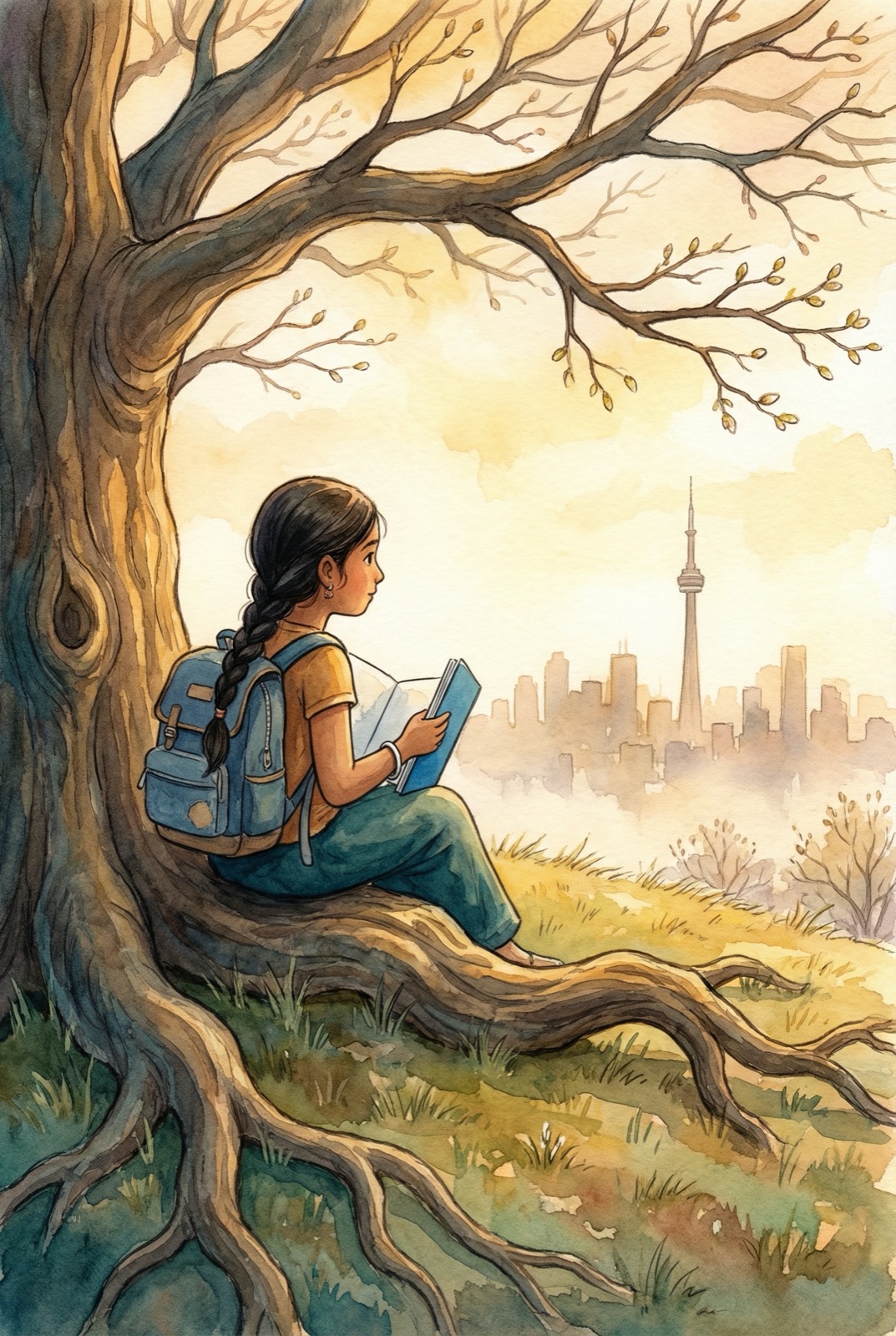
Simran Kaur and the Lost Sketchbook
About This Book
During a class trip to High Park in Toronto, six-year-old Simran Kaur discovers a lost sketchbook on a park bench. Using the clues within the beautiful drawings, she sets off on a mission to reunite the sketchbook with its creator. Along the way, Simran learns that paying attention to small details and helping others can lead to the most rewarding adventures. The story features discussion questions for families and a glossary of Punjabi words.
Themes
KindnessAdventureHelpfulness
Best For
- Children who love art, drawing, or sketchbooks and will delight in a protagonist who values creativity
- Classroom read-alouds focused on community helpers, kindness, or empathy units
- Families looking for diverse picture books with South Asian protagonists and authentic cultural detail
- Young readers who enjoy mystery and problem-solving in an age-appropriate, low-stakes format
- School or library programs exploring Canadian settings and multicultural urban life
Why Parents Love This Book
Simran Kaur and the Lost Sketchbook turns a simple act of finding something on a park bench into a full-blown detective adventure — the kind that reminds young readers that ordinary days can hold extraordinary moments. What sets this book apart is its clever structure: Simran uses the drawings inside the sketchbook as clues, which makes art appreciation feel genuinely exciting rather than instructional. Set against the real backdrop of High Park in Toronto, the story gives children a grounded, recognizable urban world to step into. Simran herself is a wonderfully active protagonist — curious, careful, and motivated by genuine empathy for a stranger she has never met. The inclusion of Punjabi vocabulary woven naturally into the narrative adds cultural texture without ever feeling forced, and the built-in discussion questions make this book as useful for classrooms as it is for bedtime. For any child who has ever wanted to solve a mystery or help someone they didn't know, Simran's adventure feels personal and inspiring.
Reading Tips for Parents
Before reading, ask your child if they have ever found something that belonged to someone else and what they did. This primes them to connect emotionally with Simran's dilemma. As you read, pause at the pages where Simran examines the sketchbook drawings and ask your child what clues they notice — this builds close-looking habits that transfer to both reading and visual art. The Punjabi glossary at the back is worth exploring together after the first read-through; make it a game to use one or two of the words in conversation during the week. The book's discussion questions are ready-made for a second read, making it an ideal two-session book for early readers who benefit from revisiting a text. Children aged five to seven can handle the story independently aloud but will get the most from it read together.
Awards & Recognition
- No major awards on record for this title
- Published 2024 — award eligibility cycle ongoing
Educational Value
This book helps children develop skills across multiple areas:
- Critical Thinking: Simran reads visual clues in the sketchbook to solve a real problem, modeling inference and deductive reasoning for early readers.
- Social-Emotional Learning: The entire plot is driven by empathy — Simran inconveniences herself to help a stranger, opening rich conversations about kindness and what it means to do the right thing.
- Cultural Awareness: Punjabi words are woven into the text with a glossary, giving all children exposure to South Asian language and culture in a natural, non-tokenizing way.
- Visual Literacy: Because the sketchbook drawings are central plot devices, children practice interpreting images for meaning — a skill increasingly recognized as foundational to literacy.
- Geography and Community: The High Park, Toronto setting grounds the story in a real Canadian landscape, sparking curiosity about local parks, nature, and urban community life.
- Vocabulary: The narrative introduces descriptive art and nature language alongside Punjabi terms, expanding children's expressive vocabulary in two registers.
Discussion Questions
Use these questions to spark conversation before, during, or after reading:
- Why do you think Simran decided to find the owner of the sketchbook instead of keeping it or leaving it where she found it?
- What clues did Simran find inside the sketchbook, and how did she figure out what they meant?
- Have you ever lost something that was really important to you? How did it feel? How do you think the sketchbook's owner felt?
- If you had your own sketchbook, what would you draw in it that would tell someone about who you are?
- What does this story tell us about paying attention to small details? Can you think of a time when noticing something small made a big difference?
Content Notes for Parents
There are no scary, violent, or mature elements in this book. The only mild tension is the uncertainty of whether Simran will find the sketchbook's owner, which resolves happily — making it a worry-free read for sensitive children.
Frequently Asked Questions
What age is this book best suited for?
The book is written for ages 4 to 7, with a beginning reader level. Younger children in the 4-5 range will enjoy it as a read-aloud, while confident readers aged 6-7 can tackle it more independently. The discussion questions and Punjabi glossary make it rich enough for repeat readings as children grow.
Do children need to know anything about Punjabi or Sikh culture to enjoy the story?
Not at all. The story stands completely on its own as an adventure about kindness and problem-solving. Punjabi words are introduced naturally and explained in the glossary, so the book actually serves as a gentle, welcoming introduction to the culture for children who have no prior familiarity.
Is this book good for the classroom?
Yes — it was clearly designed with group use in mind. The discussion questions at the back map directly onto common early childhood learning goals around empathy, observation, and community. Teachers covering themes of helpfulness, diversity, or local geography will find it immediately useful.
Are there any content concerns I should know about before reading with my child?
There are no content concerns. The book contains no frightening imagery, no sad endings, and no mature themes. The only dramatic tension is mild suspense about whether Simran will successfully return the sketchbook, which resolves positively.
What books are similar to this one if my child loves it?
Children who enjoy this book tend to respond well to other mystery-adjacent picture books with empathetic protagonists, such as The Invisible String for its kindness theme, or books in the Nate the Great early reader series for the clue-following structure. For more South Asian-authored picture books with girl protagonists, Asha's Blessings and I Am Malala (picture book edition) offer different but complementary representations.