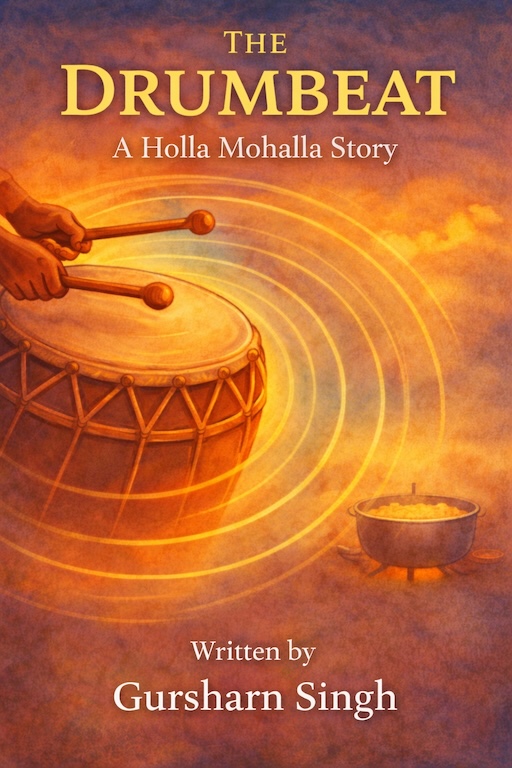
The Drumbeat: A Holla Mohalla Story
About This Book
When a diaspora girl visits Anandpur Sahib for her very first Holla Mohalla, the thundering nagaras shake the ground beneath her feet and send her running — until an elder explains that these are not drums of war but the heartbeat of the Khalsa. A story about courage, community, and discovering your roots in the noise and colour of a living tradition.
Themes
Sikh TraditionsCommunityHeritage
Best For
- Families of Sikh heritage preparing to attend Holla Mohalla or a gurdwara celebration for the first time
- Classrooms and libraries building South Asian or Sikh representation in their multicultural collections
- Children who are sensitive or anxious in loud, crowded environments and benefit from stories that normalize that experience
- Grandparents or elders sharing cultural heritage with grandchildren who grew up outside their home country
- Beginning readers ages 4-7 who are ready for slightly longer picture book narratives with meaningful vocabulary
Why Parents Love This Book
The Drumbeat: A Holla Mohalla Story earns its place in any multicultural picture book collection by centering a moment almost never depicted in children's literature: a young diaspora child encountering the nagaras — the enormous battle drums — of Holla Mohalla for the first time and feeling genuine fear. That honesty is rare and disarming. Rather than presenting heritage as something a child should automatically embrace, the story acknowledges the overwhelm a diaspora child can feel standing inside a living tradition that is loud, physical, and unfamiliar. The turn comes not through magic but through the patient words of an elder, who reframes the thunder as a heartbeat rather than a threat. That single image — the drumbeat as the heartbeat of the Khalsa — is genuinely poetic and gives children a way to hold something huge inside something intimate. The book also does cultural work quietly: Anandpur Sahib, Holla Mohalla, and the Khalsa are introduced naturally through the story rather than through a glossary insert, which keeps the reading experience warm and immersive rather than instructional.
Reading Tips for Parents
Before reading, look up a short video clip of Holla Mohalla nagara drums so children can hear the actual sound — this transforms the opening scene from abstract to visceral and gives your child a reference point for the girl's fear. As you read, pause after the elder speaks and ask your child to put the explanation in their own words: what does it mean for a drum to be a heartbeat? If your family attends a Sikh festival or gurdwara, connect the story explicitly to that experience. For children who have never attended Holla Mohalla, the book naturally opens a conversation about diaspora identity — the feeling of belonging to something you are still getting to know. Keep a bookmark in the back for re-reads after any live cultural event; the book lands differently once children have felt a crowd around them.
Awards & Recognition
- No major awards have been verified for this 2024 title at this time.
- Not yet listed on major award shortlists; check publisher updates for future recognition.
Educational Value
This book helps children develop skills across multiple areas:
- Cultural literacy: Introduces Holla Mohalla, Anandpur Sahib, nagaras, and the Khalsa in context, building genuine familiarity with a living Sikh tradition rather than surface-level exposure.
- Social-emotional learning: Models that fear of the unfamiliar is valid and normal, and that curiosity and community support can transform anxiety into belonging.
- Vocabulary: Naturally embeds words like nagaras, Khalsa, and Holla Mohalla, giving beginning readers meaningful new language anchored to a vivid story experience.
- Intergenerational relationships: Centers an elder as a trustworthy guide, reinforcing the value of listening to older family and community members.
- Diaspora identity: Gives children of immigrant or diaspora backgrounds a mirror for the specific experience of encountering ancestral heritage as something both familiar and foreign.
- Oral tradition and storytelling: The elder's explanation models how cultural meaning is passed down through story and metaphor rather than facts alone.
Discussion Questions
Use these questions to spark conversation before, during, or after reading:
- Why do you think the girl ran away when she heard the nagaras? Have you ever felt scared by something that turned out to be okay?
- What did the elder say that changed the way the girl felt about the drums? Can you explain it in your own words?
- The elder said the drumbeat is the heartbeat of the Khalsa. What do you think that means? Why might someone choose that image?
- Have you ever visited a place that felt unfamiliar or overwhelming at first? What helped you feel more comfortable?
- If you were going to Holla Mohalla for the first time, what would you most want to see, hear, or taste?
Content Notes for Parents
The opening scenes depicting a child's frightened reaction to loud nagara drums may momentarily unsettle very sensitive young readers, but the fear is quickly resolved in a warm and reassuring way. There are no scary, sad, or mature elements of concern.
Frequently Asked Questions
What age is this book best suited for?
The publisher targets ages 4 to 7, which aligns well with the story's emotional and vocabulary level. Confident readers at the lower end of that range will handle it comfortably, and the themes of belonging and courage resonate strongly with kindergarten and first-grade classrooms. Older children up to age 9 who are curious about Sikh heritage will also find it engaging.
Do we need to be Sikh to enjoy this book?
Not at all. The story works as a universal picture book about a child overcoming fear of the unfamiliar with help from a wise elder. Non-Sikh families will find it an excellent window into a vibrant cultural tradition, and it pairs naturally with any unit on world cultures, community celebrations, or intergenerational relationships.
Will the loud drums depicted in the story frighten my child?
The girl in the story does run away when she first hears the nagaras, so the book acknowledges that the drums are overwhelming. However, the resolution is warm and reassuring, and the fear is handled gently. For very noise-sensitive children, framing the book as a story about a girl who felt exactly what they might feel — and found her way through — can make it feel supportive rather than alarming.
What is Holla Mohalla, and how do I explain it to my child?
Holla Mohalla is an annual Sikh festival held at Anandpur Sahib in Punjab, established by Guru Gobind Singh Ji. It features martial arts displays, music, and community gatherings, and the nagara drums are central to the event. The book itself provides a gentle introduction, but a short video clip of the festival searched online before reading will help bring the story to life for children who have never attended.
Are there other books like this one for Sikh children or children interested in Sikh culture?
There is a growing body of Sikh-themed picture books, including other titles from Maastarji focused on Sikh values and history. For families wanting to build a fuller shelf, look for books that cover Sikh festivals, the lives of the Gurus, and diaspora identity themes. Librarians in cities with large Punjabi communities can also be excellent resources for curated recommendations.