The Invention of Hugo Cabret
About This Book
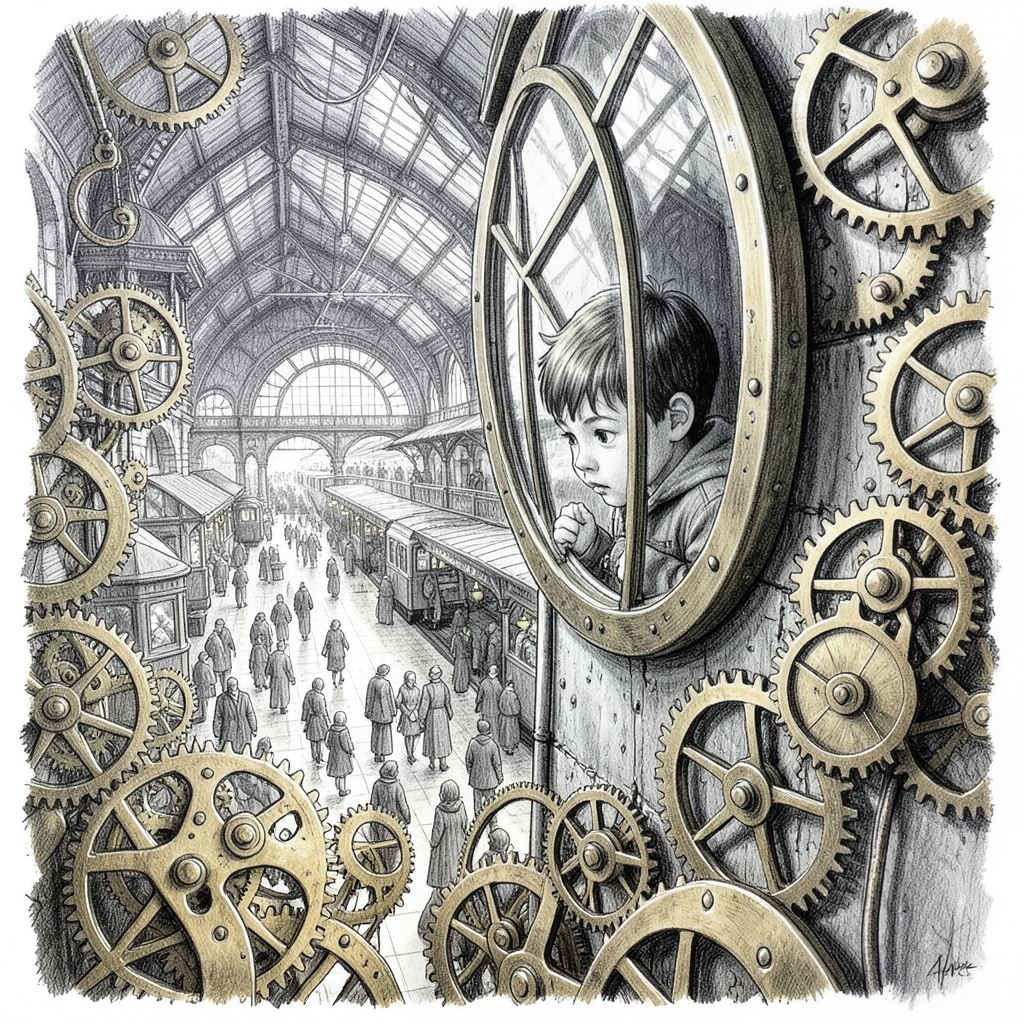
Hugo Cabret lives secretly in the walls of a Paris railway station, tending the clocks and obsessively trying to repair an automaton his father found. His search leads him to the forgotten genius Georges Méliès and the magical early history of cinema. Brian Selznick's extraordinary novel is half told in words and half in detailed pencil drawings — a book that reinvented what a book can be. Caldecott Medal winner.
Themes
MysteryHistory of CinemaBelonging
Best For
- Kids aged 9-12 who love mysteries and want something genuinely different from a standard novel
- Reluctant readers who respond better to visual storytelling — the illustration sequences keep momentum even when prose feels slow
- Children with an interest in history, film, machines, or art who want a story that takes those interests seriously
- Family read-alouds where adults and children can discuss the illustrations together as they move through the book
- A bridge book for children transitioning from heavily illustrated middle grade to longer prose-driven fiction
Why Parents Love This Book
The Invention of Hugo Cabret is one of those rare books that changes what readers think a book can be. Brian Selznick tells Hugo's story through nearly 300 pages of intricate pencil illustrations that work not as decoration but as sequential narrative — wordless sequences where you turn pages like film frames, watching scenes unfold. The result feels genuinely cinematic, which is fitting given the story's heart: the forgotten legacy of Georges Melies, one of cinema's true founding magicians. Hugo himself is a wonderfully drawn protagonist — resourceful, grieving, determined — and his obsession with repairing the automaton his late father found gives the mystery urgent emotional stakes. The Paris train station setting is rendered with atmospheric detail, and the book's reverence for mechanical ingenuity and artistic vision makes it quietly inspiring. This is a book about fixing broken things, about belonging, and about the way art preserves human beings across time. Children and adults frequently finish it and immediately want to talk about it.
Reading Tips for Parents
Plan to experience this book slowly — the illustration sequences genuinely require time and attention, and rushing past them means missing half the story. Encourage your child to treat the wordless picture sections as active reading rather than skipping ahead to text. The book's length (533 pages) is deceptive; the illustrations make it move faster than a traditional novel of that size. Some children between ages 8 and 10 may need support with the historical context around early cinema and Georges Melies. Consider pausing to watch a short Melies film clip together — Trip to the Moon (1902) is freely available online and brings the book's world to life immediately. The story deals with loss and orphanhood, so be ready for brief but meaningful conversations about grief. The ending is satisfying and hopeful.
Awards & Recognition
- Caldecott Medal (2008)
- New York Times Bestseller
Educational Value
This book helps children develop skills across multiple areas:
- Visual literacy: Extended wordless illustration sequences train readers to extract narrative meaning from images, a skill directly applicable to film, graphic novels, and visual media.
- History: The book introduces Georges Melies and the genuine early history of cinema, sparking curiosity about the origins of film as an art form.
- Social-emotional learning: Hugo's experience of grief, orphanhood, and the longing for belonging gives readers language and context for processing loss and the need for community.
- Vocabulary: Rich descriptive prose and period-appropriate terminology (automaton, mechanism, cinema, illusion) expand vocabulary in meaningful context.
- Engineering and mechanics: Hugo's work repairing clocks and the automaton offers an entry point to discussions about how machines work and the problem-solving mindset of tinkerers and inventors.
- Media literacy: The book's hybrid format — part prose novel, part illustrated narrative — naturally raises questions about how storytelling choices shape a reader's experience.
Discussion Questions
Use these questions to spark conversation before, during, or after reading:
- Hugo spends a lot of energy hiding and staying invisible in the train station. Why do you think he works so hard to stay hidden, and what does he risk if he is found?
- The automaton is very important to Hugo — almost like a message from his father. If someone you loved left you something unfinished, how would you decide what to do with it?
- Georges Melies is a real person from history who appears in this story. Why do you think Brian Selznick chose to mix real history with a fictional character like Hugo?
- The illustrations in this book tell parts of the story without any words at all. Did you find it easy or hard to understand what was happening in those sections? What did the pictures show that words might not?
- By the end of the book, multiple characters have found a place where they belong. Think about Hugo and Isabelle — how has each of them changed from the beginning?
Content Notes for Parents
Hugo is an orphan living in secret after his father's death, and there are moderately sad scenes involving loss and danger of being sent to an orphanage; nothing graphic or frightening, but sensitive children may find the orphanhood theme emotionally heavy. No violence, mature language, or inappropriate content.
Frequently Asked Questions
What age is this book really right for?
The publisher targets ages 8-12, and that range holds up well. Most 9 and 10 year olds hit the sweet spot — old enough to follow the historical content and sustain attention across a long book, young enough to find the mystery genuinely suspenseful. Strong readers at 8 can absolutely handle it, and many 12 year olds still find it completely engrossing.
My child is intimidated by the 533-page length. Should I be?
The page count is the single most misleading thing about this book. Roughly half those pages are full-page or double-page pencil illustrations with no text at all. Most readers move through it much faster than a traditional novel of similar thickness. A motivated 10-year-old can finish it in a few sittings.
Are there any content concerns I should know about before giving this to my child?
The main emotional content is orphanhood and loss — Hugo's father has died and he lives in fear of being caught and institutionalized. These themes are handled with care and are age-appropriate, but sensitive children may want a parent nearby for conversation. There is no violence, no scary content, and no mature themes.
Is this related to the movie Hugo?
Yes — Martin Scorsese adapted this book into the 2011 film Hugo, which won five Academy Awards. Many families enjoy reading the book first and then watching the film together as a comparison project. The film is rated PG and is generally appropriate for the same age range as the book.
What books should my child read next if they loved this one?
Brian Selznick wrote two follow-up books in a similar hybrid format: Wonderstruck and The Marvels, both worth exploring immediately. For more historical mystery, From the Mixed-Up Files of Mrs. Basil E. Frankweiler by E.L. Konigsburg shares the same spirit of children navigating adult worlds through ingenuity. Raina Telgemeier's graphic novels appeal to readers who discovered a love of visual storytelling through Hugo.