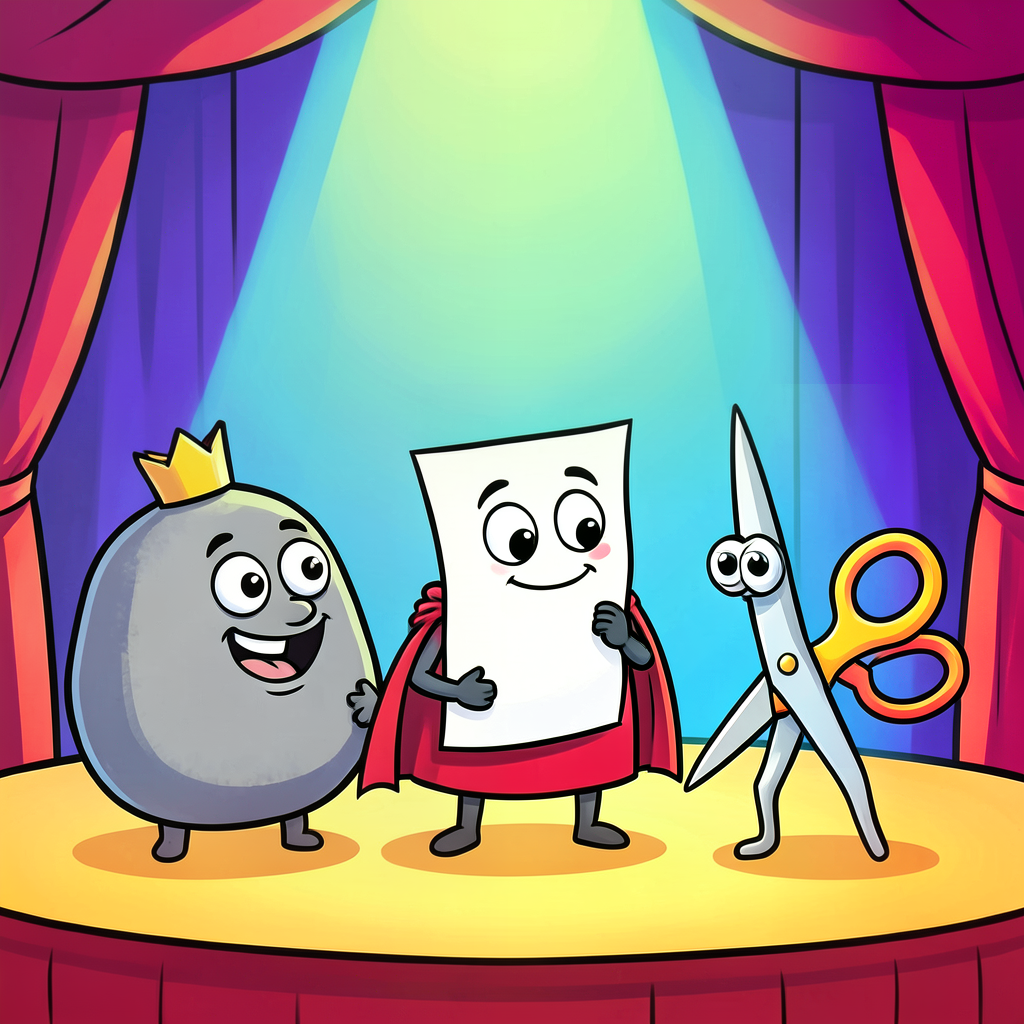
The Legend of Rock Paper Scissors
About This Book
Long ago, in the Kingdom of Backyard, a great warrior named Rock sought a worthy opponent. He found Scissors in the Land of the Junk Drawer and Paper in the Empire of the Office, and together they forged the greatest game in history. Drew Daywalt's gloriously over-the-top origin story and Adam Rex's epic illustrations make this a howlingly funny read-aloud.
Themes
HumourGamesImagination
Best For
- Read-aloud sessions where parents want a book that makes them laugh too
- Children ages 5-7 who already know how to play rock-paper-scissors
- Rainy-day reading followed by a tournament of the actual game
- Kids who love silly humor and over-the-top dramatic storytelling
- Classrooms and libraries looking for a high-engagement, crowd-pleasing read-aloud
Why Parents Love This Book
The Legend of Rock Paper Scissors takes something every child already knows — the classic hand game — and spins it into a gloriously absurd origin myth that feels both ancient and ridiculous at exactly the right moments. Drew Daywalt, who perfected the art of giving inanimate objects dramatic inner lives in The Day the Crayons Quit, does it again here with Rock, Scissors, and Paper as warrior heroes on epic quests for a worthy opponent. Adam Rex's illustrations go all in on the over-the-top fantasy aesthetic: full-bleed battle scenes, dramatic lighting, and expressions that sell every ridiculous moment. What makes this book truly special is how it rewards the adults reading aloud just as much as the kids listening. The mock-heroic language is funny on multiple levels, the pacing builds brilliantly toward the payoff, and the final reveal — that these legendary warriors become a simple children's game — lands with perfect comedic timing. It is a book that gets better every time you read it.
Reading Tips for Parents
This book is built for reading aloud, so lean into it. Use a deep, dramatic narrator voice for the epic battle sequences and then deflate it completely for the absurd moments — your child will love the contrast. Pause before the final reveal to let them guess what the three warriors are about to become. After reading, play a few rounds of rock-paper-scissors together and ask which warrior they think would win in real life. The vocabulary is deliberately overwrought (words like "vanquished" and "worthy opponent"), so slow down on those words and act them out rather than just defining them. For children who are already familiar with the game, the joke lands faster — if your child has not played rock-paper-scissors yet, teach them the game first so the ending hits the way it should.
Awards & Recognition
- New York Times Bestseller
- Amazon Best Book of the Year 2017 (Children's category)
Educational Value
This book helps children develop skills across multiple areas:
- Vocabulary: Introduces mock-heroic language like 'vanquished,' 'worthy opponent,' and 'forge a legend,' building a rich descriptive word bank in a memorable context.
- Narrative structure: The three-part quest format (Rock, then Scissors, then Paper each getting their own chapter) teaches children how stories can be structured with parallel episodes.
- Game literacy and rules: Reinforces how rock-paper-scissors works, including which element beats which, through repeated story logic.
- Humor and irony: The gap between the epic, serious tone and the silly subject matter is a gentle introduction to irony and comedic deflation.
- Social-emotional: Explores the desire for a fair and worthy opponent, touching on themes of sportsmanship and the joy of a well-matched game.
- Imaginative play: Models how ordinary objects and games can become the basis for elaborate creative storytelling.
Discussion Questions
Use these questions to spark conversation before, during, or after reading:
- Why do you think Rock, Scissors, and Paper each wanted to find a worthy opponent? What does it feel like when you want someone to play with?
- The book tells the story like an ancient legend. What clues in the words or pictures made it sound like an important, serious story?
- Were you surprised by the ending? When did you figure out what the three warriors were?
- If you were going to write a legend about where another game came from — like tag or hide-and-seek — what would the story be?
- Rock, Scissors, and Paper each came from a different kingdom. What do you think their kingdoms looked like when they weren't having battles?
Content Notes for Parents
There are no scary, sad, or mature elements in this book. The battle scenes are entirely comic and cartoonish, with no actual harm depicted — this is purely slapstick fantasy humor appropriate for the full 4-7 age range.
Frequently Asked Questions
What age is this book really best for?
The book is listed for ages 4-7, but the humor lands most fully around ages 5-7, when children already know how to play rock-paper-scissors and can appreciate the joke. Four-year-olds will enjoy the pictures and the dramatic read-aloud energy even if the irony goes over their heads. The book also genuinely works for older kids up to about age 9 who enjoy absurdist humor.
Is the battle content too intense for sensitive kids?
Not at all. The battles are played entirely for laughs — think slapstick cartoon logic rather than anything scary or violent. Adam Rex's illustrations keep everything visually fun and over-the-top rather than threatening. Children who are sensitive to conflict or loud action scenes should be completely fine with this book.
Do I need to teach my child rock-paper-scissors before reading this?
It helps a lot. The ending is a satisfying reveal that depends on the child recognizing what the three warriors represent. If your child does not know the game yet, spend two minutes teaching them the hand signs and the rules before opening the book — it will make the payoff much more fun.
What other books are similar to this one?
If your child loves this, they will almost certainly enjoy other Drew Daywalt books like The Day the Crayons Quit and The Day the Crayons Came Home, which use the same trick of giving inanimate objects dramatic personalities. For a similar mock-epic picture book tone, try The Bad Guys series (for slightly older readers) or Oge Mora's Thank You, Omu! for a gentler but equally warm read-aloud.
Is this good for a classroom read-aloud?
It is one of the best classroom read-alouds available for kindergarten and first grade. The three-act structure holds group attention, the humor is accessible to the whole class at once, and the ending gives a natural springboard into a quick game of rock-paper-scissors as a group activity. Teachers consistently report that kids ask to hear it again immediately after the first read.