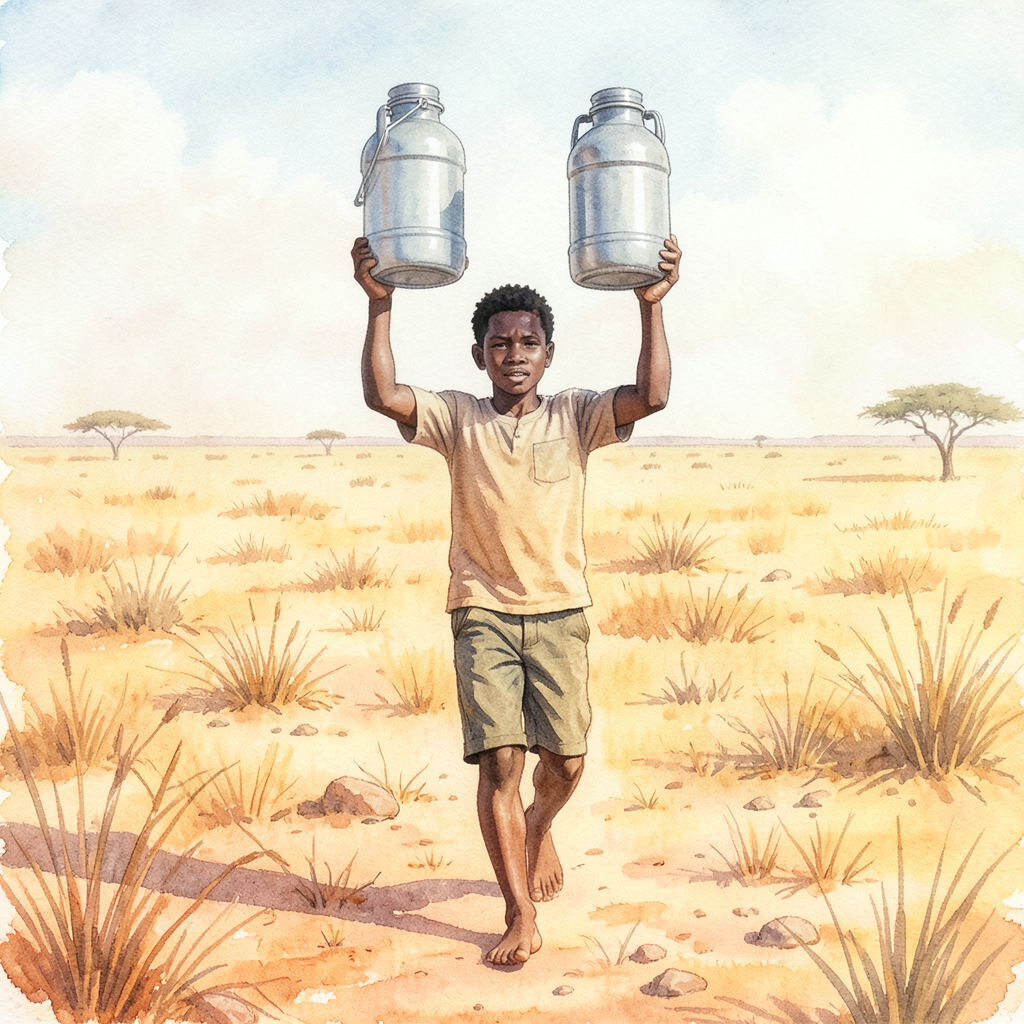
A Long Walk to Water
About This Book
In 1985, eleven-year-old Salva becomes one of Sudan's Lost Boys, walking thousands of miles across multiple countries to survive. In 2008, Nya walks hours each day to reach the only water source near her village. Their two stories converge in this powerful, spare novel based on true events, showing the enduring capacity of one person to transform the lives of thousands.
Themes
SurvivalWaterSudan
Best For
- Middle school classroom read-alouds or literature circle discussions on human rights and global issues
- Children who enjoy short, fast-paced books but are ready for emotionally serious content
- Family read-togethers that want to open a conversation about refugees, water access, or African history
- Young readers inspired by true stories of real people who made a difference
- Social studies or global citizenship units on Sub-Saharan Africa and the water crisis
Why Parents Love This Book
A Long Walk to Water is one of those rare middle grade novels that earns its place on every classroom shelf and home bookcase. Linda Sue Park weaves together two true stories — Salva Dut's harrowing journey as one of Sudan's Lost Boys beginning in 1985, and Nya's daily eight-hour walk for water in 2008 — with a precision and restraint that makes both feel immediate and real. The dual narrative structure is masterfully handled: alternating chapters build quiet tension until readers finally understand how the two lives intersect. Park never sensationalizes suffering; instead, she trusts young readers to sit with difficulty and draw meaning from it. Salva's perseverance in the face of impossible odds — losing family, crossing deserts, surviving refugee camps — is rendered not as spectacle but as ordinary human endurance. The book's brevity (just over 100 pages) makes it accessible, yet every sentence carries weight. It leaves children asking what they themselves might be capable of, and what a single determined person can do for thousands.
Reading Tips for Parents
Read this alongside a map of Sudan, South Sudan, Ethiopia, and Kenya so children can trace Salva's actual route — the geography grounds the story and deepens comprehension. The book is short enough to read aloud together in a week, which allows you to pause after each chapter pair and discuss how Salva's and Nya's experiences connect. Before starting, be prepared to explain the Second Sudanese Civil War at a basic level; a few sentences of context help enormously. After finishing, visit the Water for South Sudan website (the real organization Salva Dut founded) with your child — seeing the project alive and active transforms the ending from hopeful to concrete. Keep tissues nearby for the chapter in which Salva loses his uncle.
Awards & Recognition
- New York Times Bestseller
- Notable Children's Book, American Library Association
- Jane Addams Children's Book Award Honor Book
Educational Value
This book helps children develop skills across multiple areas:
- Geography: Traces a real journey across Sudan, Ethiopia, Kenya, and into the United States, building concrete knowledge of East African regions and refugee migration routes.
- History and Current Events: Introduces the Second Sudanese Civil War, the Lost Boys of Sudan, and the ongoing water crisis in South Sudan in an age-appropriate, human-centered way.
- Social-Emotional Learning: Models resilience, grief, and hope through Salva's experience, giving children language and perspective for processing their own hardships.
- Vocabulary: Sparse, precise prose introduces words like refugee, militia, and perseverance in clear context, supporting academic vocabulary development.
- Literary Analysis: The dual-timeline, alternating-chapter structure is an excellent introduction to narrative craft — students can study how authors build suspense and withhold information strategically.
- Civic Awareness: The real Water for South Sudan project, described in an author's note, shows children that individual action can create systemic change, reinforcing global citizenship.
Discussion Questions
Use these questions to spark conversation before, during, or after reading:
- Why do you think Linda Sue Park tells two separate stories — Salva's and Nya's — instead of just one? What does each story add that the other cannot?
- Salva repeats his uncle's words — 'One step, then another' — during his hardest moments. Has there ever been a time when you had to break a big, scary task into small steps? What helped you keep going?
- Nya walks hours every day just to collect water that is not even clean. How would your daily life change if you had to do that? What would you have to give up?
- Salva loses almost everyone he loves and still goes on to help thousands of people. What do you think gave him the strength to do that instead of giving up?
- At the end, Salva's and Nya's stories come together. Did you guess how before it was revealed? What clues did the author leave?
Content Notes for Parents
The novel depicts war, death (including the death of a beloved adult character), starvation, and the displacement of child refugees; these events are portrayed honestly but without graphic violence, handled with restraint appropriate for ages 8 and up. Parents of sensitive readers may want to preview chapters 7-10, which contain the book's most emotionally intense passages.
Frequently Asked Questions
What age is this book really right for? The subject matter sounds intense.
Most children ages 9-12 handle it well, though emotionally mature 8-year-olds can manage it with a parent reading alongside. The language is simple and the book is short, but the themes — war, death, refugee survival — are genuinely heavy. Reading it together and talking after each chapter makes a significant difference for younger or more sensitive kids.
Is there anything in the book that might be too frightening or upsetting for my child?
Yes, and it is worth knowing in advance. A character Salva loves deeply is killed, and Salva witnesses deaths during his journey. The depictions are not graphic, but they are emotionally direct. The book also portrays hunger, thirst, and displacement in ways that feel very real. These elements are handled with care, but they are not softened away.
How long does it take to read? My child is a reluctant reader.
The novel is just over 100 pages with short chapters — most children finish it in 2-4 sittings. The alternating storylines create natural suspense that tends to pull reluctant readers forward. Its brevity makes it one of the most manageable serious books for this age group.
Are the events in the book real?
Yes. Salva Dut is a real person, and his journey is based on his actual experiences as one of the Lost Boys of Sudan. Nya is a composite character representing the many girls in South Sudan who walk for water daily. The organization Salva founded, Water for South Sudan, is real and ongoing — the author's note at the back explains what has happened since.
What books are similar to this one if my child wants to read more?
For similar themes of survival and displacement, try 'Inside Out and Back Again' by Thanhha Lai (Vietnamese refugee experience, told in verse), 'The Unwanted' by Don Brown (graphic novel about Syrian refugees), or 'Refugee' by Alan Gratz, which is longer and more action-driven but explores three refugee stories across different eras. All are appropriate for ages 8-13.