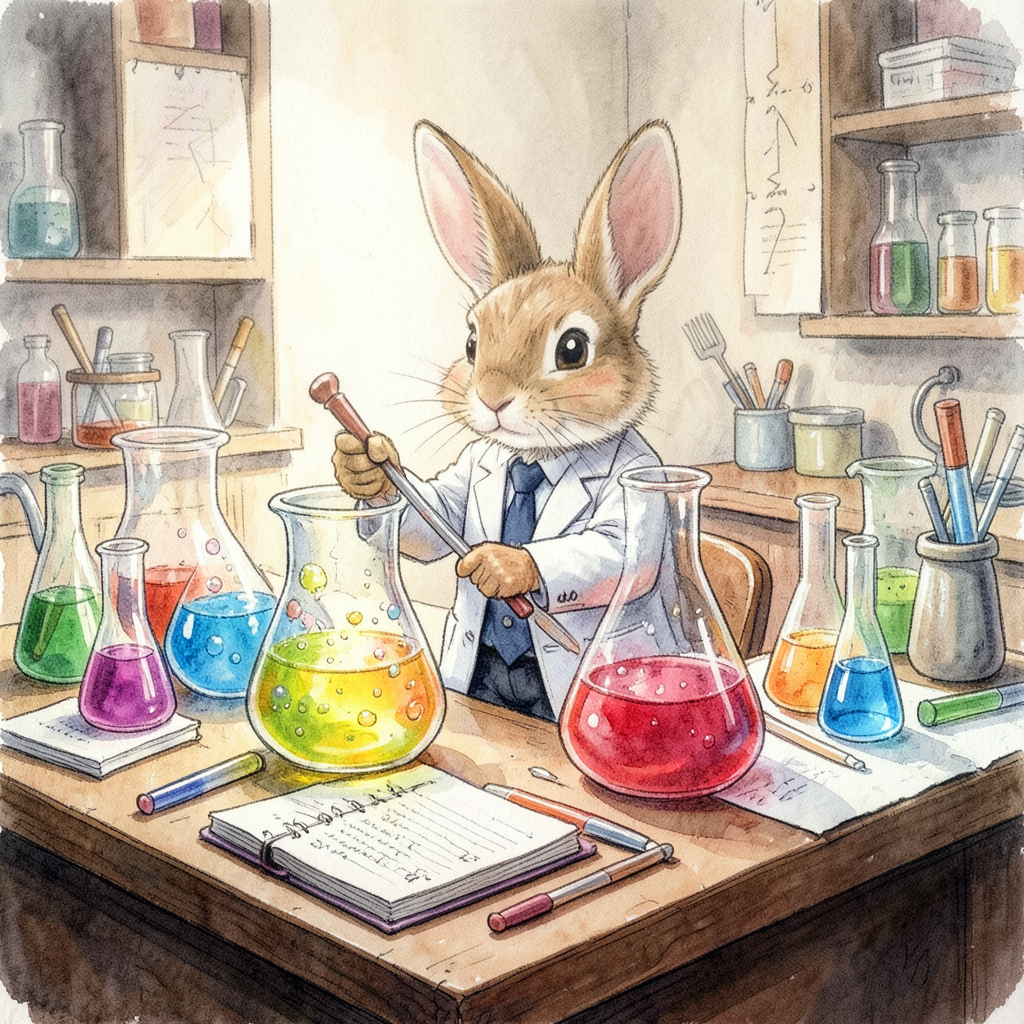
Charlotte the Scientist Is Squished
About This Book
Charlotte is a serious scientist who loves her work, but with hundreds of bunny siblings, she's getting squished. Using the scientific method — question, hypothesis, experiment, and conclusion — Charlotte conducts research to find her own space, with results that are both unexpected and heartwarming.
Themes
ScienceProblem SolvingFamily
Best For
- Children who love science or have shown early interest in how things work
- Families with multiple siblings where personal space is a real and ongoing conversation
- Classroom read-alouds introducing the scientific method at the kindergarten or first-grade level
- Parents looking for STEM-focused picture books that also carry genuine emotional warmth
- Children who tend to be methodical, detail-oriented, or feel like outsiders in their own busy families
Why Parents Love This Book
Charlotte the Scientist Is Squished is a rare picture book that makes the scientific method genuinely fun without dumbing it down. Charlotte is not a whimsical dreamer who stumbles into science — she is a methodical, serious researcher who writes in her lab notebook, forms hypotheses, and honestly evaluates her results even when they do not go as planned. That rigor is refreshing and models authentic scientific thinking for young children. What makes this book truly special is the emotional arc woven through the scientific one: Charlotte's problem (too many siblings, not enough space) is deeply relatable, and her solution, arrived at through careful experimentation, turns out to be more about belonging than personal space. Brianne Farley's illustrations fill the pages with a cheerful chaos of bunnies that contrasts beautifully with Charlotte's focused, orderly approach. The book celebrates a girl who is both intellectually serious and emotionally connected to her family, showing children that being a scientist does not mean being cold or isolated — it means asking good questions about the world around you, including the world of your own family.
Reading Tips for Parents
Before reading, ask your child what a scientist does — this primes them to recognize Charlotte's methods as they appear in the story. Pause at each step of the scientific method (question, hypothesis, experiment, conclusion) and name it aloud: "She's writing her hypothesis! What do you think will happen?" Keep a notepad nearby and encourage your child to jot or draw their own hypothesis alongside Charlotte's. After the story, revisit whether Charlotte's conclusion surprised them and why. For children with siblings, connect directly: "Have you ever felt squished or left out? What experiment could you run to feel better?" This book rewards a slow, interactive read-aloud more than a quick one — the humor and heart come through best when you let children react to each experiment's outcome before turning the page.
Awards & Recognition
- Amazon Best Books of the Year selection (2017)
- Kirkus Reviews Best Picture Books of 2017
Educational Value
This book helps children develop skills across multiple areas:
- Science process skills: Introduces all four steps of the scientific method — question, hypothesis, experiment, conclusion — in a story context children can follow and remember.
- Vocabulary: Naturally introduces words like hypothesis, experiment, data, conclusion, and research in meaningful context, building early science literacy.
- Social-emotional learning: Models healthy problem-solving by turning frustration with family crowding into a structured inquiry rather than a meltdown.
- Critical thinking: Encourages children to evaluate outcomes honestly, even when results do not match predictions — an essential scientific and life skill.
- Family and belonging: Explores themes of needing personal space while also discovering the value of connection, helping children hold both needs at once.
- Reading comprehension: The clear narrative structure (problem, multiple experiments, resolution) gives beginning readers a strong framework for tracking cause and effect.
Discussion Questions
Use these questions to spark conversation before, during, or after reading:
- Why does Charlotte decide to conduct an experiment instead of just asking her parents for more space? What does that tell us about the kind of person she is?
- What was Charlotte's hypothesis, and did her experiment prove it? Were you surprised by the conclusion?
- Have you ever felt squished or crowded by your family? What did you do about it?
- If you were a scientist like Charlotte, what problem in your life would you most want to solve? What experiment would you design?
- At the end of the story, Charlotte reaches a conclusion that is different from what she expected. Do you think it is a good conclusion? Why or why not?
Content Notes for Parents
There are no scary, sad, or mature elements in this book. Some children who are sensitive about sibling dynamics may briefly identify with Charlotte's feeling of being overlooked, but the story resolves warmly and reassuringly.
Frequently Asked Questions
What age is this book best suited for?
The publisher targets ages 4 to 8, and that range holds up well in practice. Younger children (4-5) will enjoy the bunny illustrations and the humor of Charlotte's crowded family, while older children (6-8) can engage more deeply with the scientific method steps and evaluate whether Charlotte's experiments were well-designed. It works particularly well as a classroom read-aloud for kindergarten and first grade.
Is this book actually useful for teaching the scientific method, or is it just loosely science-themed?
It is genuinely useful. The four steps — question, hypothesis, experiment, conclusion — appear explicitly and in the correct sequence, and Charlotte treats each step seriously. Teachers and parents have successfully used this book as an entry point before hands-on science activities. It does not oversimplify or skip steps, which makes it a reliable classroom tool, not just a feel-good STEM label.
My child is an only child. Will they still connect with the story?
Yes. While Charlotte's problem is specifically about having too many siblings, the underlying feeling — needing your own space, wanting to be seen as an individual — is universal. Only children often feel this at school, on sports teams, or in other group settings. The scientific problem-solving framework is also completely independent of the sibling dynamic and will resonate with any child who likes figuring things out.
Are there other books in the Charlotte the Scientist series?
Yes, Camille Andros continued the series with Charlotte the Scientist Finds a Cure (2019), in which Charlotte applies the scientific method to help a sick pet. Both books follow the same format and feature the same lovable cast of bunny characters, making them natural companions for children who enjoy the first book.
Does the book have any content I should be aware of before reading it with a sensitive child?
There is nothing concerning in this book. It is warm, funny, and fully age-appropriate. The closest thing to a difficult moment is Charlotte feeling overlooked in her large family, but that is resolved gently and reassuringly by the end. Sensitive children who relate strongly to feeling left out may have feelings to discuss, which the book handles as an opportunity rather than a source of distress.