Charlotte's Web
About This Book
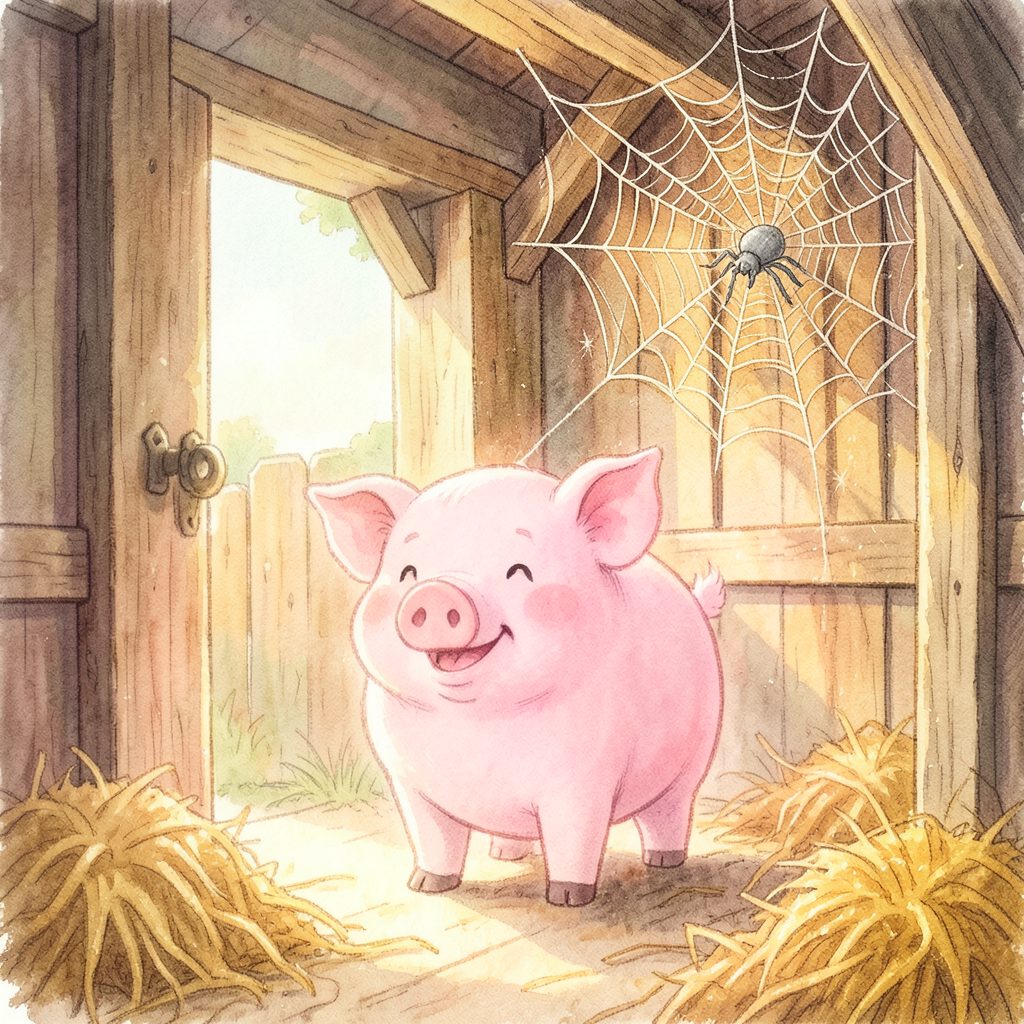
Wilbur the pig is terrified to learn he'll be slaughtered come winter. His unlikely friend Charlotte, a wise barn spider, devises a plan to save him by weaving words into her web praising Wilbur as 'Some Pig' and 'Terrific,' turning him into a local celebrity.
Themes
FriendshipLoveCourage
Best For
- Children who are ready to experience their first genuinely emotional book and talk about big feelings with a trusted adult
- Families who enjoy reading aloud together before bed — the chapter length and pacing are ideal for nightly read-alouds
- Kids who love animals or farm settings and want stories that respect animals as full characters
- Young readers making the transition from early chapter books to more literary fiction
- Classrooms or book clubs looking for a shared text that generates rich discussion across a wide range of readers
Why Parents Love This Book
Charlotte's Web has held children and adults spellbound since 1952, and its staying power is no accident. E.B. White wrote it as a meditation on friendship and loss that never condescends to young readers — it trusts them with the full weight of love and mortality. At the center is an unlikely bond between a pig who fears death and a spider who chooses, freely and generously, to spend her greatest gift — her words — in service of someone else. Charlotte does not save Wilbur because she expects anything in return. She does it because friendship, at its best, asks us to give without counting the cost. Garth Williams's illustrations bring the warm, hay-scented world of the Zuckerman barn to life in a way that feels timeless rather than dated. The book is also quietly funny — Templeton the rat provides perfect comic relief — which gives readers breathing room between the emotional peaks. It is one of those rare stories that children grow up with and carry into adulthood without losing anything.
Reading Tips for Parents
Plan to read this one aloud together even if your child is a capable independent reader — the emotional payoff is richer when experienced as a shared event. Chapters are short enough for nightly sessions, and the book lends itself naturally to pausing and talking. Be prepared: the ending involves Charlotte's death, and it is written with quiet honesty that often catches children off guard. This is a feature, not a flaw — most children handle it beautifully when a parent is present to sit with the sadness. Before you reach that point, it helps to name the theme early: "Charlotte knows something might happen to her. What do you think she would want Wilbur to remember?" That gentle framing gives children permission to feel and talk rather than shut down.
Awards & Recognition
- Newbery Honor Book, 1953
- Chosen for the American Library Association's list of the most frequently challenged books that survived censorship challenges
- Ranked by School Library Journal as the best children's novel ever written (2000 poll of librarians)
- Publishers Weekly all-time bestselling children's paperback
Educational Value
This book helps children develop skills across multiple areas:
- Vocabulary: Words like 'radiant,' 'terrific,' 'humble,' and 'salutations' are introduced in context, giving children memorable anchors for building a richer word bank.
- Social-emotional learning: The story models selfless friendship, grief, and the idea that love can outlast loss — themes children carry into their own relationships.
- Literary analysis: Charlotte's Web is an ideal introduction to concepts like foreshadowing, character motivation, and theme, making it excellent groundwork for middle school English.
- Science connection: Charlotte's life cycle, her egg sac, and her role as a spider invite natural curiosity about arachnids and barn ecosystems — a gentle entry point for non-fiction follow-up.
- Ethics and empathy: Wilbur's fear of slaughter opens age-appropriate conversation about animal welfare, fairness, and how we treat living creatures.
- Writing craft: E.B. White's precise, uncluttered prose is a model for young writers learning that clarity and emotion are not opposites.
Discussion Questions
Use these questions to spark conversation before, during, or after reading:
- Why do you think Charlotte decides to help Wilbur even though he can't do very much for her in return? What does that tell us about what real friendship looks like?
- Templeton the rat usually only does things for himself. Does he ever act differently in the story? What do you think changes for him?
- How do the words Charlotte weaves into her web — 'Some Pig,' 'Terrific,' 'Radiant,' 'Humble' — change the way people see Wilbur? Do words have that kind of power in real life?
- If you were Wilbur, how would you feel at the end of the story? Do you think he should feel happy, sad, or both at the same time?
- Charlotte works very hard on something she knows she won't be around to see finished. Have you ever done something kind for someone without expecting anything back?
Content Notes for Parents
Charlotte's death near the end of the book is handled with gentleness and honesty, and it is the element most likely to bring tears to children and parents alike — expect big feelings, and welcome them. There is no violence, no frightening content, and nothing inappropriate; the one difficult theme is mortality, which the book treats as a natural part of life rather than something to fear.
Frequently Asked Questions
What age is Charlotte's Web really right for?
The book is typically recommended for ages 7 to 10, and most children read it independently between grades 2 and 4. That said, it works beautifully as a read-aloud for children as young as 5 or 6 when a parent is present to help process the emotional moments. Older children who missed it earlier often discover it and love it just as much.
Will the ending upset my child?
Charlotte's death is sad, and children who have bonded with the characters will feel it — that is intentional, and it is part of what makes the book great. Most children handle it well, especially when a parent is nearby to acknowledge the sadness. E.B. White does not linger on death graphically; he treats it with quiet dignity. Many families find it opens valuable conversations about loss that children remember for years.
Is this appropriate for school reading?
Yes, Charlotte's Web is one of the most widely taught books in elementary school, particularly in grades 2 through 4. It covers vocabulary, theme, character development, and literary devices at a level that suits classroom discussion. The only content to be aware of is Charlotte's death, which teachers typically handle with care and which appears on no major content-concern lists.
What books might my child enjoy after this one?
Children who love Charlotte's Web often move on to Stuart Little and The Trumpet of the Swan, also by E.B. White. The One and Only Ivan by Katherine Applegate explores similar animal-perspective storytelling with emotional depth. For slightly older readers, Island of the Blue Dolphins or My Side of the Mountain share the same combination of nature, survival, and friendship.
Is there a good edition to buy?
The Harper Trophy paperback with Garth Williams's original illustrations is the standard edition and widely available. A hardcover collector's edition also exists for families who want a keepsake copy. The audiobook narrated by E.B. White himself is a remarkable listen — hearing the author read his own words adds a layer of intimacy that many families treasure.