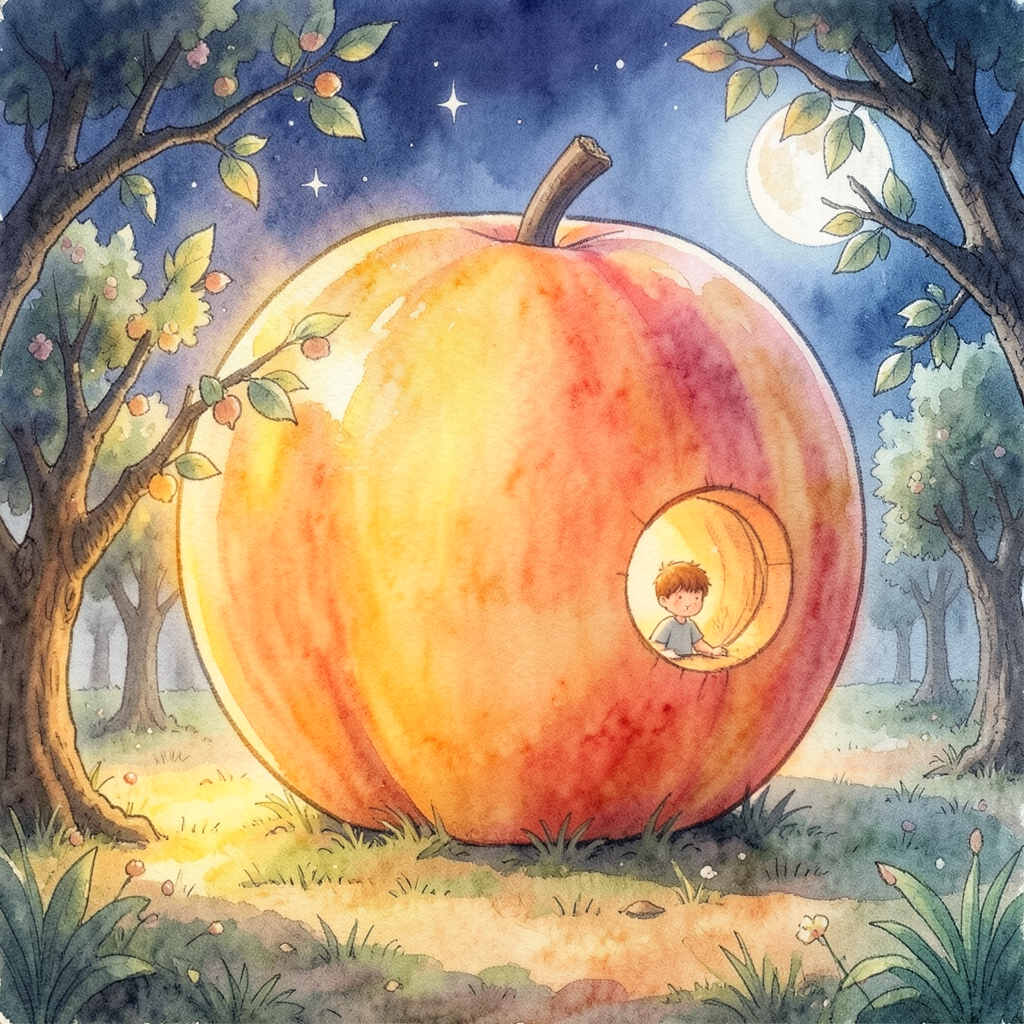
James and the Giant Peach
About This Book
Orphaned James Henry Trotter lives miserably with his cruel aunts Sponge and Spiker until a giant peach grows in the garden. Inside, he meets human-sized insects who become his friends as the peach rolls into the ocean and they embark on an extraordinary voyage across the Atlantic.
Themes
AdventureFriendshipCourage
Best For
- Children ages 8-10 who are ready to graduate from early chapter books and want something genuinely exciting
- Family read-alouds during a long trip or over a week of bedtimes — the short chapters and cliffhangers make pacing easy
- Kids who feel like outsiders or who are navigating a difficult home or school situation and need a story that validates their feelings
- Classrooms studying Roald Dahl as an author — pairing this with Charlie and the Chocolate Factory reveals his signature style clearly
- Children fascinated by insects or nature who will delight in the fact that the insect characters have real-world traits
Why Parents Love This Book
James and the Giant Peach has captivated readers since 1961 because Roald Dahl understood something profound about childhood: the desperate need to escape and belong. James Henry Trotter starts the story in one of the bleakest situations in children's literature — an orphan at the mercy of two genuinely monstrous aunts — and Dahl never sugarcoats that cruelty. That honesty is precisely why children trust him. The payoff is spectacular: a peach the size of a house, a cast of oversized, fully realized insect characters (the Centipede's boastfulness, the Earthworm's anxiety, the Silkworm's quiet industry), and an Atlantic voyage that manages to feel both absurd and emotionally true. Quentin Blake's scratchy, kinetic illustrations give every character a distinct personality. More than an adventure, this is a book about chosen family — James doesn't find better blood relatives, he builds a crew of friends who see his worth when no one else will. That message lands with children who have ever felt overlooked.
Reading Tips for Parents
This is a read-aloud powerhouse for ages 7 and up, though confident independent readers will devour it around 8-9. Give each insect a distinct voice — the Centipede calls for bluster and swagger, while the Earthworm benefits from a long-suffering sigh. Chapters are short (many run only three or four pages), making this easy to pace in nightly installments. Some children are initially disturbed by the death of James's parents and the cruelty of Aunt Sponge and Spiker; a brief acknowledgment before you start ("the beginning is sad, but things get wonderful") helps. The book naturally prompts conversation about what makes someone a true friend versus a guardian in name only. Keep a dictionary handy — Dahl's vocabulary is rich and specific, and the Centipede's songs introduce terrific nonsense words worth savoring.
Awards & Recognition
- New York Times Outstanding Book of the Year (1961)
- Adapted into a major Disney/Skellington Productions feature film (1996), reflecting its enduring cultural status
- Frequently included on the American Library Association's lists of most challenged books, attesting to its widespread readership and cultural impact
Educational Value
This book helps children develop skills across multiple areas:
- Vocabulary: Dahl's prose is deliberately extravagant — words like 'luminous,' 'phosphorescent,' and 'centipede' (with its actual leg count) give children rich targets for word study and dictionary work.
- Social-emotional: James's journey from isolated, frightened child to confident member of a chosen family offers a powerful framework for discussing belonging, self-worth, and recovery from difficult home situations.
- Science: The book sparks real curiosity about invertebrates — silkworms, earthworms, centipedes, grasshoppers, and glowworms are all featured, and their real-world traits are woven into the plot in ways children want to verify.
- Geography: The Atlantic crossing, the approach to New York City, and the cloud sequences invite map work and discussion of ocean geography, weather systems, and migration routes.
- Creative writing: The Centipede's boastful songs and the insects' storytelling sessions are natural models for children to write their own boastful poems or tall-tale monologues.
- Critical thinking: The contrast between James's life under his aunts and his life on the peach encourages children to articulate what fairness, kindness, and good leadership actually look like in practice.
Discussion Questions
Use these questions to spark conversation before, during, or after reading:
- Why do you think James feels so much safer with the insects than he ever did with his aunts, even though he had just met them?
- The Centipede loves to brag, but he also helps the group when it really matters. Do you know anyone who is like that? Is it possible to be both annoying and a good friend?
- If you could travel inside a giant piece of fruit with any five animals or insects in the world, which would you choose and why?
- James's parents died suddenly when he was very young, and he had no say in where he went to live. How do you think that would feel? What would you want most if you were in his situation?
- The insects argue and tease each other but they also work together to keep the peach moving. What does the story show us about how a team works best?
Content Notes for Parents
James's parents are killed by a rhinoceros in the opening pages, and his aunts are depicted as genuinely cruel — they starve, belittle, and hit him. These elements are treated matter-of-factly rather than graphically, but sensitive younger children or those with experience of family trauma may need a parent present for the early chapters.
Frequently Asked Questions
What age is James and the Giant Peach really appropriate for?
Most children read it independently between ages 8 and 10, but it works beautifully as a read-aloud starting around age 6 or 7 with a parent present. The reading level is accessible, but the emotional themes — parental loss, cruelty, and isolation — land better when slightly older children encounter them. Very sensitive children under 7 may find the aunt scenes upsetting.
Is the content too dark or scary for kids?
Roald Dahl is intentionally dark in places, and James and the Giant Peach is no exception. The death of James's parents and his aunts' cruelty are presented bluntly. However, Dahl balances this with humor, absurdity, and genuine warmth — the tone is never hopeless. Most children handle it well; parents who know their child is sensitive to loss or family themes should simply be present for the first few chapters.
How does the book compare to the 1996 movie?
The film is a loose adaptation that expands some scenes, changes character dynamics, and adds musical numbers. Children who love the movie will enjoy the book, but the book's Centipede is funnier and more obnoxious, and the Atlantic voyage is more vividly described. Reading the book after the film is a good way to discuss how stories change when they move between formats.
Are there similar books you'd recommend if my child loves this one?
Roald Dahl's own Charlie and the Chocolate Factory and The BFG are natural next reads and share the same blend of cruelty-to-triumph and magical invention. E.B. White's Charlotte's Web offers similar insect companionship with deeper emotional weight. For older readers ready for something longer, Stuart Little by E.B. White or The Phantom Tollbooth by Norton Juster hit comparable notes of wit and wonder.
Can this book be used in a classroom setting?
Yes — it is a staple of upper elementary classrooms and works well for grades 3 through 5. It supports units on adventure narratives, character motivation, point of view, and author's craft (Dahl's use of exaggeration and voice is particularly teachable). The insect characters also support cross-curricular science connections. The book's presence on challenged-books lists can itself prompt age-appropriate discussion about why stories sometimes make people uncomfortable.