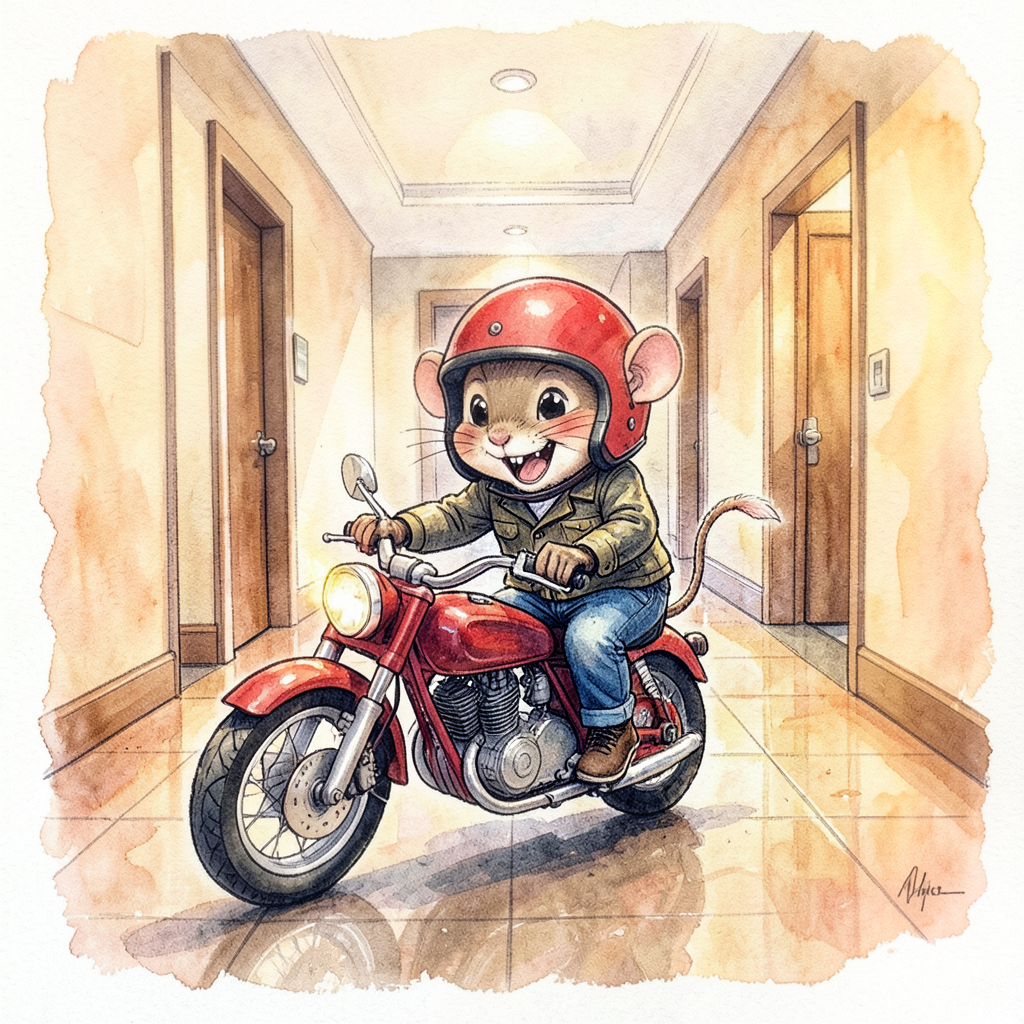
The Mouse and the Motorcycle
About This Book
When young Keith and his family check into a run-down hotel, he discovers Ralph, a daring young mouse who learns to ride Keith's toy motorcycle by making engine sounds. Their unlikely friendship leads to adventures and a deal — Ralph gets the motorcycle in exchange for finding Keith's lost aspirin.
Themes
FriendshipAdventureCourage
Best For
- Newly independent readers who are ready for their first longer chapter book
- Road trips or family vacations — the hotel setting makes it extra resonant when read on the go
- Kids who love vehicles, speed, and action but have not yet connected with fiction
- Bedtime read-alouds for ages 6-9 where you want a compelling cliffhanger at the end of each short chapter
- Children who enjoyed Stuart Little or Despereaux and are looking for a similar animal-adventure with heart
Why Parents Love This Book
Beverly Cleary's 1965 classic endures because it does something rare: it treats a child's imagination as serious currency. Ralph the mouse does not just talk — he negotiates, takes risks, and faces real consequences for his recklessness, making him feel like a fully realized character rather than a cute device. The premise (a mouse who rides a toy motorcycle by making "pb-pb-pb" engine sounds) is immediately irresistible, and Cleary builds on it with tight plotting and genuine emotional stakes. Keith and Ralph's friendship develops on equal footing — each needs something the other can provide, and both keep their word. Louis Darling's illustrations ground the fantasy in tactile detail, making the hotel setting feel lived-in and slightly shabby in exactly the right way. Crucially, the book rewards readers who are ready to invest in a longer story — the payoff of Ralph's dangerous aspirin mission late in the book earns every page that preceded it. It is a perfect bridge for newly independent readers moving from picture books into chapter books.
Reading Tips for Parents
This is an ideal read-aloud for ages 6-8 or an independent read for ages 8-10. Read a chapter a night to stretch the experience and give children time to predict what Ralph will do next. Before starting, briefly explain that the story is set in a mountain inn in the 1960s — the slightly outdated setting (no phones, aspirin as a big deal) is worth a quick note so it does not confuse young readers. Encourage children to make the "pb-pb-pb" motorcycle sound aloud with you — it draws reluctant readers into the physical pleasure of reading. After the aspirin-rescue chapter, pause and ask whether Ralph honored his deal fairly. This is a rich moment for discussing promise-keeping without lecturing. Two sequels (Runaway Ralph and Ralph S. Mouse) extend the relationship if your child falls in love with the characters.
Awards & Recognition
- New York Times Outstanding Books of the Year (1965)
- Young Reader's Choice Award (Pacific Northwest Library Association)
Educational Value
This book helps children develop skills across multiple areas:
- Vocabulary: Introduces vivid, precise words like 'teetered,' 'reckless,' and 'linoleum' in context, building reading comprehension through a compelling story rather than word lists.
- Social-emotional: Models reciprocal friendship — both characters contribute something real and honor a mutual agreement, showing children that good friendships involve give-and-take.
- Ethics and character: The aspirin subplot asks readers to weigh risk against responsibility, providing a natural framework for discussing courage, loyalty, and keeping promises.
- Reading stamina: As a 16-chapter novel, the book builds the habit of sustained reading across multiple sessions — a key milestone for the 8-12 age group.
- Empathy and perspective-taking: Seeing the hotel entirely from Ralph's mouse-level vantage point exercises imaginative perspective-taking, helping children consider how the same world looks different depending on who you are.
Discussion Questions
Use these questions to spark conversation before, during, or after reading:
- Why do you think Keith and Ralph become friends even though they are so different? What does each one get from the friendship?
- Ralph has to make the motorcycle sound himself to make it go. If you could make any toy come to life by doing something, what would it be and what would you do?
- Ralph takes a big risk sneaking through the hotel at night to find the aspirin. Was it a brave thing to do, a foolish thing, or both? What is the difference between bravery and foolishness?
- Keith gives Ralph the motorcycle in exchange for finding the aspirin. Do you think that was a fair deal? Have you ever made a deal with someone — how did you decide if it was fair?
- If you were a mouse living in a hotel, what would be the best and scariest parts of your day?
Content Notes for Parents
There are no significant content concerns — Ralph faces some danger (vacuum cleaners, a crow, navigating the hotel at night) but nothing frightening for the intended age range. The peril feels exciting rather than threatening, and all situations resolve safely.
Frequently Asked Questions
What age is this book really best for?
As an independent read, most children are ready around ages 8-9. Confident readers as young as 7 will enjoy it, and it works beautifully as a parent read-aloud for ages 6 and up. The vocabulary is accessible and the chapters are short enough to hold attention without exhausting younger listeners.
Is there anything scary or violent in the book?
Not in a way that concerns most parents. Ralph faces dangers like a vacuum cleaner and a threatening crow, but Cleary keeps the tone light and adventurous rather than frightening. Children who are sensitive to peril involving animals may need a reassuring word, but the story resolves all its dangers happily.
Are there sequels, and do we need to read them in order?
Yes — Beverly Cleary wrote two sequels: Runaway Ralph (1970) and Ralph S. Mouse (1982). They follow Ralph's further adventures and are best read in order, though each stands reasonably well on its own. Many families enjoy reading all three back-to-back once a child falls for Ralph's character.
My child says chapter books are boring. Will this one work?
The Mouse and the Motorcycle is one of the most reliable entry points for reluctant chapter-book readers because the hook arrives on the very first night Keith meets Ralph. The motorcycle concept is concrete and exciting, the chapters are short (most under 10 pages), and the 'pb-pb-pb' sound effect gives even reluctant readers a participatory moment that makes the book feel fun rather than like work.
How does this compare to Stuart Little or Charlotte's Web?
All three are beloved animal-fantasy chapter books, but The Mouse and the Motorcycle is the most action-focused of the three and the least emotionally intense — there is no death or loss, which makes it a gentler starting point. Stuart Little is quirkier and more episodic; Charlotte's Web is richer emotionally and thematically. Cleary's book is often the best first choice for younger or more reluctant readers before moving on to White's deeper work.