Extra Yarn
About This Book
Annabelle finds a box of yarn with one peculiar quality: it never runs out. She knits sweaters for herself, her dog, her neighbours, and eventually for every house, tree, bridge, and creature in the whole drab town — and still there is extra yarn. Jon Klassen's moody, beautiful illustrations make this Caldecott Honor book feel like a fairy tale about generosity itself.
Themes
GenerosityCommunityMagic
Best For
- Classrooms and read-alouds introducing themes of generosity and community
- Children going through a transition where they are learning to share or give to others
- Families who enjoy fairy-tale-style stories with a satisfying moral arc
- Art-focused readers or children who respond strongly to illustrations and color
- Bedtime reading that leaves children with a warm, settled feeling
Why Parents Love This Book
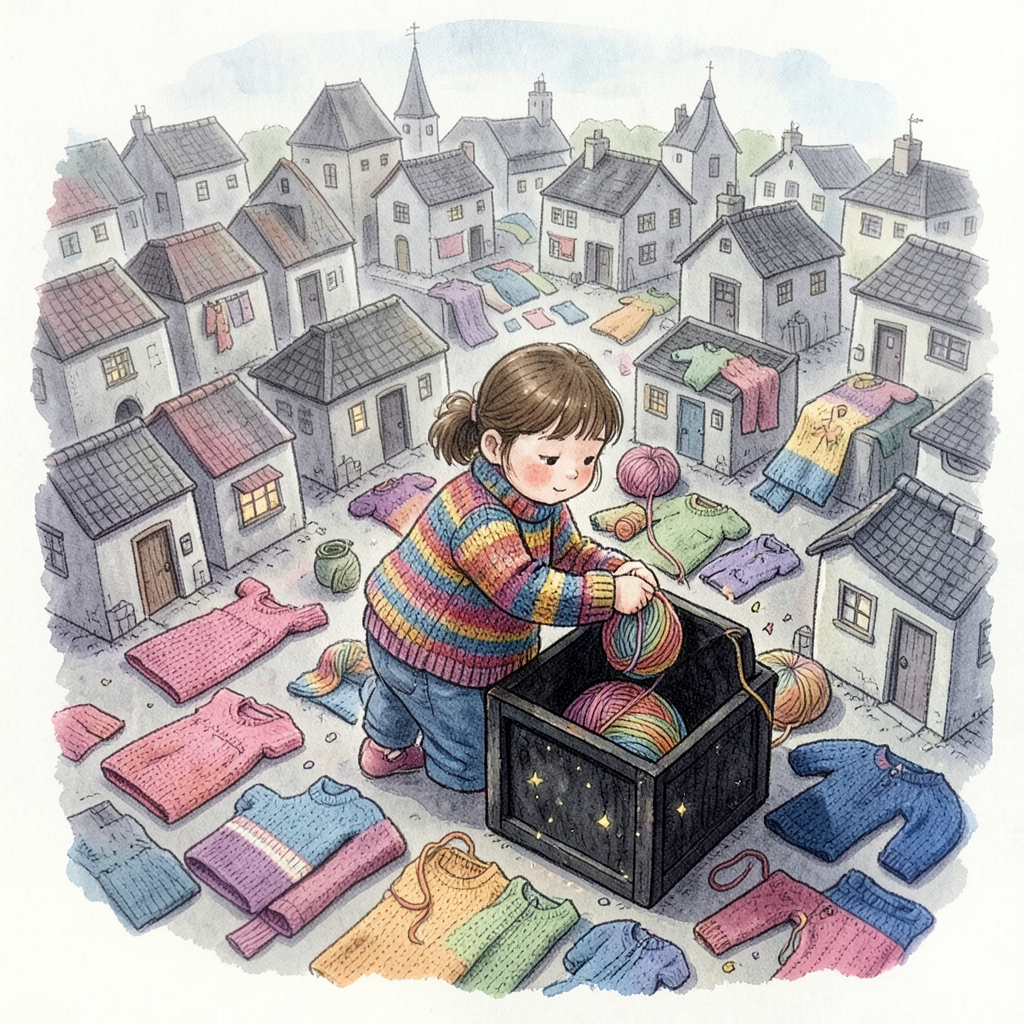
Extra Yarn works as both a gentle fairy tale and a quiet meditation on what happens when one person decides to give without limit. Annabelle does not set out to transform her town — she simply knits, and keeps knitting, because the yarn never runs out. Mac Barnett's prose has the cadence of an old folk story: spare, a little wry, and utterly confident. Jon Klassen's illustrations are the other half of the magic. The town begins in near-grayscale — grey streets, grey sky, grey everything — and as Annabelle's colorful sweaters spread from body to house to tree to bridge, color literally bleeds back into the world. That visual metaphor lands powerfully even for a four-year-old. There is also a sly villain, a satisfying comeuppance, and an ending that trusts children to feel the warmth without having it explained to them. It is the rare picture book that rewards re-reading at every age.
Reading Tips for Parents
Before you open the book, spend a moment on the cover together and ask your child what they notice about the colors. As you read, pause when each new recipient receives a sweater and let your child predict who might be next — the cumulative structure makes this very satisfying to anticipate. The archvillain's arrival roughly two-thirds through the book surprises many young readers; a brief heads-up that "someone greedy shows up but doesn't win" can help anxious children stay relaxed. After finishing, invite your child to look back through the illustrations and trace exactly where color enters each spread. The before-and-after contrast is stunning and makes for a rich second read. This book is also a natural launchpad for a simple hands-on activity: give your child yarn or colored paper strips to "knit" their own pretend sweater for a toy.
Awards & Recognition
- Caldecott Honor Book (2013)
- E.B. White Read Aloud Award, Picture Book Category (2013)
Educational Value
This book helps children develop skills across multiple areas:
- Vocabulary: Introduces rich words like 'peculiar,' 'archduke,' and 'drab' naturally in context, giving children repeated exposure to elevated language through the story's fairy-tale register.
- Social-emotional: Models unconditional generosity — Annabelle gives without being asked and without expecting anything back — making it an excellent anchor for conversations about kindness and community.
- Visual literacy: Klassen's deliberate shift from monochrome to color teaches children to read meaning through illustration, not just text, building graphic awareness useful across all reading.
- Narrative structure: The story follows a clear cumulative pattern (each gift building on the last) that helps early readers understand story rhythm and predict what comes next.
- Critical thinking: The villain's failure to use the magical yarn invites children to reason about why generosity cannot be bought or stolen, a concept in ethics accessible through story.
- Creative arts: The knitting premise naturally connects to textile arts and craft, opening doors to hands-on exploration of how fabric and color are made.
Discussion Questions
Use these questions to spark conversation before, during, or after reading:
- Why do you think Annabelle decided to keep knitting for other people instead of keeping all the yarn for herself?
- The town looks grey and dull at the beginning. How does it feel different by the end? Can you find the page where you first notice the change?
- The archduke wants the box of yarn but it won't work for him. Why do you think that is?
- If you found a box that never ran out of something, what would you want it to be full of, and who would you share it with?
- Annabelle knits sweaters for her dog and even for the trees. If you could knit something for your neighborhood, what would it be?
Content Notes for Parents
An archduke steals the magical box of yarn, which may briefly upset sensitive children, but the situation resolves happily with no lasting harm or scary imagery. There are no other content concerns; the book is gentle, warm, and suitable for all children in the 4-7 age range.
Frequently Asked Questions
What age is Extra Yarn best for?
The book is ideal for ages 4 through 7. The fairy-tale prose is simple enough for preschoolers to follow, but the visual storytelling and themes of generosity give it staying power well into early elementary years. Many parents report that six- and seven-year-olds who can read independently still love having it read aloud to them.
Is there anything scary or upsetting in the book?
There is a greedy archduke who steals the magical yarn box, which introduces a brief moment of conflict. Most children find it more funny than scary, and the resolution is swift and satisfying. If your child is highly sensitive to villains or theft plots, a quick preview and reassurance that everything works out is all you need.
What makes Jon Klassen's illustrations so distinctive here?
Klassen renders the town almost entirely in grey and muted tones at the start, then gradually introduces saturated color as Annabelle's knitting spreads. This visual contrast is not decorative — it is the emotional core of the book. Even children who cannot articulate what is happening feel the shift from cold to warm as the story progresses.
Are there books similar to Extra Yarn we might enjoy next?
If your child loved the quiet generosity theme, Shel Silverstein's The Giving Tree and Oliver Jeffers' The Incredible Book Eating Boy are warm companions. For more of Mac Barnett's wit, try Sam and Dave Dig a Hole (also illustrated by Klassen) or It Happened on a Train. Jon Klassen's I Want My Hat Back trilogy showcases more of his deadpan humor.
Can this book be used in a classroom setting?
Absolutely — it is a natural fit for lessons on community, color, and narrative structure. The cumulative giving pattern makes it easy to chart on a whiteboard, and the color-shift in the illustrations provides a ready-made visual literacy exercise. Teachers often pair it with a simple textile or color-mixing art activity to reinforce the themes hands-on.