First the Egg
About This Book
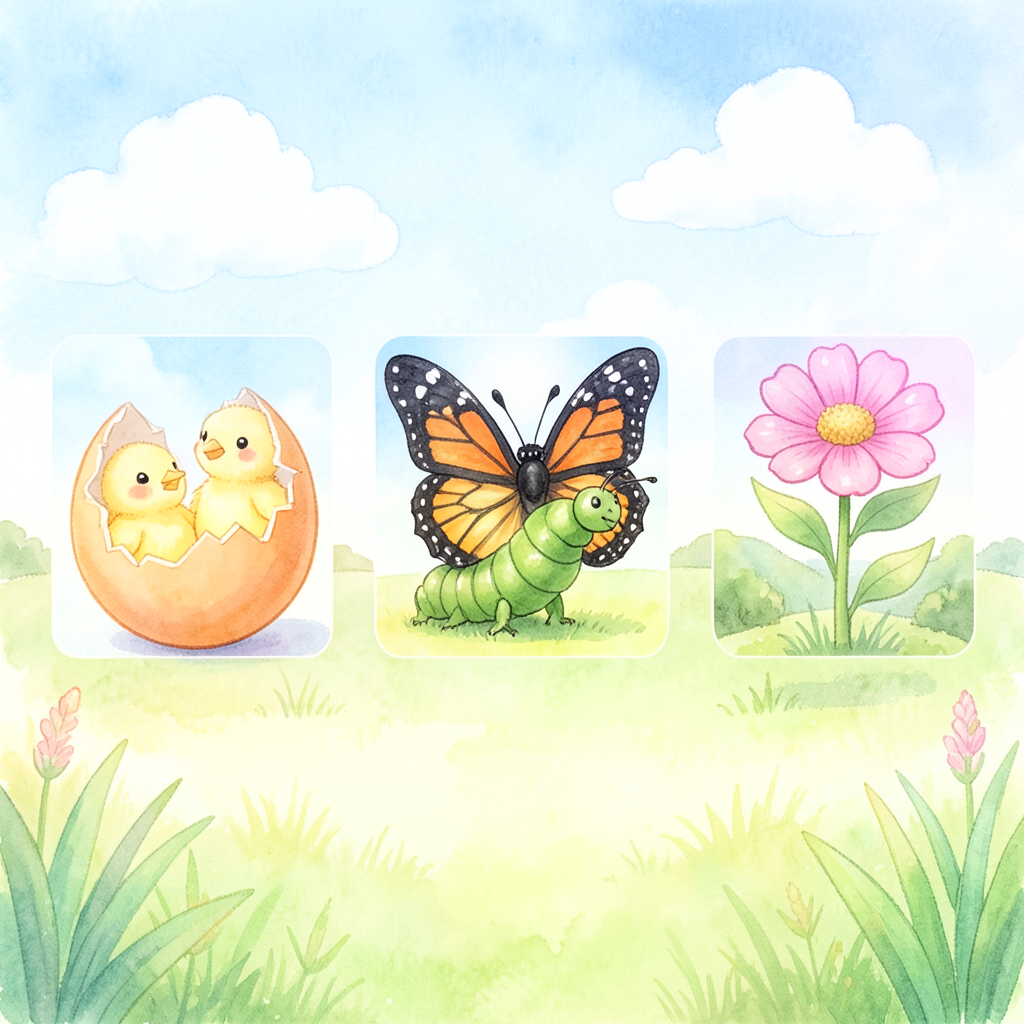
First the egg, then the chicken. First the seed, then the flower. First the paint, then the picture. Laura Vaccaro Seeger uses clever die-cut pages to reveal the natural transformations hiding inside each beginning, turning the concept of change and growth into a breathtakingly simple visual poem. A Caldecott Honor book.
Themes
GrowthChangeNature
Best For
- Introducing life-cycle and nature concepts to babies and toddlers
- Toddlers who love lift-the-flap or interactive books, since the die-cuts deliver a similar surprise
- Calm, quiet bedtime reading thanks to its soothing repetitive structure
- Early childhood classrooms exploring science themes like growth and change
- Gift-giving for babies and one-year-olds — it holds up through many years of re-reading
Why Parents Love This Book
Laura Vaccaro Seeger's "First the Egg" is a small masterpiece of visual storytelling that makes the concept of transformation feel like pure magic. The book's genius lies in its die-cut pages: you see an egg through a precisely cut hole in one page, and when you turn it, the egg has become a chicken. The same quiet wonder plays out across seed and flower, caterpillar and butterfly, tadpole and frog, paint and picture, word and story. Each reveal is a tiny gasp of delight. Seeger's paintings are bold and luminous, rendered in a palette that feels both modern and timeless. The minimalist text — just four or five words per spread — gives very young children something they can actually learn to say aloud. There is no narrative tension, no conflict, just the steady, reassuring rhythm of things becoming what they are meant to become. It is a book that trusts children completely, letting the images carry the meaning, and it rewards re-reading in a way few board books do.
Reading Tips for Parents
Before you open the cover, give your child a moment to look at the die-cut hole on each left-hand page and guess what it reveals. Ask "What do you see?" then turn the page together and let the transformation land. Young toddlers will want to feel the cut edges with their fingers — that tactile curiosity is part of the experience, so go with it. Because the text is so spare, you have natural room to pause and name what you see: "That's a caterpillar. Now it's a butterfly!" After a few reads, many children around age two will begin anticipating the next pair and try to fill in the word themselves. The book works beautifully as a bedtime read because its calm, repetitive structure is inherently settling. It also pairs well with a walk outside to spot eggs, seeds, or caterpillars in real life.
Awards & Recognition
- Caldecott Honor Book (2008)
- New York Times Best Illustrated Children's Book
Educational Value
This book helps children develop skills across multiple areas:
- Science: Introduces life-cycle concepts — egg to chicken, tadpole to frog, caterpillar to butterfly, seed to flower — as concrete visual pairs that lay the groundwork for biology.
- Vocabulary: Builds foundational nature words (egg, seed, caterpillar, tadpole) in a low-pressure, high-repetition format ideal for pre-readers.
- Sequencing: Reinforces the idea that things happen in a specific order, an early math and language-arts skill that supports later reading comprehension.
- Visual literacy: Die-cut pages train the eye to look for clues and make predictions before a page is fully turned, strengthening observational skills.
- Cause and effect: Each spread is a concrete model of cause and effect, helping children begin to understand that one thing leads to another.
- Social-emotional: The steady rhythm of growth and change offers gentle reassurance that transformation is natural and good — a message with real emotional value for toddlers navigating rapid change.
Discussion Questions
Use these questions to spark conversation before, during, or after reading:
- What comes first — the egg or the chicken? What do YOU think?
- Can you remember what the caterpillar turned into? Did that surprise you?
- The book shows a seed turning into a flower. If you planted a seed, what would you want it to grow into?
- At the end, words turn into a story. What story would YOU write if you could?
- Can you think of something else that changes and grows, like the things in this book?
Content Notes for Parents
There are no scary, sad, or mature elements in this book. It is entirely gentle and age-appropriate for readers from birth onward.
Frequently Asked Questions
What age is 'First the Egg' best suited for?
The book is officially recommended for ages 0-3, but it has real staying power beyond that. Babies enjoy the bold images and parent narration, toddlers love the die-cut surprises and begin to name the animals, and many three- and four-year-olds still request it because they enjoy anticipating the reveals. It is genuinely one of those rare books that grows with the child.
Is this a board book or a picture book?
It was published as a hardcover picture book rather than a traditional board book, though it is short and simple enough for very young children. The pages are standard picture-book paper with die-cut holes, so very young babies should be supervised since the cut edges and pages are more delicate than a typical board book.
Are there any scary or upsetting parts I should know about?
None at all. The book is entirely calm and positive in tone. There is no conflict, no loss, and no frightening imagery — it is a visual poem about natural change and growth.
What books are similar to 'First the Egg' if my child loves it?
Children who love 'First the Egg' often enjoy other Laura Vaccaro Seeger titles such as 'Green' and 'One Boy.' For the life-cycle theme specifically, Eric Carle's 'The Very Hungry Caterpillar' is the natural next read, and Lois Ehlert's 'Growing Vegetable Soup' extends the seed-to-plant idea with more detail.
Can I use this book to teach science concepts in a preschool classroom?
Absolutely. The book is widely used in early childhood settings to introduce life cycles and the concept of sequential change. Each page pair can anchor a brief science conversation or a simple art activity — for example, drawing a before-and-after sequence of a seed growing into a flower. Its brevity makes it easy to read aloud to a group multiple times in one sitting.