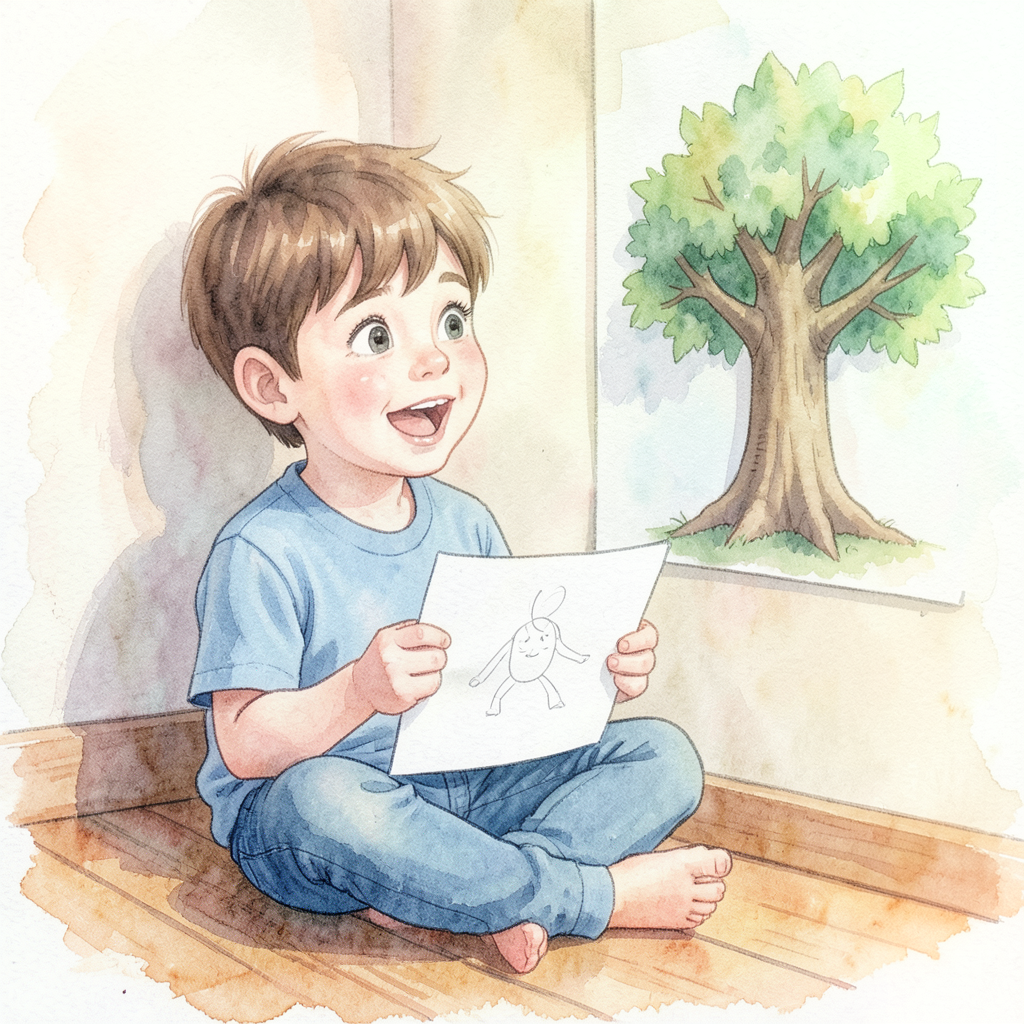
Ish
About This Book
Ramon loves to draw until his brother laughs at one of his pictures — and suddenly every drawing feels wrong and stiff and not good enough. It takes his little sister, who has kept all his crumpled drawings on her wall, to show him that a drawing can be vase-ish, tree-ish, wonderful-ish. A companion to The Dot that speaks directly to the fear of imperfection.
Themes
CreativityPerfectionismConfidence
Best For
- Children who have stopped drawing, writing, or creating because their work 'wasn't good enough'
- Classroom read-alouds at the start of an art unit or creative writing project
- Siblings — opens a conversation about how we treat each other's creative efforts
- Children who are hard on themselves and struggle with perfectionism across many areas, not just art
- Parents looking for a gentle, story-based way to introduce growth mindset concepts
Why Parents Love This Book
Peter H. Reynolds has a rare gift for capturing the interior life of a child, and "Ish" may be his most emotionally precise book. The story's turning point — Ramon's little sister Marisol revealing she has wallpapered her room with his crumpled, rejected drawings — is a genuinely moving moment that works on children and adults alike. Reynolds understands that the wound of a single dismissive laugh can silence a young artist for a long time, and he takes that seriously without being heavy-handed. The concept of "ish" thinking is immediately practical: a drawing doesn't have to be a perfect vase, it just has to feel vase-ish. This reframe is liberating in a way that abstract encouragement ("just do your best!") rarely is. The loose, watercolor-and-ink illustrations model the very freedom the story preaches. As a companion to "The Dot," it deepens the same message while standing entirely on its own — Ramon's journey feels complete and specific, not like a sequel repeating a formula.
Reading Tips for Parents
Before reading, ask your child to draw something quickly without erasing or starting over — this primes them to feel the pressure Ramon feels. As you read, pause when Ramon crumples his drawings and ask what they notice on his face. After reading, introduce "ish" language into your daily routine: "that's circle-ish," "that's pretty-ish." This vocabulary gives children a concrete way to defend their creative choices against their own inner critic. If your child has ever quit drawing, painting, or writing because something "didn't look right," return to this book in that moment — the connection will be immediate. Consider displaying your child's artwork without correcting it, mirroring what Marisol does for Ramon. The book pairs naturally with time spent drawing together, where you model making "ish" marks without worrying about accuracy.
Awards & Recognition
- New York Times Bestseller
- ALA Notable Children's Book (2005)
Educational Value
This book helps children develop skills across multiple areas:
- Social-emotional learning: Directly addresses the fear of imperfection and the impact of a single critical comment on creative confidence — essential vocabulary for young children navigating peer judgment.
- Vocabulary: Introduces the concept of approximation through the suffix '-ish,' which children can transfer to everyday language and begin using as a genuine thinking tool.
- Creative arts: Models process-over-product thinking by showing that expressive, loose marks can be more meaningful than technically correct ones.
- Empathy: Marisol's quiet act of collecting Ramon's rejected work invites children to think about how small gestures of loyalty and belief can change someone's life.
- Reading comprehension: The story's emotional arc — loss of confidence, recovery through unexpected recognition — gives beginning readers practice identifying character feelings and cause-and-effect relationships.
- Growth mindset: Reframes 'failure' in creative work as a normal and even valuable part of making, giving children a concrete framework (ish thinking) rather than just abstract encouragement.
Discussion Questions
Use these questions to spark conversation before, during, or after reading:
- Why do you think Ramon stops drawing after his brother laughs? Has anyone ever laughed at something you made?
- How do you think Ramon felt when he walked into Marisol's room and saw all his crumpled drawings on the wall?
- What does it mean for something to be 'vase-ish' instead of just a vase? Can you think of something in your own drawings that is 'ish'?
- Marisol kept every drawing Ramon threw away. Why do you think she did that? What does that tell us about how she feels about Ramon's art?
- If you could make 'ish' art about anything today, what would you draw or paint?
Content Notes for Parents
No concerning content. The moment when Ramon's brother laughs at his drawing may briefly resonate painfully with sensitive children who have experienced ridicule, but the book handles it gently and resolves it warmly.
Frequently Asked Questions
What age is 'Ish' best for?
The book is aimed at ages 4 to 7 and works beautifully as a read-aloud for preschool and early elementary children. Older children up to age 9 or 10 who struggle with perfectionism will also connect deeply with Ramon's experience, even if they're reading independently.
Do I need to read 'The Dot' first?
No — 'Ish' stands completely on its own. It shares themes and a character (Marisol appears in both) with 'The Dot,' but Ramon's story has its own beginning and resolution. If your child loves one, the other makes a natural follow-up, but there is no required reading order.
My child is very sensitive to teasing. Will the scene where Ramon is laughed at upset them?
It may land with particular sharpness for sensitive children, but Reynolds keeps the moment brief and moves quickly toward Marisol's loving response. For children who have experienced being mocked for their creative work, that sting can actually make the book more powerful and cathartic. You can pause and acknowledge the feeling before continuing.
What books are similar to 'Ish' for kids who love this one?
'The Dot' by Peter H. Reynolds is the obvious companion. 'Beautiful Oops!' by Barney Saltzberg takes a similarly playful approach to mistakes in art. 'What Do You Do With an Idea?' by Kobi Yamada explores the vulnerability of creative ideas with comparable emotional depth.
Can this book be used in a classroom setting?
It is extremely well-suited to classrooms, particularly at the start of an art class, writing workshop, or any project where children will be creating and sharing work. The concept of 'ish thinking' gives teachers and students a shared language for discussing approximation, effort, and the courage to make something imperfect.