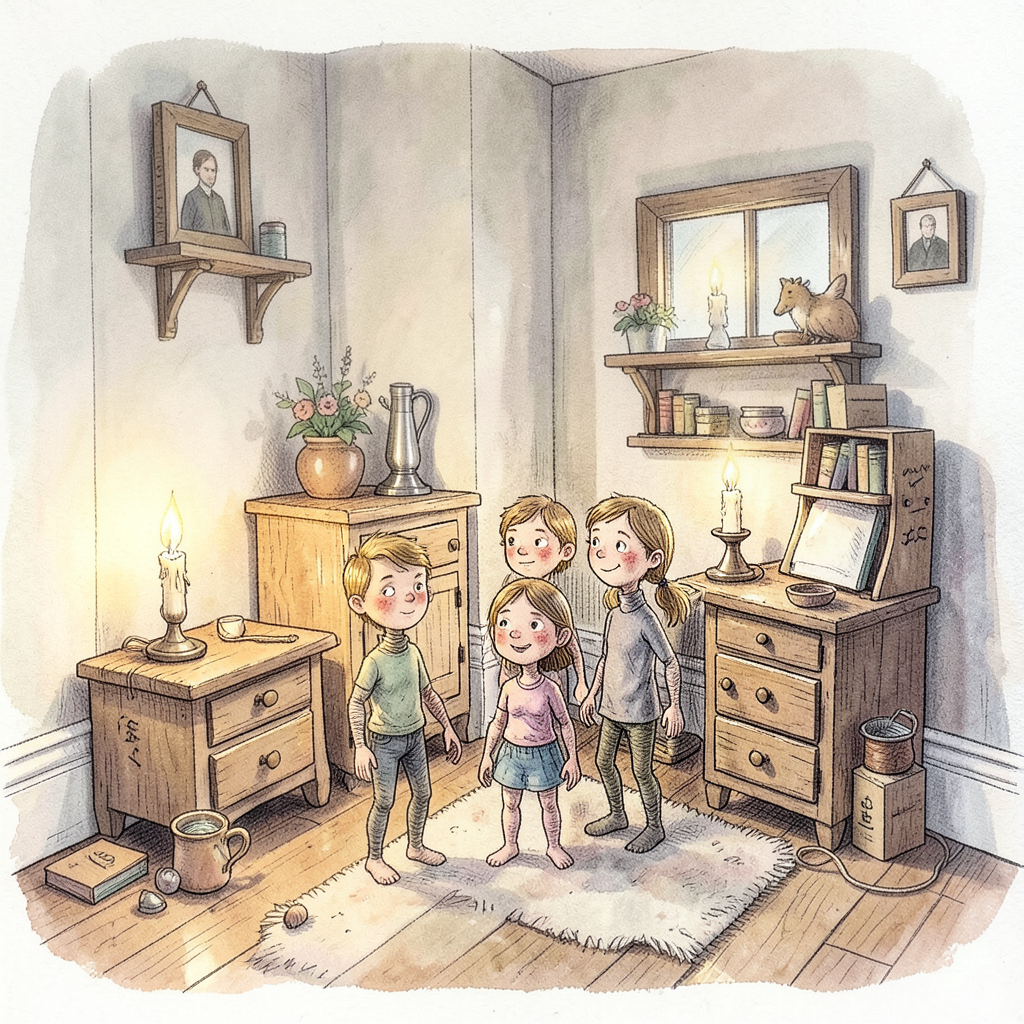
The Borrowers
About This Book
Beneath the floorboards of an English house live the Clock family — Pod, Homily, and their daughter Arrietty — tiny people who survive by 'borrowing' items from the human inhabitants. When Arrietty is discovered by a boy, their secret world is threatened and they must decide whether to stay or flee.
Themes
AdventureFamilyCourage
Best For
- Children aged 9-11 who have outgrown early chapter books and are ready for richer, more immersive storytelling
- Families who enjoy read-alouds with detailed world-building that sparks conversation
- Kids who love miniature things, dollhouses, or building tiny spaces — this book will feel like a direct invitation to their imagination
- Readers looking for a classic that opens into a full series with four sequel adventures
- Children who enjoy quiet, character-driven stories over action-heavy plots
Why Parents Love This Book
Mary Norton's The Borrowers is one of those rare books that fundamentally shifts how a child sees the ordinary world. Published in 1952, it invites readers to imagine a miniature civilization thriving beneath the floorboards of an English country house, constructed entirely from discarded human objects — a cotton-reel chair, a postage-stamp painting, a thimble used as a pot. Norton's genius lies in the specificity of these details; every borrowed item feels chosen with care and wit. At the heart of the story is Arrietty Clock, a young Borrower who yearns to explore beyond her hidden home. Her curiosity, her longing for friendship, and her courage in the face of danger make her one of children's literature's most timeless protagonists. The book also quietly explores what it means to live in secrecy, to depend on others without their knowledge, and to weigh safety against adventure. It rewards both young independent readers and those being read aloud to, sparking rich conversations that linger long after the final page.
Reading Tips for Parents
This is an excellent chapter-book read-aloud for ages 7 and up, or a strong independent read for confident readers aged 9-12. Pace it slowly — Norton's prose rewards lingering over the details of the Borrowers' miniature world. Before or during reading, invite your child to look around your own home and ask which objects they might "borrow" if they were tiny, and what they would use them for. This imaginative exercise deepens engagement considerably. The book is the first in a five-book series, so be prepared: many children will want to continue immediately with The Borrowers Afield. There are no illustrations in all editions, so younger listeners may benefit from the Beth Krush-illustrated editions to anchor the visual world. Chapter lengths are moderate, making it ideal for 20-minute nightly reading sessions.
Awards & Recognition
- Carnegie Medal winner, 1952 (UK's most prestigious children's book award)
- Lewis Carroll Shelf Award, 1960
- New York Times Outstanding Book designation
Educational Value
This book helps children develop skills across multiple areas:
- Vocabulary: Norton's prose introduces rich, precise language — words like 'diminutive,' 'scullery,' and 'furtive' appear naturally in context, building reading sophistication without interrupting the story.
- Social-emotional: Arrietty's struggle between obedience and independence offers a powerful lens for discussing the tension between safety and personal growth, and how families navigate disagreement.
- Creative thinking: The Borrowers' world is built entirely from repurposed human objects, sparking inventive thinking about everyday items and encouraging children to see ordinary things in new ways.
- Cultural and historical literacy: Set in mid-20th century rural England, the book provides natural exposure to British domestic life, vocabulary, and social customs of the era.
- Empathy: Readers experience the world from the perspective of beings who are vulnerable and overlooked, building compassion for those who feel small or unseen in everyday life.
- Reading stamina: As a multi-chapter novel with detailed world-building, it strengthens the ability to hold a complex narrative in mind over multiple reading sessions.
Discussion Questions
Use these questions to spark conversation before, during, or after reading:
- Why do you think Arrietty is so curious about the world outside even though her parents want her to stay hidden? Have you ever felt that way — wanting to explore somewhere new even when it felt scary?
- The Borrowers take only small things that humans won't miss. Do you think what they do counts as stealing? Why or why not?
- Pod and Homily have very different personalities. How does each of them react when Arrietty is discovered by the boy? What does that tell us about who they are?
- If you were the size of a Borrower living in your own house, which room would you live in and what objects would you borrow to furnish your home?
- Why do you think the boy decides to help the Borrowers? What would you have done in his place?
Content Notes for Parents
There are no violent, sexual, or overtly frightening elements in this book. The Borrowers do face genuine peril and the threat of being discovered creates sustained tension, which sensitive readers may find stressful, but it remains well within the range appropriate for ages 8 and up.
Frequently Asked Questions
What age is The Borrowers really right for?
Most children enjoy it as a read-aloud from around age 7-8, and as an independent read from about age 9. The vocabulary and sentence structure are rich but accessible, and the story's emotional stakes are well-calibrated for middle elementary readers. Very sensitive children around age 7 may find the threat of discovery stressful, so gauge your child's comfort with suspense.
Is this the start of a series? Do we need to read them in order?
Yes — The Borrowers is the first of five books by Mary Norton, followed by The Borrowers Afield, The Borrowers Afloat, The Borrowers Aloft, and The Borrowers Avenged. They should be read in order, as each book follows directly from where the last left off. Most families find that children are eager to continue once they finish the first book.
Are there any scary or upsetting parts I should know about?
The book does not contain violence or mature content, but there is sustained dramatic tension as the Borrowers face the threat of being discovered and potentially exterminated like pests. This peril is handled with restraint, but sensitive children may feel anxious during certain scenes. The ending of this first book is somewhat open and uncertain, which some younger readers find unsettling — it resolves more fully across the series.
What books would you recommend alongside or after The Borrowers?
Families who love The Borrowers often enjoy Stuart Little by E.B. White (another tiny protagonist navigating a big world), The Indian in the Cupboard by Lynne Reid Banks (miniature figures come to life), and The Secret Garden by Frances Hodgson Burnett (similarly atmospheric, English-countryside, character-driven). For a modern equivalent with similar imaginative energy, try The Menagerie series or Mrs. Frisby and the Rats of NIMH.
Is the book better read aloud or independently?
It works beautifully both ways, but many families find reading it aloud to be a particularly special experience because Norton's prose has a distinctive, measured rhythm that benefits from being heard. Independent readers aged 9 and up who enjoy descriptive, immersive books will also do well with it on their own. If your child struggles to visualize settings from text alone, look for editions illustrated by Beth Krush, which help anchor the miniature world.