Ten Lights, One Flame
About This Book
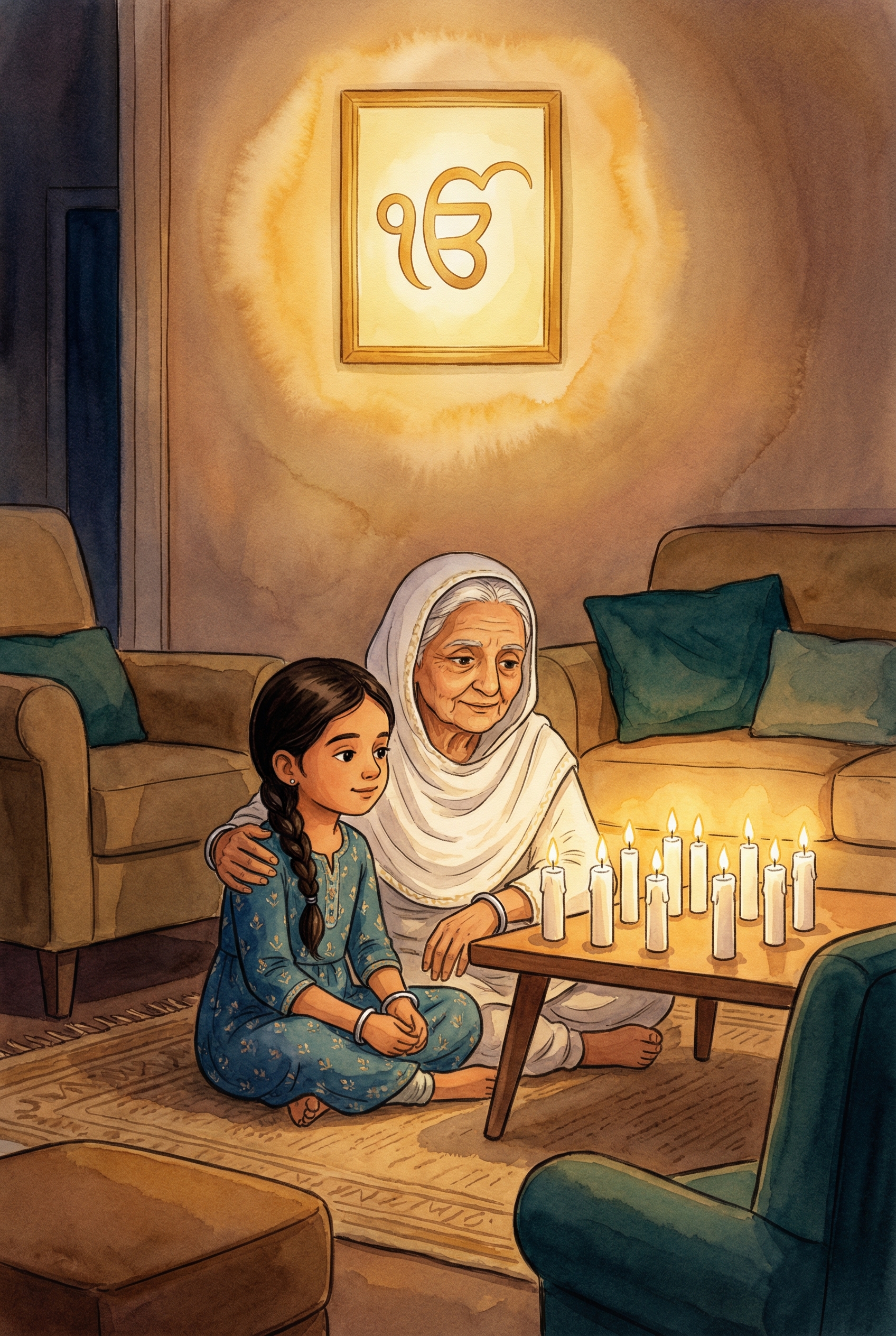
On a dark evening, a grandmother lights ten candles and tells her grandchildren the story of the ten Sikh Gurus — each one carrying forward the same light, the same message, from Guru Nanak Dev Ji to Guru Gobind Singh Ji, until the eternal flame passed to the Guru Granth Sahib Ji. A luminous introduction to Sikh history, told in the warmth of a family home.
Themes
Sikh HistoryFaithFamily
Best For
- Families preparing a child for their first visit to a Gurdwara
- Classroom units on world religions or cultural diversity
- Bedtime reading when parents want a calm, meaningful story with spiritual depth
- Grandparents looking for a way to share Sikh heritage with grandchildren
- Non-Sikh families seeking an accurate, accessible introduction to Sikhi for young children
Why Parents Love This Book
Ten Lights, One Flame does something rare and beautiful: it takes more than five centuries of Sikh history and makes it feel as intimate as a bedtime story. The framing device — a grandmother lighting candles one by one for her grandchildren — is inspired. Each candle becomes a Guru, each flame a reminder that the same divine light passed unbroken from Guru Nanak Dev Ji all the way through to the Guru Granth Sahib Ji. That continuity is the heart of the book, and it lands with quiet power. For children who may feel overwhelmed by names, dates, and historical detail, this approach gives them something to hold onto: one flame, ten carriers, one message. The family home setting anchors the history in everyday love and ritual, so children see faith not as something distant or ceremonial but as something alive at the kitchen table. It is the kind of book that makes abstract concepts — lineage, spiritual succession, eternal guidance — feel warm and touchable.
Reading Tips for Parents
Before you open the book, light a candle (with appropriate safety supervision) and let your child hold that image in mind as you read. Each time a new Guru is introduced, pause and ask your child to count along. Having ten fingers ready to fold down one by one turns the counting into a physical, memorable activity. After the final page, when the light passes to the Guru Granth Sahib Ji, take a moment to explain that this is why the scripture is treated as a living Guru in Sikh practice today — it is a concept children often find surprising and meaningful. If your family visits a Gurdwara, this book pairs beautifully with that experience as preparation or reflection. For non-Sikh families reading for cultural literacy, a brief note that Sikhi is a distinct faith — not a branch of Hinduism or Islam — helps set accurate context.
Awards & Recognition
- No major awards identified for this 2024 title at time of cataloging.
- Not yet listed on major bestseller lists as of 2024 publication date.
Educational Value
This book helps children develop skills across multiple areas:
- History: Introduces all ten Sikh Gurus in sequence, giving children a chronological framework for Sikh history spanning roughly 1469 to 1708.
- Counting and Sequencing: The one-candle-per-Guru structure reinforces ordinal counting (first, second, third...) and the concept of a sequence with a meaningful end point.
- Religious Literacy: Explains the concept of the Guru Granth Sahib Ji as the eternal, living Guru — a foundational idea in Sikh theology that builds interfaith understanding.
- Social-Emotional: Models intergenerational storytelling and the role grandparents play in passing on cultural and spiritual identity, affirming family as a source of wisdom.
- Vocabulary: Introduces words and names from Sikh tradition (Guru, Waheguru, Guru Granth Sahib Ji) in context, supporting vocabulary growth for both Sikh and non-Sikh children.
- Critical Thinking: The central metaphor of one flame in ten candles invites children to think about what it means for an idea or value to be carried forward across generations.
Discussion Questions
Use these questions to spark conversation before, during, or after reading:
- Why do you think the grandmother chose to tell this story using candles? What does the light stand for?
- All ten Gurus carried the same flame. What do you think that flame — the message — actually was?
- The light at the end passes to a book, the Guru Granth Sahib Ji, instead of a person. Does that surprise you? Why or why not?
- If you were going to pass on something important to someone younger than you, what would it be?
- Can you remember any of the ten Gurus the grandmother talked about? Which one stuck with you most, and why?
Content Notes for Parents
There are no scary, violent, or upsetting elements in this book. The tone is warm, quiet, and reverent throughout, making it appropriate for all children in the 4-7 age range and younger listeners as well.
Frequently Asked Questions
What age is this book best suited for?
The publisher targets ages 4-7, and that range feels right. The candle-counting structure and warm grandmother-grandchild framing work well for preschoolers, while the historical detail of ten Gurus gives early readers in kindergarten through second grade something to really engage with. Younger children (2-3) can enjoy it as a lap read focused on the candles and the rhythm of the storytelling.
Do we need to be Sikh to enjoy this book?
Not at all. The book is written in a way that introduces Sikh history and beliefs gently and clearly, without assuming prior knowledge. Non-Sikh families will find it a respectful and accessible window into a tradition that is often underrepresented in children's literature. A brief parent note explaining that Sikhi is an independent world religion (founded in the Punjab region in the late 15th century) helps set helpful context before reading.
Is this book accurate about Sikh history and beliefs?
Yes. The book correctly represents the lineage of ten human Gurus and accurately conveys that the Guru Granth Sahib Ji serves as the eternal Guru following Guru Gobind Singh Ji. The central metaphor of one continuous flame is itself drawn from Sikh theological tradition, where the Gurus are understood to carry the same divine light rather than being ten separate spiritual authorities.
How long does it take to read aloud?
A single read-through takes roughly 8-12 minutes at a comfortable pace, making it ideal for a bedtime slot. If you pause to count candles together and ask a question or two along the way, plan for 15-20 minutes. It is short enough to read twice in one sitting, which many children request.
Are there similar books you would recommend reading alongside this one?
For families wanting to go deeper, look for picture books specifically about Guru Nanak Dev Ji or the story of Vaisakhi 1699, both of which connect directly to themes in this book. For broader interfaith reading at a similar level, books introducing the stories of other world religions in a family storytelling frame make good companion reads and help children see faith traditions as part of a larger human conversation.