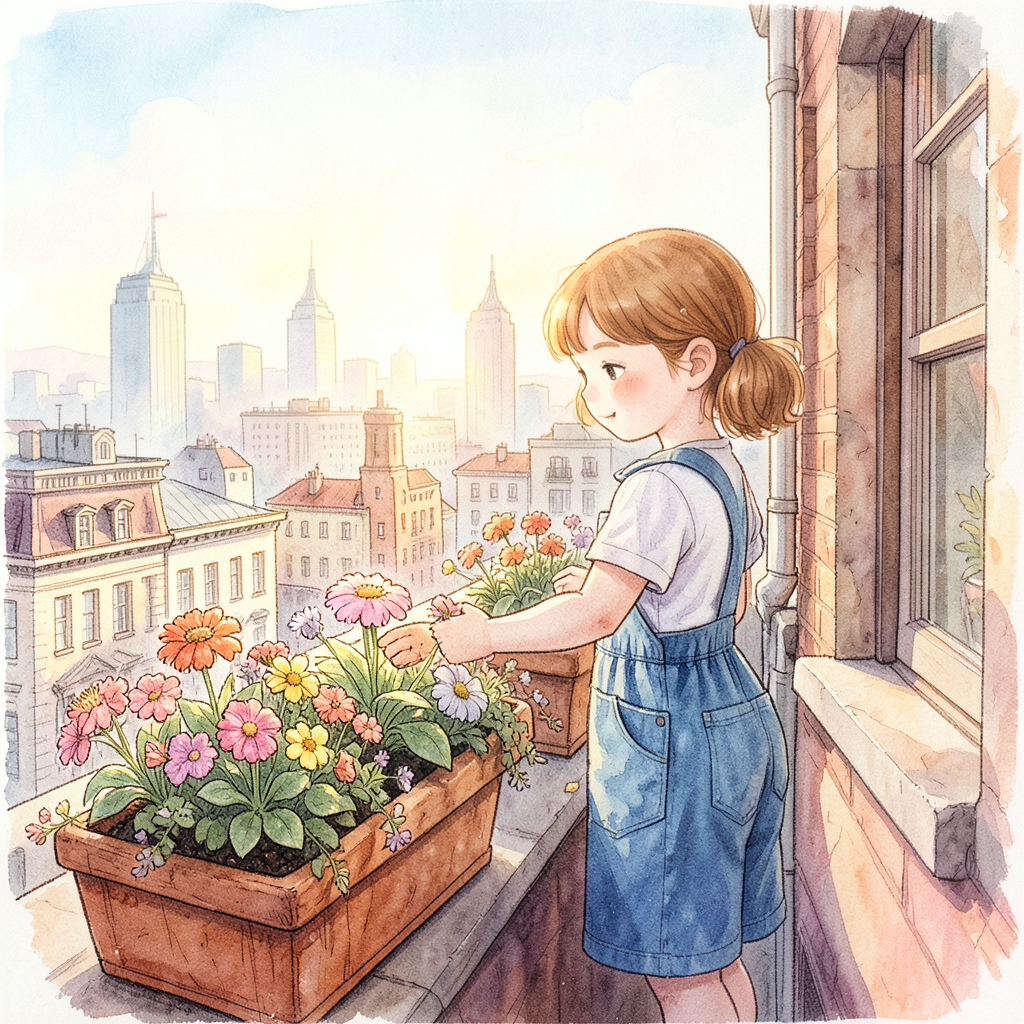
The Gardener
About This Book
During the Great Depression, young Lydia Grace is sent to live with her stern Uncle Jim in the city. She brings seeds and a determination to make things grow. Through letters home and secret gardening, Lydia Grace transforms a dreary bakery rooftop into a glorious garden — and tries to make her uncle smile.
Themes
PerseveranceKindnessNature
Best For
- Children who love nature, plants, and gardening and want to see those interests reflected in stories
- Families navigating a move, a long separation, or a stay with relatives — the book normalizes homesickness gently
- Classroom read-alouds that introduce letter-writing as a genre
- Children ready for a quieter, more emotionally layered story that rewards close looking
- Parent-child read-together sessions where discussing illustrations is part of the experience
Why Parents Love This Book
The Gardener is a quietly powerful picture book that earns its place among the classics of children's literature. Told entirely through Lydia Grace's letters home, Sarah Stewart's epistolary format is rare in picture books for young children, yet it feels completely natural. We see a little girl's inner world — her homesickness, her hope, her unshakeable belief that beauty can take root anywhere — without a single word of direct narration. David Small's watercolor illustrations do the heavy lifting in the most beautiful way: his expressive line work captures both the grim gray of a Depression-era city and the explosive color of a rooftop garden in full bloom. What makes this book truly special is its emotional restraint. Lydia Grace's uncle never actually smiles in the way she hopes, yet the ending is deeply satisfying because what he does do speaks just as clearly as a smile. Children feel the warmth of that resolution even if they cannot fully articulate it. This is a book about persistence, about finding your purpose far from home, and about how one person's quiet effort can change the atmosphere around them.
Reading Tips for Parents
Before you read, briefly explain the Great Depression in child-friendly terms: "A long time ago, lots of families had very little money and had to make big changes." This context makes Lydia Grace's separation from her family feel real rather than puzzling. As you read the letters aloud, slow down and let your child look at the illustrations — Small often shows things Lydia Grace does not write about, and noticing those details is half the pleasure. Ask your child to watch Uncle Jim's face across the pages; his expressions shift subtly and tracking that change is a wonderful close-reading exercise. After finishing, consider planting a seed together — even a bean in a paper cup reinforces the book's central message that growth takes patience and care. The epistolary format also makes this an excellent springboard for children who are just learning about letter-writing.
Awards & Recognition
- Caldecott Honor Book, 1998
- ALA Notable Children's Book, 1998
Educational Value
This book helps children develop skills across multiple areas:
- Social-emotional learning: Explores homesickness, resilience, and the courage it takes to build connections with unfamiliar adults in a new place.
- Literacy: The epistolary format introduces children to letter-writing conventions — greetings, sign-offs, dates — and models how letters convey emotion and story.
- Vocabulary: Rich, context-supported words like "dreary," "determined," "rooftop," and "bloom" expand language in a memorable narrative setting.
- History and Social Studies: Provides an accessible, child-centered window into the Great Depression, showing how ordinary families coped with economic hardship.
- Science and Nature: Seeds, soil, sunlight, and plant growth are woven naturally into the story, laying groundwork for conversations about life cycles and gardening.
- Art Appreciation: David Small's expressive watercolor illustrations invite children to read pictures as closely as text, building visual literacy skills.
Discussion Questions
Use these questions to spark conversation before, during, or after reading:
- Why do you think Lydia Grace keeps her rooftop garden a secret from Uncle Jim for so long?
- Lydia Grace really wants to make Uncle Jim smile. Has someone ever done something kind for you even when it was hard? How did it make you feel?
- Look at Uncle Jim's face at the very end of the book. Do you think he is happy? How can you tell without seeing a smile?
- If you had to leave home and could only bring one bag, what would you pack — and why?
- Lydia Grace writes letters instead of calling on the phone. Why do you think she writes letters? What would you put in a letter to your family if you were away?
Content Notes for Parents
There are no scary or violent elements. The book does carry a gentle emotional weight — Lydia Grace misses her family and her uncle can seem cold — but the overall tone is hopeful and the ending is warm. Parents of especially sensitive children may want to briefly acknowledge that being away from family can feel hard before reading.
Frequently Asked Questions
What age is The Gardener best suited for?
The book is ideal for ages 4 through 7 as a read-aloud, though its emotional nuance and the epistolary format make it especially rich for ages 5 and up. Children around 6 or 7 will begin to pick up on the subtle emotional cues in David Small's illustrations without needing everything explained. Confident readers aged 7 to 9 can also enjoy it independently.
Is the Great Depression setting confusing or upsetting for young children?
It is neither confusing nor upsetting for most children when a parent offers a brief one-sentence explanation before reading. The story stays close to Lydia Grace's perspective and does not dwell on economic hardship in graphic terms. Children will understand that things are hard for her family without feeling overwhelmed.
Uncle Jim never actually smiles — does the book have a satisfying ending?
Yes, and this is one of the book's greatest strengths. Uncle Jim expresses his feelings in his own way by the end, and the resolution feels earned and genuinely warm. Many children and adults find the ending more moving precisely because it avoids a tidy, predictable smile. It opens a wonderful conversation about how people show love differently.
Are there other books like The Gardener that we might enjoy?
If your child loved The Gardener, try Miss Rumphius by Barbara Cooney (planting flowers to make the world more beautiful), Ox-Cart Man by Donald Hall (rhythms of rural life and quiet perseverance), or The Relatives Came by Cynthia Rylant (warmth of family connections). All share The Gardener's gentle pace and emotional depth.
Can this book be used to introduce letter-writing to young children?
Absolutely — it is one of the best picture books available for that purpose. After reading, many children are inspired to write a letter themselves. You can use the format Lydia Grace follows (date, greeting, news, closing) as a simple template. Writing a letter to a grandparent or friend right after reading deepens both the literacy lesson and the book's emotional message.