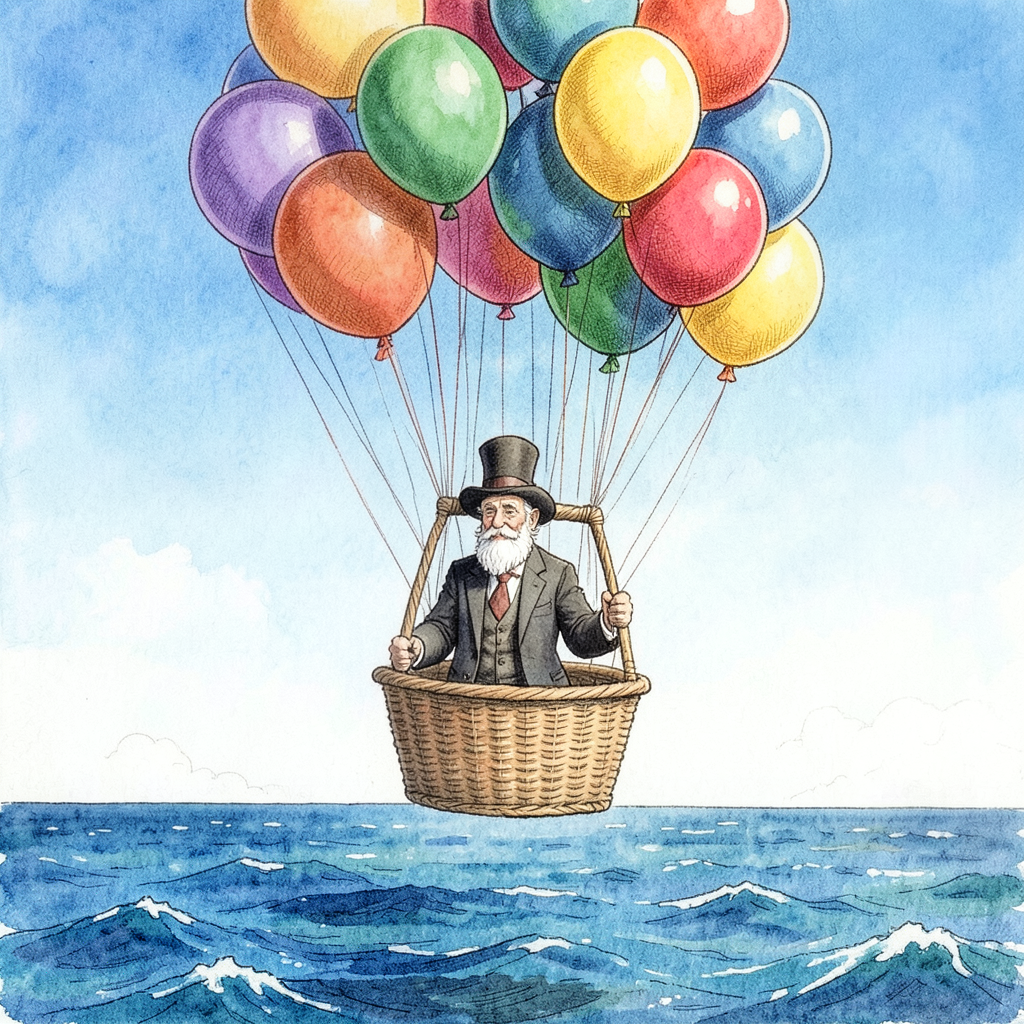
The Twenty-One Balloons
About This Book
Professor William Waterman Sherman sets off in a balloon for a year of peaceful solitude over the Pacific, and lands instead on Krakatoa — where a secret society of twenty families has built the most extraordinary civilisation imaginable, funded by the world's largest diamond mine. A Newbery Medal winner that combines Jules Verne adventure with a purely exuberant love of invention.
Themes
AdventureInventionHistory
Best For
- Children who love invention stories and want to know exactly how imaginary machines work
- Families reading aloud together who enjoy stopping to discuss ideas and sketch out descriptions
- Kids who enjoyed Jules Verne, H.G. Wells, or other classic adventure-with-science stories
- Classroom use in grades 4-6 exploring narrative structure or early 20th-century writing style
- Independent readers aged 10-12 who are ready for a longer, slower-burning adventure with payoffs that accumulate over time
Why Parents Love This Book
Published in 1947 and awarded the Newbery Medal, The Twenty-One Balloons has lost none of its charm in the decades since. William Pene du Bois crafts a story that feels like Jules Verne rewritten by a particularly inventive uncle — one who genuinely believes that the right engineering can solve any problem, including dinner. Professor Sherman's accidental landing on Krakatoa reveals a hidden civilization where twenty families have organized their entire social lives around restaurants, each family responsible for one cuisine from around the world. The sheer delight of the book lies in its inventions: the houses, the vehicles, the escape mechanisms, all described with the kind of loving, precise detail that makes readers want to grab a pencil and sketch them out. It rewards imaginative children who love to ask "but how would that actually work?" and it delivers a genuine sense of wonder at human ingenuity without ever feeling like a lecture.
Reading Tips for Parents
This book works best read aloud in chunks, pausing to let children visualize each invention before moving on — du Bois's illustrations are wonderful but the text descriptions alone are rich enough to spark mental pictures. Before starting, briefly explain that Krakatoa is a real volcanic island in Indonesia that famously erupted in 1883, which adds weight to the story's climax. Older children (10-12) can read independently with ease; strong readers at 8-9 will manage but may need help with some vocabulary. Keep a world map nearby — the story's framing device has Professor Sherman recounting his journey to a geographic society in San Francisco, and tracing the Pacific route together adds geographic engagement. Budget for a longer read: the pacing is leisurely and rewards patience.
Awards & Recognition
- Newbery Medal, 1948
- ALA Notable Book
Educational Value
This book helps children develop skills across multiple areas:
- Vocabulary: The book introduces technical and scientific terms related to ballooning, engineering, and geology in context, building a rich word-hoard for young readers.
- History and Geography: Krakatoa's 1883 eruption is a real historical event; the story invites children to research the actual disaster and compare it to the fictional account.
- Engineering and Design Thinking: Each invention described in detail models the process of identifying a problem and designing a solution, nurturing systematic creative thinking.
- Cultural Awareness: The restaurant civilization introduces children to the idea that different cultures have distinct culinary traditions and that diversity can be a community's greatest strength.
- Narrative Structure: The story uses a frame narrative — a speech before a geographic society — giving children early exposure to nested storytelling and the concept of an unreliable or selective narrator.
- Reading Stamina: The leisurely, descriptive prose rewards patient readers and builds the habit of sitting with a longer, slower-paced text rather than racing to the next plot event.
Discussion Questions
Use these questions to spark conversation before, during, or after reading:
- Professor Sherman set off wanting a full year of peaceful solitude. Have you ever wanted to be completely alone for a while? What would you do with that time?
- The twenty families on Krakatoa each ran a different restaurant representing a different cuisine. If your family ran one of the restaurants, which country's food would you choose and why?
- The island civilization was funded by a secret diamond mine. Why do you think the families kept Krakatoa's existence a secret from the rest of the world? Was that the right choice?
- Du Bois describes many unusual inventions on the island. Which invention would you most want to bring back to the real world, and what problem would it solve?
- When Krakatoa erupts, the families have to use their escape plan immediately and leave everything behind. What three things would you grab if you had only minutes to flee your home?
Content Notes for Parents
The volcanic eruption of Krakatoa provides genuine dramatic tension and the civilization is destroyed, which may be sad for children who have grown attached to the island world. There is no graphic violence, but the eruption sequence and the forced abandonment of the island could be emotionally intense for sensitive younger readers.
Frequently Asked Questions
What age is this book really right for?
The book is best suited to ages 9-12 for independent reading. Strong readers at 8 can manage with some support, particularly with the longer descriptive passages. The ideas — hidden civilizations, volcanic geology, elaborate social organization — are rich enough to hold the interest of adults reading alongside children.
Is the Krakatoa eruption scary for younger kids?
It can be. The eruption creates genuine urgency and the families lose their entire world, which is emotionally impactful. Most children in the target age range handle it well because du Bois maintains an almost cheerful tone of competence throughout — the escape plan works, everyone survives. Sensitive children under 9 may find the loss of the island sad.
My child loves this book. What should we read next?
Try Around the World in Eighty Days by Jules Verne for a similar flavor of globe-trotting invention and adventure. The Wonderful Flight to the Mushroom Planet by Eleanor Cameron offers comparable whimsy with engineering at its heart. For something more recent, The City of Ember by Jeanne DuPrau shares the theme of a hidden civilization with secrets.
Is this book historically accurate about Krakatoa?
The 1883 Krakatoa eruption is a real historical event and du Bois uses the actual date accurately as the story's climax. The fictional civilization living on the island is entirely invented. Reading the book alongside a non-fiction account of the real eruption makes for an excellent comparison exercise in how fiction uses historical fact.
Why does the story start at the end, with Professor Sherman giving a speech?
Du Bois uses a frame narrative — the professor recounting his adventure to the Western American Explorers' Club — which means we know from the first pages that Sherman survived. This choice removes survival suspense and instead builds anticipation about what he found. It is a useful technique to discuss with children learning about how authors control what the reader knows and when.